Showing posts with label Germany. Show all posts

Monday, November 16, 2009

On words

'Words in action, with ice cream. Two friends in Mumbai (Bombay), India.' An image of two little girls, talking to each other on the kerb of a road.
Dear Gentle Reader,

Regular visitors know that I love words, especially less usual ones, such as words which vary over time, in either spelling or meaning.

I also, however, recognize that words are not the be all and end all, despite the intellectual traditional I stem from. Today, a little stroll to illustrate these thoughts. A stroll amidst words.

Just as fried eggs can be served sunny side up or sunny side down I like the fact that we can lie prone, face down, or supine, face up--and I aim to ensure that we don't only use those words while getting a massage or performing an autopsy.

(Aside: I have great autopsy stories from when I was kid--which might explain a lot... Also, for those interested, there are many, many other ways that fried eggs can be served if you come from an exacting, exhaustive culinary tradition--like the French do... maybe another post, one day.)

Andrew Marvell's poem "The Character of Holland", which I reproduced last Friday, was written in the seventeenth century and is a veritable cornucopia of lovely words (nouns, verbs, adjectives and more!), most with archaic spellings.

Ambergreece, for example, and from the poem, is an archaic spelling of ambergris.

Ambergris, of course, is frightfully expensive; it's whale vomit that has floated on the ocean's surface for a few years to age and rot a bit; ambergris has no value when it is a fresh, floating slick.

Sailors lucky enough to find and collect ambergris can retire happy; they'll be richly scented with eau de cash.

Ambergris, as you know, is used as a binding, fragrant base note for the finest perfumes.

It's a perfect Taoist substance, really; ambergris is something vile and earthly (metaphorically, as physically it comes from a water bound leviathan) through which ethereal beauty is contained, transmuted, and then sprung free.

Anyway, as we know, I groove on words.

The mental pitter patter of words and meanings, dancing their tarantellas on my consciousness when I read or hear or write or speak, provides a syncopated rhythm of denoted and connoted meanings yielding a rich patina of both definitional meanings and allusional, contextual meanings.

Sometimes I find the joy and verve of words, themselves, alone, so great that I belt out extemporaneous songs, to my wife's varying amusement or chagrin, subject and location depending.

I like to think that we are all like this; I simply lack the ability to behave with propriety, sometimes.

And, I hold that intellectually, culturally, and traditionally, most of my readers come from a background which asserts the primacy of words.

In the Christian tradition we read in John 1:1 that:
εν αρχη ην ο λογος και ο λογος ην προς τον θεον και θεος ην ο λογος
The key word here is λογος which would be translated into the Latin Vulgate bible as verbum, or word.
in principio erat Verbum et Verbum erat apud Deum et Deus erat Verbum
The English translation of this phrase, from the Modern King James version, is:
In the beginning was the Word, and the Word was with God, and the Word was God
The idea of "word", as opposed to "reason", representing both God and his Son, through the Christian revelatory experience, is fascinating in itself as a word choice in translation and comes, I think, from the Gnostic background of St. John the Evangelist, but this, somehow, became lost by the time of the Enlightenment.

Still, the primacy of the word itself, in the European academic and cultural tradition, had been set, especially in the Middle Ages when illiteracy was the encompassing norm.

The Moslem tradition includes the Christian tradition by virtue of the succession of prophets, and their texts, whilst none of my Hindu or Buddhist friends are slouchs when it comes to words.

Words, quite simply, are not the prerogatives of either the West or of Christianity.

Words, as vehicles for sharing meaning, have long been seen as important for all peoples; words are the basis of communication.

But, sometimes, I get given grief for my love of hefty or allegedly obsolete words.

Some folks think that I contribute to a loss of meaning by using 'non-standard' words.

I hear the point, but know that you, Gentle Reader, have an excellent vocabulary as well as access to a good dictionary, as I do, too.

And, I instantly apprehend and comprehend that words are not the be all and end all, despite John the Evangelist's first words, quoted above. John the Evangelist, after all, didn't stop at John 1:1; he had much more to say.

Further, sometimes, words are simply not to be relied on.

A case in point:

...and here is the paper which bears his name upon it, as well as mine.

This quote, you may recall, comes from British Prime Minister Neville Chamberlain, 30 September 1938, at Heston Aerodrome (outside of London, England) on his return from his meeting with Fuehrer and Chancellor (Reichskanzler) Herr Adolf Hitler at Munich (the signing of the Munich Agreement).

This, of course, was the agreement by which Prime Minister Chamberlain, would, later that same day, at his official residence, No. 10 Downing Street, declare to have secured, for Britain, "...peace with honour... ...peace in our time." ...and the year, once again, was 1938...

So, I recognize that sometimes words, or, more accurately, the meanings of words, cannot be trusted.

But, still, you gotta love them; what other choice do we have?

With that, I'll end the day here, resting up for three word Wednesday, in two days.


Tschuess,
Chris

So, as I'm adding music these days... What song would go with today? Hmm...


Click to hear 'What I am' by Edie Brickell & The New Bohemians


Amazon.com iTunes


Or, a tarantella...

Tuesday, June 9, 2009

On Division, or, an excuse to throw 10 haiku at you

Image of a plate of soft cheeses.Dear Gentle Reader,

Division, the process of dividing, is an odd duck.

In math, division makes things smaller.

Simultaneously, however, in biology, division makes things more numerous.

After all, division, as in meiosis, deals with the propagation of the species.

Similarly, though not identically, division, as in mitosis, sees the replication of whole cells, the propagation of a part; one mother cell becomes two identical daughter cells.

Division, like sex, can also lead to many challenges.

Seemingly sidling away from the topic of division, the Heroine, the Hero, and your humble scribe all love cheese, hard and soft cheeses both.

This hardly seems related to division, let alone problems.

Humble scribe, you may say, first, cheese is a mixture, not a separation; no division is required to make cheese, no, things are added. Second, you may say, if you like cheese, then cheese is hardly a problem.

But, gentle reader, you will, I am sure, concede that the hard/soft cheese dichotomy is clearly a categorical division.

And, on closer inspection, cheese is the product of physical division.

Yes, cheese is derived from a protein, fat, and water slurry, but, the special feature of cheese production is how that slurry is modified by dividing, and hence expanding, colonies of bacteria.

Division abounds and division is at the heart of the creation of cheeses (especially soft cheeses, where the bacteria at their centres, their hearts, are frequently most active).

So, where lies the problem?

The problem lies not in the creation of cheese, gentle reader, but in the division of the same.

For most cheeses, most people use knives to split cheeses, to divide them, to share them.

Almost all soft cheeses have to be cut to properly get to the fruits of their constituent bacterial guests' lives' labours, the steamy, fragrant divisional product of bacterial culture.

Now, usually, soft cheeses are cut into wedges prior to further division then consumption.

And, this is where the sexual problems of division begin, or, more accurately, the problems between the sexes, in our house, begin.

One divisional problem, portion equity, is well documented by that great Dane, Piet Hein (1905-1996).


SOCIAL MECHANISM (by Piet Hein)

When people always
try to take
the very smallest
piece of cake
how can it also
always be
that that's the one
that's left for me?

It should be noted that while Piet Hein was talking about (just) desserts, I believe that the same principle can be applied to cheeses.

After all, a savoury cheese platter may precede, follow, or even substitute for a sweet dessert.

It should also be noted that the Danes know whereof they speak, when they speak of division.

In the beginning, Danes acquired by dividing others' lands and things. They then amalgamated these divisions (from others' holdings) to their own holdings.

For a long while, the Danes never saw any problem with this.

It was when the Swedes started dividing Danish spoils, for their Swedish selves, that the joy of division was spoiled for the Danes.

(Here, one could note, is where Einstein's propositions on the importance of the observer, in physical dynamics, and relativity in general, make their application in social dynamics, long before Einstein was even around to observe or remark...)

Back to the present day and to the cheese.

Your Heroine, though of Northern European extraction, is relatively scrupulous regarding portion size when she creates fromage frontiers.

She steers clear of the Piet Hein Problem.

The Heroine's failing, from your humble scribe's perspective, is that she keeps the best parts for herself; she high grades; she takes the central part of soft cheeses.

The central part, the thin edge of the wedge, is, of course, where the bacterial culture, in soft cheeses, has had its strongest and greatest effects on flavour and on texture.

One must remember, though, that the Heroine is German; cultural high-grading is in her blood.

Germans love all things to do with culture; Goethe, Schiller, Cranach, Flanders, France...

Hurriedly skipping back to the cheese plate, your humble scribe has fulminated greatly on divisions, especially as a recipient of the outer, lesser graded sections of wedges of soft cheese.

So, today, I indulge myself and divide my thoughts ten ways to generate ten haiku along the simple theme of division.

For my pleasure, here they are:


If you take your cheese v. seriously...

divorce might be right
this separation? no good.
i want high grade too


Early biological classification

animalia
and vegetabilia
Aristotle's split

*** Humble scribe's note of the use of poetic license.

It was the great Swedish classifier Carl von Linné (1707-1778), better known by his Latinized name, Carolus Linnaeus, who divided living organisms under the specific descriptors animalia and vegetabilia. But, Aristotle (384-322 BC) did separate the world into animals and vegetables, too (and almost 21 centuries earlier).

Aristotle just did it in Greek.


Animalia

multicellular
soft cell walls and motile, too
heterotrophic


Plantae

multicell(s/ulose)
meiosis yields haploid cells
photosynthesis


Innie and outie

100 "k" "m"
lowest earth orbit that works
inner/outer space


Western expansion in the USA, where does it begin?

Demarcation, here.
one hundredth meridian
wet east/arid west


Peace, Order, and Good Government (POGG) versus Life, Liberty, and the Pursuit of Happiness
or, duelling values in constitutional residual clauses
or, communalism (community values) vs. individualism (individual values)

Canada: POGG (rules)
the forty-ninth parallel
US: U. Party


How China, with Hong Kong, or Macau, copies Canada's handling of difference...

deux cultures, un pays
je me souviens, mais oui...
two systems, one state

For the non-Canadian scholars, Canada not only has two languages, English and French, enshrined in the constitution, it also uses the continental legal system in its second biggest province, by population, Quebec.

Much of past-Prime Minister Brian Mulroney's testimony in a recenty inquiry was predicated upon a totally different legal regime than what Anglo Canada is used to, and I fear that these legal distinctions were lost on the majority of the populace judging by the polemical online comments on news articles posted in the national, public news media.

A further examples of demagoguery, in extremis...

Political religious divides on the great subcontinent

Hindu/Muslim split
partition '47
nation rent; two form...


*** Author's aside: I prefer this haiku orally when the "two" could equally be heard as "to"...


A division of colonial power alone

African land/lord
uti possedetis; change
lord not boundaries

And ten is more than enough, I am sure.

Tschuess,
Chris

Tuesday, March 17, 2009

Ugly American was not intended; an explanation

Image of a Bank of Hell banknote; I am worried that people will view your humble scribe the wrong way and cast aspersions of nationalistic vitriol, withdrawn from the Bank of Hell, on your humble scribe based upon yesterday's posting...Dear Gentle Reader,

Mea culpa.

I wrote some long notes to yesterday's post. 

But, just as I know that very few roll their mouse over the images to see what messages or titles I have left, almost nobody goes back to look at comments. 

So, I will repackage them because it is important.

Yesterday's post could be seen as an easy attack on three self-centered Americans who happened to be girls. Classic ugly Americans in action. That was not my intention.

The post was meant to be a sardonic look at the actions of three young people, three young girls, who happened to be American.

The posting does me no credit as I had to have an Oscar Wilde line at the end; I couldn't just walk away. 

But, I feel worse if people think I harbour anti-American sentiments.

So, I will risk further assaults on my character and revisit yesterday.

In yesterday's post I meant to highlight the profligate silliness, obtuseness, and self-centered nature of youth (compared, of course, to the foil of my helpfulness, reasonableness, and cleverness.)

First, ugly Americans do exist.

As do hooligan Brits, lager lout Dutch, culturally self-centered and self-righteous French, towel-wielding beach-reserving Germans, et cetera. And snide Canadians, too.

There are, statistically and in my experience, almost as many ugly Canadians as ugly Americans.

But, thankfully for Canadians, there are ten times more Americans than Canadians, which skews the number of ugly Americans as opposed to ugly Canadians that other countries' citizenry get to meet.

Then, we can further skew the ratio because more than ten times the number of Americans, compared to Canadians, have the disposable income to send their kids, or themselves, abroad.

That results in more than the 10:1 ratio of ugly Americans:ugly Canadians abroad that you would expect.

And the ugly idiots always stand out, if only for their idiocy and ugliness. 

Everyone remembers the idiots; their impacts crowd out the memories of the lovely people. 

Now add international resentment to the USA's wealth and power... 

Still, today, a vast amount of the world's GDP (GDP is Gross Domestic Product--the total value of all final goods and services produced with the national borders of a political economy within a particular year) is generated inside the USA. 

Yes, the EU generates a similar GDP, but that is the entire EU... not just one country... (The EU is the European Union whose countries now include all of Western Europe less Switzerland, all of Northern Europe less Norway, all of Southern Europe, and most of Eastern Europe...)

I just crunched the numbers. 

If we use 2007 IMF (International Monetary Fund) numbers then the US produces 25% of world GDP and the EU produces almost 31% of world GDP.

If we use 2007 World Bank numbers then the US produces 25% of world GDP and the EU produces 22% of world GDP.

If we use 2007 CIA world factbook numbers then the US produces 18% of world GDP and the EU produces 24% of world GDP.

Whichever numbers you use, the US is wealthy. 

This wealth provides the US federal government the ability to fund military and economic activities to create and project power.

The USA is still the only global superpower as it has been from the end of the cold war to today. 

It still is the world's policeman, and it struts accordingly, some days. 

It has also taken on the role of the world's judge through the doctrine of extra-territorial jurisdiction which is the US doctrine that US laws apply anywhere and everywhere... ...a bit of a slap in the face to the sovereignty of every other country on the planet.

So, people like to latch onto the idiots and tar the rest with their cultural misdeeds. It allows people to feel better, nationalistically, when innately comparing their country to the might, power, and wealth of the USA.

It's too easy to make fun of the ignorant few. 

Hence my big mea culpa, today; I do not want to be considered anti-American.

I am just intolerant of fools, no matter what their nationality.

I had not intended to raise the spectre of ugly Americans in yesterday's post, I was just poking fun at three vapid, self-centered young girls. 

And, heck, they were likely exhausted, jet-lagged, culture-shocked, and unprepared to hear people tell them hotel rack rates in dollars in English and they might have been confusing the HKD prices with USD prices. 

The ten dollar (USD) per night hell holes in Chungking Mansions might have been interpreted by them as 78 USD per night, instead of the 78 HKD per night that would have been meant when the reception staff would have leered and said "78 dollars, Missie" to their breasts.

What bothered me about the three girls was the way they were trying to control me with orders and their gravity-defying breasts. And the slyness of the looks they gave each other when they thought I had given up some state secrets of housing to them...

Tschuess,
Chris

Monday, March 9, 2009

Building blocks behind the bamboo curtain

A pile of cut bamboo lying on the sidewalk in Hong Kong.Dear Gentle Reader,

Hello again, from behind the Bamboo Curtain.

I have been known to talk about origins and architecture, both, in this e-place.

Origin comes from the Latin origo, origin meaning a beginning.

In the beginning, there was nature.

Then there was that that was not of nature.

That dichotomy, things produced by nature as opposed to things made by man, produced art.

Art, in the beginning of English's history, meant anything made by man, as opposed to anything produced by nature.

In more modern times, we have modified that distinction and replaced art with craft.

We tend to think of craftsmen as delivering skill and technique to modify the natural world, whereas some extra inner spark is required for art. But, in earliest times, craft fulfilled that distinction entirely.

Of course, technically, craft comes from techne, and from art.

Techne, the other half of craft, comes from the Greek Technikos, from which we also derive the English words technique and technical.

I sense impending e-yawns.

I hurriedly increase the pace to reach my first destination, this morning.

Architecture, as an English word, my OED tells me, dates to at least 1563, and its first meaning is the art or science of constructing edifices for human use, specialized as Civil, Ecclesiastical, Naval, and Military.

(The Romans had the word already, architectura, as did the French, architecture.)

Fundamentally, architecture was about creating new, structural things from nature.

Trees had to be trimmed and fashioned into columns and beams.

Later, stone was dug, quarried, cut, and dressed to be formed into blocks to be transported to building sites to make structures.

Some think that
classical columns, in dressed stone, were derived from people copying the look of trees cut and dressed to form supporting columns in proto-houses.

Nature was, at least initially, copied and transformed by architects.

Rocks were obviously at the base of mountains. Why not also use rocks at the base of buildings? And then for walls?

Architecture required obvious changes from Nature, and the manipulation of nature to new purposes.

Gothic builders might remove trees from the earth, dig through the earth and remove the earth, to get to stone that they might quarry for building purposes.

Then, when they started building a great ecclesiastical structure, say a Gothic church, the master builder might put nature to new uses in his original art, the construction of the edifice.

Bremen State Cathedral (Bremen, Germany) a nice Gothic Church (admittedly, this facade shows the work of a Romanesque Revival 'facelift' done in the late nineteenth century, but it shows the scope of the structure...)
When Gothic builders could not reach up to place stones in the walls, they created timber platforms to stand upon and to lug stones onto, by means of winches and block and tackle mechanisms.

When the timber platforms seemed too high for safety (they were hauling heavy stones on them) they would dismantle the timber platform, shovel heaps of earth into the church, and rebuild the platform upon the new earthen base. This iterative process would continue until the church was built.

When the church was completed the architect and the builders would finally remove all the platforms and the earth, decorating the interior with paintings and frescoes as they went downwards to bare earth and consecration of the structure.

What does any of this have to do with Hong Kong?

Lots of tall buildings here, yes...

But, Gothic structures were not built in Hong Kong. Besides, the origins of Hong Kong's skyscrapers and high rises does not seem remotely linked to nature.

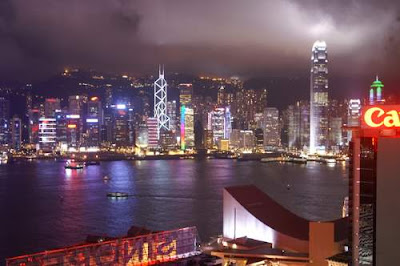
Image of Hong Kong, at night, taken from your Scribe's building.
Hong Kong residents definitely did not fill these structures with earth or wooden platforms to build them from the inside out.

These buildings are distinctly different from nature.

So why would I have started, today, with the top image of bamboo?

Or debated about using this picture as the lead image?

Another pile of cut bamboo lying on the sidewalk in Hong Kong.Truth is stranger than fiction.

And, it has to be seen to be believed.

First, Hong Kong is profit oriented.

Land prices are the highest here, on the planet.

(Which is my rent is so freaking expensive.)

Also, this is why you want to cut your building costs as low as possible, and to construct things as rapidly as possible.

Which is where the ubiquitous bamboo shown in the title image comes in.

Bamboo is a grass from the Poaceae family.

More technically, bamboo is perennial evergreen from the subfamily Bambusoideae, tribe Bambuseae.


Image of bamboo growing in an abandoned field in Hong Kong's New Territories.There are at least 57 types of bamboo found in Hong Kong growing from sea level to the tops of the mountains.

It is ubiquitous in nature, so artists and craftsmen have found uses for it so that it is now ubiquitous in art (original usage) in China and Hong Kong.

It is strong, tall, and flexible.

The flexibility is useful in a place racked by strong winds.

And so, builders in Hong Kong use bamboo for scaffolding...

Image of a small house in Hong Kong surrounded with bamboo scaffolding for the workers to walk on.
Gothic craftsmen built wooden platforms inside the churches to build the church.

Hong Kong craftsmen build bamboo platforms--scaffolding--outside the structures they build.

Bamboo scaffolding was simply tied up at the joins with twine, historically.

Image of a plastic ties on bamboo scaffolding.Now, the craftsmen use plastic ties.

And, in situ, they look like this..

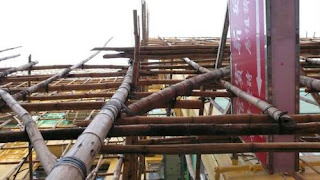
Image of bamboo scaffolding pieces tied together with plastic ties, in situ, in Hong Kong.Let's step back, and look up at this second example of scaffolding to see the interplay of vertical structure and diagonal supports.

Image of bamboo scaffolding around a small building in Hong Kong from directly beside the bottom supports.
That picture may be funky, but it does not provide much clarity.

Let's step back across the street to get a sense of perspective...

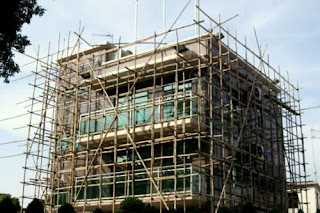
Image of a small building undergoing renovations with bamboo scaffolding around it in Hong Kong.OK...

Well, this is a little bigger than the first building which we saw bamboo scaffolding erected around.

The fierce winds, in typhoon season, can easily pass through the bamboo scaffolding, so it won't be ripped down.

The scaffolding is light, so it can be supported easily by itself.

The scaffolding is also cheaply found, and will not rust in a wet environment, like steel scaffolding would.

Also, because space is limited, it can easily be burnt or used as fill when its useful life has expired.

Further, if there is an economic downturn, you don't need to store the scaffolding on expensive land. Just burn your inventory. It grows around you anyway, and the burnt scaffolding can even be used as fertilizer...

Finally, bamboo is light and easy to transport around the city to various building sites.

But wait.

I forget, Gentle Reader, that you have seen many pictures of Hong Kong.

You know the buildings here are, generally, much bigger than single storey houses or small eight storey low rises.

So, the question now is, what do they do for the big buildings?

What do they use for scaffolding? It has to be cheap, easy for rapid set up and take down, and substantial enough to work for some of the planet's tallest building construction sites.

Image of a more substantial bamboo scaffolding on a building site, with green mesh to prevent tools or material from falling out while allowing the wind to pass through with relative ease.
Let's walk down the street...

This building site certainly seems to have a more substantial scaffolding structure.

Of course, this one is still, obviously, made of bamboo.

But this scaffolding has also been covered with a light plastic mesh that the wind can still pass through it.

Presumably the mesh prevents people or things from falling between the gaps in the bamboo.

But, the bamboo seems to be set closer together, here.

The squares seem to be much smaller, no?

Or is that just a trick of perspective?

Let's step back again...


Image of bamboo scaffolding on a residential high rise/skyscraper in Hong Kong.
Those pieces of bamboo are the same size, and in the same configuration as the previous scaffolding... ...they just go up higher.

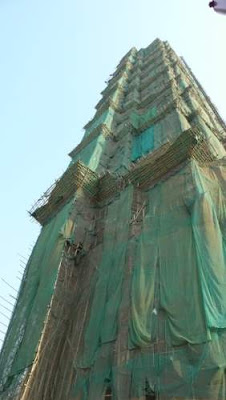
Another image of bamboo scaffolding on a residential high rise/skyscraper in Hong Kong.
Note the streetlight extending over the sidewalk hoarding at the bottom left of the picture for perspective. I couldn't step farther back to get better perspective--a busy motorway impeded my picture taking.

So bamboo, the ubiquitous product generated by nature, has been transformed, by art, into a building material.

It has been formed into a superstructure for architecture.

The bamboo cage becomes a meta-structure, mirroring the outline of the building it encloses.

(Meta-structure? Well, in some ways, yes. It is very insubstantial, and airy... and that is one of bamboo scaffolding's virtues after all...that wind and rain can pass through the bamboo scaffolding--it supplies minimal resistance.)

And the origin of modern architectural structures in Hong Kong is derived from Nature, and her bamboo, but bamboo used in ways that nature did not build on her own.

This architecture is truly art, and its origins are truly a craft, originating in nature, then modified by intelligence and effort.

Once again, this is my town. Welcome to Hong Kong.

Tschuess,
Chris