Showing posts with label words. Show all posts

Thursday, August 5, 2010

3WW CXCX

Image of metal and paper lanterns, by night, outside a temple in Kyoto, Japan.Dear Gentle Reader,

This week the 3WW writing community received these three words to ignite inspiration: drink, feeble, and predict.

I find these three words difficult, but, I proffer three haiku (OK, senryu), each with an American Sentence title.

So, without further ado... drink, feeble, and predict....


Drinking in her honey pot is better than in your cups, but, beware...

Drink in her curves, but
I predict her tequila
laced honey's feeble...


**A paraphrase of the title could be "If you are going to get drunk, make love not war, but, be careful..."

For English as a second-language readers, a honey pot can be an attractive woman, but, really, it is a synecdoche as the honey pot itself refers to the salty-sweet sexual centre of a woman.

To drink in a honey pot could mean to gaze at a beautiful woman. It could also be something more visceral, more graphic.

The second half of the title, being in your cups, refers to drunken fighting (from the Apocrypha, I Esdras 3:22 "And when they are in their cups, they forget their love both to friends and brethren, and a little after draw out swords:").

From there, after a title exhorting us to, when drinking, make love, not war, is a warning to be careful of the company that too much alcohol may bring...


Sneering command to the old to stand aside and die, ignored, forlorn.

Fade, senescent shade--
predict thine obsolescence;
drink feebly to death.


Leary never dreamed of chemical precogs, but fascists did, with glee.

Drink the future! Pre-
-dict, -pare, -judge, -kill. Keep: future
crime feeble; us safe!


**Timothy Leary (1920-1996) was a futurist and an American countercultural icon who is best known in the popular press for his advocacy of LSD (it was legal when he started his experiments in consciousness-raising with LSD) and for the phrase, that he popularized, "Tune in, turn on, drop out".

Though Dr. Leary was anti-establishment, the establishment took note and undertook its own tests on hallucinogenics to see how they could manipulate patients' understanding of reality.

This poem looks at the concept of a class of chemically-induced precognitives (precogs) and the use that they could be put to in search of pre-crime investigation, enforcement, and punishment.


Tschuess,
Chris


Postscript about Haiku and American Sentences


First, technical definitions of the poetic forms I play with.

The English language version of the haiku is grammatically stricter (though semantically looser) than the original, Japanese form of this poetical form.

English Haiku are usually required to have three lines with 5 syllables on the first line, 7 syllables on the second line and 5 syllables on the final line.

The American Sentence is a poetical form structurally closer to the Japanese haiku format in some ways. It requires 17 syllables in one sentence and was created by the American poet Allen Ginsberg.

Yes, I know that there are content issues regarding what topics are permissible in Japanese haiku (Yes, I know that I write senryu, not haiku, subject-wise.) and that Japanese poets don't count syllables as they are generally understood in English.

I am not overly concerned.

If you are, I am sure I have discussed it sometime before. Check the haiku topic listing and have fun.

Wednesday, March 3, 2010

3WW CLXXIX

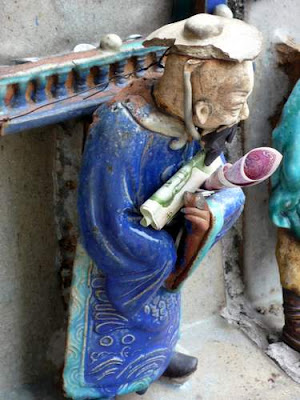
Detail of a ceramic frieze atop the Dragon Mother's Temple, Guang Dong Province, China. People lean over the upper balcony to tuck money into the sculptures to help lubricate the passage of their wishes to reality.Dear Gentle Reader,

It's 3WW.

This week the prompt words are amaze, frail, and sacred.

Your starter is a titled picture with, as always, descriptions if you run your mouse over the image.

Then, as usual, I serve up three haiku/senryu, each with an American Sentence title.

For dessert, I close off with a musical offering.

So, promptly, away.

Let the games begin with amaze, frail, and sacred...


Amazing Grace, Newton's sweet sound--though he'd sold men, bound, in slavery...

frail prayers waft up,
borne with sacred incense swirls;
plead amazing grace


** True, John Newton (1725-1807) did end life campaigning with John Wilberforce for the abolition of slavery, but he started life as a slaver, and, though he had changed careers to become a curate, he had not denounced slavery when he penned 'Amazing Grace' in 1779.

The British Slave Trade Act of 1807, which Wilberforce and Newton campaigned for, became law little more than 9 months before Newton's death and abolished slavery in the British Empire.

Britain would take until 1833 to determine that slavery as an institution was inherently illegal.

That said, the Western world would not see slavery as being a jus cogens, an international legal wrong, or, more specifically, that a jus cogens itself could exist until the conventions for drafting the Vienna Convention on the Law of Treaties were commenced in 1949 and the text finally adopted in 1969 (see Article 53). It would still take until 1980 for the Vienna Convention on the Law of Treaties, 1969, to enter into force.

This whole 'aside' merely is my way of pointing out the frailty of some prayers, especially those implicitly contained within 'Amazing Grace', penned at the time by an unrepentant ex-slaver and slave trader.


Forget storge, philia, and agape; give me eros each day.

frail hearts quail, tremble.
love is sacred? hah! Violent!
stunned, amazed, we pant.


** Storge, philia, agape, and eros are the four forms of love in Classical Greek thought.

Storge, στοργή, refers to loving, familial affection.

Philia, φιλία, refers to friendship--the love between friends.

Agape, αγάπη, refers to an abiding, deep love and contentment.

Eros, έρως, finally, refers to passionate love. Eros doesn't have to be sexual, but Plato's modification of love, Platonic love, a non-sexual love, is a modification of eros--which point to the importance of sexuality in the non-Platonic eros.


Crowds queued (Paris-style) for her; Quasimodo tried to save her; she died.

frail Esmeralda's
sacred sanctuary fails;
amazed Q's heart breaks


** If you haven't read Victor Hugo's (1802-1885) 'Notre-Dame de Paris', or, 'The Hunchback of Notre Dame" then this little piece will surely fail. The only thing I will point to here is the ambiguity of 'Q' in the last line.

Normally this 'Q' would clearly refer to Quasimodo, but, with the title of this poem, 'Q' could also be the Parisian crowd which 'queued' outside of Notre-Dame to show its support of Esmeralda--fabulously misread by Louis XI, the King of France, in the book....


*** As per queuing 'Paris-style', don't think Paris of Hector, or of Helen, think French Revolution.

Think Eugène Delacroix and 'La Liberté guidant le peuple', or, 'Liberty guiding the people'...

Image of painting by Eugène Delacroix (1798-1863) entitled ' La Liberté guidant le peuple', or 'Liberty guiding the People'. This image is in the public domain and is sourced from the Wikimedia Commons.

An aside and a query. Does "to hector" in English come from Homer's Iliad?

Hector (eldest son of King Priam [of Troy] and Hecuba), who berated his brother, Paris, with lines like "Paris, you pretty boy, you woman seducer, why were you ever born? Why weren't you killed before your wedding day"...


Tschuess,
Chris

Ah... and the music for today is...

Hmm. My data storage site appears to be down...

I'll have to try to add the music later...


Wednesday, February 24, 2010

3WW CLXXVIII

These boots are meant for talking. These legs are meant for gawking. Don't call my name, Alejandro. (Shenzhen (China) Girl.)Dear Gentle Reader,

It's 3WW, again.

This week the prompt words are generate, meager, and tease.

As usual, I serve up three haiku/senryu, each with an American Sentence title.


Things have still not hit equilibrium in Hong Kong, yet, so I am woefully behind in reading, responding, and even posting, myself.

Nonetheless, I am here for Thom's prompts.

Your starter is a titled picture with, as always, descriptions if you run your mouse over the image.

For dessert, I close off with a musical offering, which, this week, is related to last week's offering.

So, promptly, away.

Let the games begin with generate, meager, and tease...


Fresh officer learns quickly that herbal teas aren't wanted at the front.

meager teas, hot-wet,
generates no goodwill, sir.
serve joe booze instead.


** ... joe is a US slang term for coffee whilst Joe is a US slang term for either an "ordinary Joe" or an ordinary soldier, a la G.I. Joe. my lack of capitalization yields ambiguity...


High tension cabling required for these; restrain the dogs of war on base.

Meagre tees. Wet, thin,
strained, stretched, full to bursting
generate ten-shun.


** ... "Ten-Shun" is a North American slang term, on the military parade ground, for 'attention'. It is usually phrased and delivered in the imperative tense. And the implicit puppies in the American Sentence title are also a slang term for breasts. Usually women's. Oh. And, after Heroine testing, it might be noted that tees are tee shirts...


When home's an alley and the only purr is your belly... ...gotta eat...

Meager tease goes home
hungry. Generate coin, food...
Rough trade; go pro, boy.

** ..."Rough trade" is a slang term for a male prostitute.


Tschuess,
Chris


Postscriptum

Last week I gave you a baroque 'Ciaccona', a chaconne, which I said always reminded me of modern dance music as baroque chaconnes have a driving bass line with a series of short harmonic variations which dance around that beat.

I also said that I enjoy dance music.

Rereading last week's post, I thought of today's musical piece by Kenny Mellman.

Sure, Kenny uses a banjo (I think) rather than a harpsichord, but the plucking is similar to a baroque harpsichord. And, Kenny uses his voice as a driving bass line with a series of short harmonic, plucked banjo variations dancing around that bass line.

...Baroque to Dance-Electro-Pop and back to baroque...

(R)evolution?
"Music evolution change
Sometimes the common makes it sound strange"

Buckshot Lefonque

Gentle Reader (and listener), if you think that my musical selection this week is akin to a malformed pearl, then I am delighted.

(A malformed pearl, in Portuguese, is now uma pérola malformado. But, in the seventeenth century, a malformed pearl, or a misshapen pearl, was uma barroca, from whence we get Baroque.)


Tschuess,
Chris

Wednesday, February 17, 2010

3WW CLXXVII

Image of a bouquet of roses, made from some foamed plastic, with glowing snippets of fibre optic cable sticking out. This image is titled 'Alien Bouquet hot from Victoria Park's Chinese New Year Fair (Hong Kong, 2010)'Dear Gentle Reader,

It is 3WW. Again.

Not so much love for my loose id postscript for last week's 3WW, but I take what I get, and I did like what I did receive. (What a suck, no?)

Anyway, thanks are due to Thom, as usual.

This week the 3WW word prompts are occur, ragged, and tidy.

As usual, I present three haiku/senryu, each with an American Sentence title.

So, let the games begin with occur, ragged, and tidy....

OH! You might note that I have gone with aural interpretations of the words, and visual sleight-of-hand, too, just for fun. (Mine.)

And, lastly, the Heroine of this site recommended that folks read the green explanations under two of the poems... ...and, without further adieu...


William shakes fist, spear; shivers the air with his tempestuous anger...

Oh cur! Oh ragged
Cur! Hang cur! Hang you whoreson...
[Tidy curse for foes!]


**The Tempest, Act 1, Scene 1
Antonio: "Hang cur! Hang, you whoreson, insolent noisemaker!"
William Shakespeare (1564-1616)


In soft, modern days and ages the old lives on, even if not here...

(D)ragged over thresholds--
out of tidy home to hell;
forced weddings occur.


To test his theory the new priest undressed her, removed her rags, and then...

Tidy ochre scraps
swept into neat piles by priest.
D-ragged... ...Mummy gone...


**Mummies, those fabulous Egyptians whose bodies were rendered less mortal, ultimately derive their name from bitumen, a heavy petroleum product, once worked into devotional art by the Medes, early Persians, and by others.

It was believed, from the colour of the preserved corpses, that bitumen, mum in Persian, thence mumia in Latin, thence Mummy in English, had been used in the mummification process.

The modern priestly caste, sometimes known as scientists, de-ragged, or removed the wrappings on the corpses--the Mummies--to check, and found no trace of bitumen in the Mummies' corpses.... so, linguistically, the Mummy was a Mummy no more (no bitumen).


Tschuess,
Chris


PS. As an aside the baroque musical style 'Ciaccona', possibly more familiar to most through its French name, chaconne, always reminds me of modern dance music; it has a driving bass line with a series of short harmonic variations which dance around that beat. I enjoy dance music (I enjoy dancing) and tend not to be too epochcentric... Hopefully some of you will enjoy this selection.

(Admittedly, the beat per minute rate of this Ciaccona is slower than most modern dance and electronic music, but most ravers and dubsteppers are wearing clothing easily weighed in micrograms, not the kilograms of baroque outfits, not to mention those Lady GaGa-esque baroque wigs...)


Tschuess,
Chris


Wednesday, February 10, 2010

3WW CLXXVI

Image of a squid in a tub ready for sale for dinner. Poor Squid. The title of this image is 'Cthulhu awakes from a bubble bath, ready to pump up the jam; beware... Or maybe this is a gentle reader, eyeing your humble scribe cautiously, trying to determine if he will stay around this time...'.Dear Gentle Reader,

It is 3WW and I am back after another absence (see prior post).

This week the words are lucid, righteous, and salvage.

As usual (when I am present), I offer three haiku (ish), each with an American Sentence title.

For those that don't know, the 'Coles Notes' version explanation of Haiku and American Sentences follow first, with a bit of extra fluff--or dander, and then come the poems...

Haiku originated in Japan, but the English version of haiku is, usually, a bit stricter than the original Japanese haiku format.

The English language haiku generally requires three lines with 5 syllables on the first line, 7 syllables on the second line and 5 syllables on the final line.

Of course, haiku, classically, deal with seasons or nature and use a 'cutting word' (frequently onomatopoeic) to divide the poem into two parts.

I don't normally do that.

In fact, I rarely write haiku, technically speaking.

I frequently write about human foibles, or deviancy, sometimes with irony and, sometimes, humour, which are the subject matter domain of senryu rather than haiku.

Senryu are structurally similar to haiku except for the subject matter revolving around men (and women) rather than nature or seasons (haiku).

That difference is probably irrelevant to most folk; I figure that most folk either know this stuff already, or can't be bothered to know about, or be interested in, the senryu/haiku differences.

The American Sentence is a poetical form far closer, syntactically, to Japanese haiku, in my opinion--and this is readily debatable. This form requires 17 syllables in one flowing sentence and was created by the American poet Allen Ginsberg.

Now, let my verbiage end and the games begin with lucid, righteous, and salvage... (thanks for the words, Thom).


Sleeping on Milton's black gulf, burning with rage amidst sulphur, dreaming...

Lucifer dreams hot,
lucidly, righteously of
salvaging his rank


Eco-warrior, on the margin (of sea and land), finds funds for her cause.

Lucid beachcomber
salvages timber for cash;
righteous tree-hugger.


When brains go snap, and psyche flees, hope follows and soon is lost or trapped...

Lucidity--gone.
Psycho-chem'cal salvage--failed.
Righteous wail, despair.


Tschuess,
Chris


The combination of Lucifer, folk on the margins, or between the margins, neural snapping, and righteous whales made me think of H.P. Lovecraft and Cthulhu.

And Cthulhu is what inspired both the image at the top and this piece of folk on the margins...Canadian gypsy jazz (jazz manouche) meets French disco... by some Canadian, Quebecois confrères...

Amazon.com
The Lost Fingers' English language website is here...

Tschuess,
Chris