Showing posts with label sculpture. Show all posts

Wednesday, June 17, 2009

A cheapness in my soul

Small image of a copy of the Goddess of Democracy statue, which was originally constructed by the Tiananmen Square students. This copy stands at the University of British Columbia in Vancouver, Canada. This image was taken outside of Student Union Building of the University of British Columbia by Dr. Kwan and uploaded to the Wikimedia Commons on 2007-04-27 when it was placed by Dr. Kwan into the public domain.Dear Gentle Reader,

I do not prize cheap. It is not a word of hope; it is not a word of comfort; it is not a word of cheer; it is not a word of inspiration! It is the badge of poverty; it is the signal of distress... Cheap merchandise means cheap men and cheap men mean a cheap country.

William McKinley, Jr. (1843-1901)
25th President of the USA (1897-1901)

President McKinley was a protectionist, although this speech was from his prior time as a Senator, and, from a Senate campaign that he lost.

I do not agree much with protectionists, but, I do agree with some of Senator McKinley's campaign lines; I agree with his analysis of cheap.

I also believe that there is a cheapness in some souls and beliefs, including your humble scribe's.

In the West, Wal-Mart has championed cheap, at the cost of paying people what they need to survive, not what they need to thrive.

And, here in the East, there are many that self-censor themselves, your humble scribe included, because the price of not self-censoring is high, and it is hard to see the benefits of one's actions.

It is almost two weeks past the twentieth anniversary of the crackdown on the students in Beijing.

The power brokers of Beijing were quite protectionist, then.

They are still parsimonious with non-economic liberties.

And your humble scribe was too parsimonious with his convictions to publicly note the anniversary.

There was a cheapness in my soul.

I cannot remedy that. But, I can ask you to remember.

Large image of a copy of the Goddess of Democracy statue, which was originally constructed by the Tiananmen Square students. This copy stands at the University of British Columbia in Vancouver, Canada. This image was taken outside of Student Union Building of the University of British Columbia by Dr. Kwan and uploaded to the Wikimedia Commons on 2007-04-27 when it was placed by Dr. Kwan into the public domain.

Tschuess,
Chris

Monday, March 2, 2009

Shenzhen Museum of History in the Shenzhen Civic Centre

Image of the Shenzhen Civic Center, Shenzhen, Guangdong, China.Dear Gentle Reader,

Truth is not always black and white. It is not even yellow or white, like it should be with eggs.

Regarding the previous post, I strongly note that very few eggs in China are fake, none have been found in Hong Kong (to date), and most egg dishes in China are fantastic.

From tea eggs to tomato eggs to thousand year eggs (sticking with literal translations of the Chinese names), I eat them all. Happily and with aplomb.

Yes, China has many challenges.

When you have over a billion citizens, some will be scamsters.

China also has many triumphs, like lifting over 400 million people out of poverty that we have looked at in a past posting.

Put into perspective, China has lifted, internally, the entire population of the USA with almost every man, woman and child in Germany thrown in, for good measure, out of poverty. That is truly a triumph. Yes, there is much more work to be done, but to ignore that heroic achievement is not fair to the Chinese state's achievement.

Today, another triumph.

Today's title image is of Shenzhen's Civic Centre.

With a 91 thousand square meter footprint (979,524 square feet) and 210 thousand square meters of floorspace (2,260,440 square feet), this is a big building.

The roc is Shenzhen's symbol and the Shenzhen's Civic Centre's soaring roofline is meant to be evocative of the roc's mythical wingspan.

Many feel that Shenzhen's Civic Centre architecture also hearkens to Tang dynasty architecture (618-907 AD ... with a brief break from 690-705 when Wu Zetian seized the throne to briefly usher in the Second Zhou Dynasty... China's only official female leader, but I digress).

The title image was snapped from a bus, two blocks away, with a couple of skyscrapers in the background and some people in the foreground for size comparison.

Shenzhen's Civic Centre's architect was Li Mingyi and it was built by the Shenzhen QiXin Construction Group Co., Ltd. (see their website archive here for more images of it...) and finished in 2004.

Image of the Shenzhen Civic Center, Shenzhen, Guangdong, China.But your Heroine and I came for something even newer, that we found in a small corner....

With a tiny footprint (45, 800 square meters or 492,991 square feet...) the Shenzhen Museum of History opened up on Christmas day, 2008.

This museum is fantastic, and fantastically new.

On various floors, the museum explores ancient Shenzhen, modern Shenzhen, Shenzhen folk culture, the history of Reform and opening up (of China's economic and political policies) in Shenzhen (far more interesting than you might believe on first reading that description...), and it has a floor for traveling exhibitions.

There are many aspects to Shenzhen that will be discussed in future posts (why and how, for example, a rural hinterland became one of the biggest cities in China, the absolute wealthiest city in China, and the city with the highest income per capita in all of China).

The fact that there is an excellent museum though, that has just opened (and is free!) is something worth celebrating here.

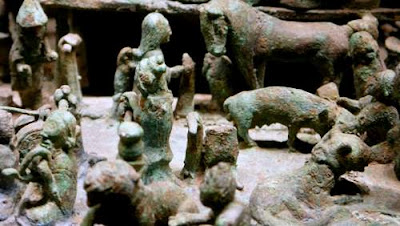
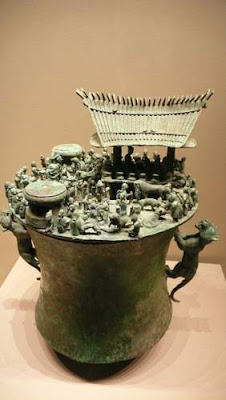
Right now the travelling exhibition is on bronze castings from China's past.

Let me telescope outwards on one here...

Close up of a Chinese bronze casting

Close up of a Chinese bronze casting

Close up of a Chinese bronze casting

Close up of a Chinese bronze casting
I will let the images speak for themselves; this is a museum well worth visiting.

As an older "China Hand", I think that culture and history gaining renewed emphasis... in a positive light, after the dark years of the Cultural Revolution... is wonderful.

It is true that there are still impoverished people in China, but culture is for everyone, rich and poor. And China is making efforts to continue combatting poverty.

I firmly believe that studying, or even just observing, culture is a way to appreciate differences which, eventually, builds tolerance to differences. It can also lead to greater sensitivity to those who are less well off.

The existence of this museum indicates that values are changing.

Everyone who visits this site knows that your humble scribe enjoys talking, and I will, but later in this week and in the weeks to come.

To get to Shenzhen's Civic Centre, from Hong Kong, take the KCR subway/train line to Lok Ma Chau and go through the border crossing (you need a China visa to get in).

On the China side, take Line No. 4 of the Shenzhen Metro and get off at the third station for the Shenzhen Civic Centre.

Cross the road and aim for the massive flying wing on the other side of the street.

Enjoy the town.

Tschuess,
Chris

Friday, February 27, 2009

No worries about cholesterol today...

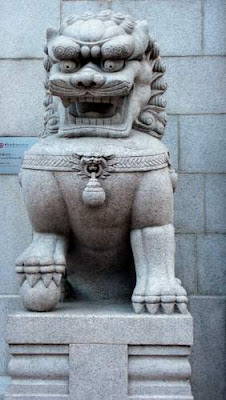
Image of an Imperial Guardian Fu Lion in Tuen Mun, Hong Kong, in front of a Buddhist temple-Dear Gentle Reader,

I have wittered on about guardians (lions) this week.

It looks like we all need one.

If worrying about plastics (melamine) being substituted for protein in food was not enough of an issue...

What about fake eggs?

Fake eggs? 

When boiled, they resemble real eggs, except the yolk is bouncier... Oh, and they have no protein and might harm you...

When raw, and in their fake(!) shells, they are difficult to differentiate from real eggs, although they lack the vaguely fishy smell associated with very fresh eggs. And raw ones sound watery when shaken...

The Standard, an English-language free daily paper in Hong Kong, broke this story about a week ago, here (the Feb 17, 2009 issue of the Standard). 

Fake eggs have now been found in Fujian Province, China after having previously being found in Chengdu (2008), Beijing (2007), and Guangzhou (2005).

These fake eggs are fraudulently replacing real eggs because of the cost differential in production; it costs 0.12 to 0.65 USD cents to produce fake eggs compared to 3.2 to 3.9 USD cents for real eggs. 

What does that mean in the egg carton? 

You can potentially make almost 27 fake eggs for the same cost as making only 1 real egg; then those super cheap fakes are sold as real eggs at real egg prices.

None of the ingredients used to make the fake eggs are inherently dangerous, although, aluminum impurities found in these fraudulently sold eggs have been linked to mental development issues. 

But, there could be other harmful additives, or impurities, tainting the constituent chemical ingredients used to manufacture the fake eggs. 

If you are making fake eggs, fraudulently, you are not worried about using only food-grade chemicals with only food-grade impurities... ...so who knows what else these fake eggs are tainted with.

The security of my food chain has been an issue since I first moved to Asia in the mid-nineties and started realizing what could, and did, go wrong with food...

I tried turning to words for sustenance, as Emily Elizabeth Dickinson (1830-1886) suggested in this poem, prodded along by her first stanza:

He ate and drank the precious Words

He ate and drank the precious Words --
His Spirit grew robust --
He knew no more that he was poor,
Nor that his frame was Dust --

He danced along the dingy Days
And this Bequest of Wings
Was but a Book -- What Liberty
A loosened spirit brings --

But, I found those words, alone, could not sustain me, physically. 

My literary diet not only loosened wings, but also my pants. 

I returned to traditional sustenance, but a regular diet of non-literary food demands belief that the food bought is what it purports to be.

That is why we need guardians. Libertarians, take note. 

Fake eggs are an example of why bigger government is good; we need branches to test things, like food safety.

So, I close today, and this week, with more looks at guardians because we plainly need them.

Everybody needs a guardian, not just a friend...

First, a couple of lions from the major Buddhist temple in Tuen Mun...

Image of a male Guardian lion with his foot on the circle of life.Image of a female Guardian lion with her foot on her cub.


To see more, we simply cross the road, go down the block and gaze across the street at the first restaurant we find. 


This restaurant, with its own guardian lions, is on the left, just across the street...


Image of guardian lions outside a restaurant in Tuen Mun, Hong Kong.
But, it is not just restaurants that feel the need for guardian lions.

People have them for their houses:

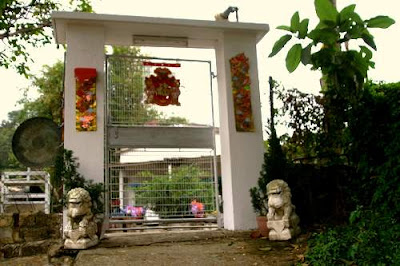
Image of guardian lions outside a private residence in Tuen Mun, Hong Kong.
And even for their car parks...

Image of guardian lions outside a private car park in Tuen Mun, Hong Kong.

Everyone is fearing something.

Today it's fake eggs. 

I hesitate to guess what tomorrow will bring.  

(Enjoy your poached eggs.)

At least I don't have to worry about cholesterol anymore.

Tschuess,
Chris, Regina, and Pommes

Wednesday, February 25, 2009

Guardians at the Gate

Image of a Chinese Lion, taken Chinese New Year, 2009, in Kowloon, Hong Kong.Dear Gentle Reader,

As you can see from today's picture, and as I have tried to warn you, Hong Kong can be dangerous.

Here is a wild, Chinese lion, roaming the streets in Hong Kong. 

I do not believe that he has imbibed the East Wind... This is an all-natural, supernatural Chinese lion.

Hong Kong nature at its finest.

When you visit, bring heaps of cash and your humble scribe will intercede and propitiate the lions so that you can return safely to your home country. 

You don't know about this?

Well, bear with me and I'll tell you more. 

I note that not a single guest has been devoured by lions, yet. 

Your scribe must know what he is talking about...

So, on Monday, we met the very handsome lions, Stephen and Stitt, at HSBC in Hong Kong.

Stephen and Stitt, in Hong Kong, as explained, are Western versions or manifestations of the Chinese Imperial Guard Lions.

The Chinese, historicially, have incorporated metal or stone Imperial Guard Lions as architectural ornamentation and security adjuncts, for Imperial and, later, Governmental and high-ranking personage's buildings.

The original Bank of China guard lions, right next door to HSBC, look like...

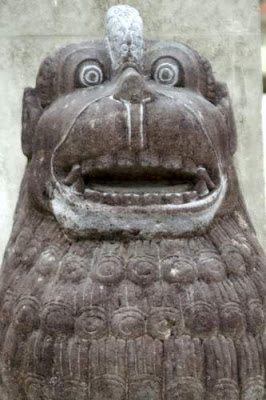
Image of the original Bank of China (in Hong Kong) male Imperial Guardian Lion, on the left of the entrance.Imperial Guardian Lions, or Fu Lions, are always cast or sculpted, and placed in sets of two. 

The male is (usually) on the left, the female is (usually) on the right.

You can tell the male lion because his paw rests on a ball, the flower of life.

The flower of life is a geometric
al figure of multiple, symmetrical, overlapping circles that yields an overall six-part symmetry (like a hexagon, which is the symbol of HSBC...).

The male lion's job is to protect the physical structure that he guards.


For the geometrically minded, who are curious about the flower of life, the centre of each circle in the flower of life is intersected by six other circles of equal dimensions. So a circle of life could look like this... 

Image of a circle of life, taken from the Wikipedia Commons and based on a PNG created by User:AnonMoos.  Small, clear image of the most common form of the

...But the circle of life is normally mapped onto a sphere, not simply shown flat. Sometimes there are spherical circles of life insided spherical circles of life, going down as small as the children's fingers needed to carve out the last sphere ...

You can tell the female Imperial Guard Lion because her paw is on a lion cub, representing the cycle of life. 

Image of the original Bank of China (in Hong Kong) female Imperial Guardian Lion, on the right of the entrance.

The female lion's job is to protect the occupants of the structure she guards.

But, your humble scribe still prefers Stephen and Stitt. 

Please do not forget them, as many of you assured me you wouldn't, when you visit.

Also, as you saw from the opening picture, wild lions roam the streets of Hong Kong.

Propitiate, by feeding, all the lions by feeding the Imperial guard lions.

But, be careful... This is dangerous work. 

Do not feed them, yourself, when you visit, they have strong jaws, like granite. Once they lock into position, nothing escapes. 

(Remember, it was rumoured that Stitt had the capacity to potentially change into a zombie lion...)

It is best to leave the feedings of guardian lions to trained professionals.

Like your humble scribe.

Coming, literarily, from the fertile crescent (Sepiru, ancient Akkadian Babylonian for scribe) (or, at least, from a fertile imagination), your humble scribe knows a thing or two about lions. 

And your humble scribe is a lawyer, after all; he has heard a lot of lion...

Feeding lions in the wild involves fresh meat, and lots of it.

Feeding "domesticated" bank lions involves fresh funds, cash preferably, and lots of it.

To propitiate these elegant lions with offerings of money (the only food they eat) and to retain possession of all your limbs, give the offerings to your humble scribe, who will ensure it symbolically enters them (via an ATM machine that he has the secret codes to).

Don't you feel safer just knowing me?

Start saving to soothe the wild beasts when you visit.

Tschuess,
Chris and Pommes (glaring at your scribe for an important omission) 

Right. 

Pommes wants to remind all that a can of tuna or salmon, 100% pre-tested by himself for purity and quality control, is an important additive to the standard fare that should be offered bank lions to ensure safe passage in Hong Kong. 

Go figure. OK, Pommes? 

Claws out of my lap, then. Thanks.

Monday, February 23, 2009

Stephen & Stitt; Lions among men

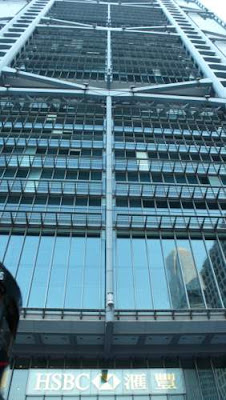
Image of the HSBC flagship operation in Hong Kong.Dear Gentle Reader,

Normally, people look up when they get here.

Here being HSBC's flagship operation in Hong Kong.

Or, people look in their jacket or purse to get their wallet out to visit the most used ATMs in the world.

(The Chief Economist of HSBC Bank Canada, about a decade ago, told me that the maximum lifespan of these ATMs, then, was a couple of months, and that some last only a few weeks, as they were used so often...)

People do not normally notice Stephen and Stitt.

Stephen and Stitt who?

Looks like we need to do some talking...

First, open your wallet.

Pull out some bills.

Ideally, you will be in Hong Kong right now. If you are not, I had better help you.

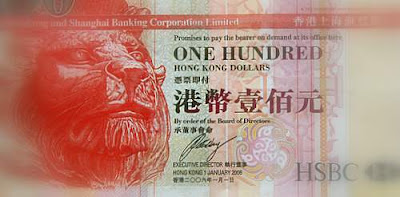
Partial image of a 100 Hong Kong Dollar Bill, cropped, and digitally obscured to prevent counterfeiting charges....In Hong Kong, paper currency is printed by HSBC, Standard Chartered Bank, and the Bank of China. All three are privately owned banks.

(Legal note: This partial image of less than one side of a 100 HKD bill is cropped and digitally obscured to prevent your humble scribe running afoul of counterfeiting legislation. Also, fair use doctrines are invoked to show the portion of the currency which I do show. I need this image to communicate the message I want to communicate, and I have obscured the portions not neccesary.)

Who is that big guy on the left of the banknote?

That is Stitt.

Who do people coming to HSBC ignore?

They ignore Stitt.

They also ignore Stephen.

Image of Stephen, the lion you see on your left when staring at HSBC HQ in Hong Kong.
Stephen is the lion on your left when you stand in front of HSBC Hong Kong's flagship tower.

Stitt (the ignored) sits opposite Stephen on the other side of HSBC's entry square.

For those with incredibly short memories, Stitt, not Stephen, is the lion on the HKD bank notes printed by HSBC such as the 100 HKD note that you saw farther above, cropped and obscured.

In the picture below it looks like that crowd around Stitt might be looking at him, and thus not ignoring him...

Image of Stitt, the lion you see on your right when staring at HSBC HQ in Hong Kong.
Unfortunately, looks are deceiving. These people were really using him as a seat and as a place to put their food, books and things.

This was a small group of domestic helpers on a Sunday who had simply found a place to sit and hang out for the day.

Stephen and Stitt were cast in 1935 for the new HSBC headquarters in Hong Kong.

Stephen was named after A.G. Stephen, the General Manager of the Hong Kong HSBC operations at the time. Stitt was named after the General Manager of the Shanghai HSBC operations at the time.

When the Japanese occupied Hong Kong in the second world war, 1941-1945, poor Stephen was used as target practice.

Image of Second World War damage done to Stephen by Japanese forces using him as target practice.
Stitt initially escaped unscaped, but then both Stephen and Stitt were hauled off to Japan to be melted down for their metal (for Japan's war effort).

Thankfully the war ended before Stephen and Stitt were melted.

They were identified by Allied Forces and returned to HSBC where they resumed their stance, protecting HSBC and securing its financial future.

OK. Before we leave, let's stray from history to myth...

Popular culture has it that Stitt, whose mouth is closed, originally had his mouth open, just like Stephen. But...

Popular culture has it that the geomancers realized that, due to Stitt's (and Stephen's) orientation being sideways, not in the standard Chinese Imperial Guardian Lion style with head facing forward, away from the building, that Stitt might imbibe the Eastern Wind at night.

Imbibe the Eastern Wind at night?

He might become, in Western parlance, a zombie lion.

As you can imagine, a zombie lion could, potentially, cause public unrest.

So, popular culture says, Stitt was recast to avoid the possibility of him imbibing the Eastern Wind an night. And that, says popular culture, is why Stitt has his mouth shut.

When your humble scribe meets the Chief Archivist for HSBC at a Royal Asiatic Society meeting, (it seems the type of place that one would meet the Chief Archivist) then this is a question your humble scribe will be sure to ask.


Tschuess,
Chris

Wednesday, February 18, 2009

Icarus Daedulus Canova

Image of a sunset on a Beach in Niedersachsen, Germany.
Dear Gentle Reader,

The most beautiful sculpture in the Museo Correr, Venice, is a sculpture of Icarus and Daedulus by the Venetian sculptor Antonio Canova (1757-1822).

Canova renders, possibly, the most beautiful flesh in marble. 

His sculptures, like Henry Moore's, beckon to be caressed.

In the sculptural composition of Icarus and Daedulus, Canova captures the expressions on Icarus' and Daedulus' faces, as Daedulus finishes sewing the wings onto Icarus' arms, in preparation for their joint flight to freedom which will end in wet tragedy for them both.

Daedulus' tragic face will long be wet with tears. 

Daedulus will grieve Icarus, his son, who will not heed the warnings and will fly too close to the sun, melting the wax that keeps his feathers in place. 

Icarus, tragically, will plummet from the sky to his watery death in the sea.

In the sculpture, Canova catches the fear and the foreknowledge of doom and despair in Daedulus' eyes. 

Simultaneously, Canova catches the rebellious impudence of youth in Icarus' face, too.

Yes, yes, yes father. 

"Remember, don't fly too high." 

Yes, yes, yes father.
I won't.
Yes, yes, yes father. 
I know.
(Whatever.)

Daedulus, the master builder who crafted the Labyrinth holding the Minotaur, knows he cannot live in exile on the isle of Crete. 

Daedulus must escape, and he must bring his son.

The tragedy is that, as a father, Daedulus well knows his son's weaknesses and failings. 

Daedulus knows that his son's impetuousness foreordains his son's death. 

Yet Daedulus continues building the wings and attaching them, hoping against his inner knowledge. What else can he do?

The heavy stone in his gut, the catch in his throat, and the swallowed, invisible fear are all visible in light lines around Daedulus' eyes and face.

If this sculpture does not move you, then I wonder what injustice forced on man would move you.

Your humble scribe has no image for this sculpture; it is impermissible to take them in the Museum Correr. 

That said, if you do a google image search with this post's title you will find images taken surreptitiously; but none of them do Canova's brilliance justice. 

They are too pale or too shadowed or too stark. I suppose they might be considered better than nothing if you do not have an historical art book handy.

But, those images I have pointed the way towards are just not adequate, as is, and they are not mine to fix. 

The only thing that is mine to fix is the world I live in.

What do you fix?

Tschuess,
Chris