Showing posts with label politics. Show all posts

Wednesday, March 10, 2010

3WW CLXXX

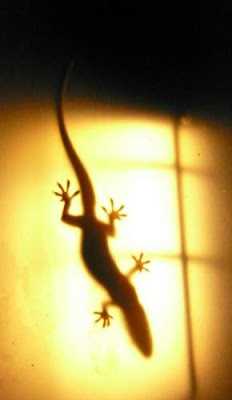
Beauty wants to be seen. It needs to peek out! But, is this gecko seen? Or unseen? Veiled or viewed? And I cannot believe that Thom, of 3WW, did not know what he was hoping for when he came up with the 3WW word, this week. Good on him.Dear Gentle Reader,

It is 3WW time.

This week the prompt words are modify, obedient, and veil.

Your starter is a titled picture with, as always, descriptions if you run your mouse over the image.

Then, as usual, I serve up three haiku/senryu, each with an American Sentence title.

For dessert, a musical offering.

If you're like me, have dessert first, and enjoy it while reading.

So, away.

Let the games begin with modify, obedient, and veil...


Please, Sir, up or down, in or out, fast or slow, ..., ...how do you like it, sir?

A veil keeps sin out.
But, modified, with shimmies...
...obedience in...


** Bearing in mind that not everyone speaks English as a first language, all my poems are meant to be read aloud.

The last line of this haiku has a greater effect, I think, when these two words are in the same eigenspace of comprehension as their oral/aural equivalent...

...'obedient sin'...

...then shimmy the two in your mind...

...obedient sin/obedience in...

...then tell me what is obedient, and to whom, and you're a better man than I am, Gunga Din.


Sarkozy wants her to be strong (obedient); "Modify thy veil!"

Obedience or
Obeisance? Try my veil./? It
modifies me?/. Thee?/.


** With a Gallic shrug, and a governmental tug, her veil could be gone... ...Sarkozy, President of France, declared that the burqa, the full body 'veil', is not welcome in France. Six months later, a French parliamentary committee recommended banning full veils from public buildings.

Now your humble scribe is not going to be drawn into a discussion of the nuances between purdahs and burqas, hijabs and niqabs.

One bottom line is that either people have freedom to choose their elements of expression in apparel or they do not.

And, of course, properly, both sides of the debate can argue that they are for the
freedom to choose elements of expression in apparel and that the other side is against the same proposition.
Which, in a way, is part of the wonderful duality of life. Long live the differences.
Point and counterpart sometimes produce harmony, but, today, in France, they produce dissonance. And the score has not even been finished--it is certainly not settled.
I've tried, in the poem, to shimmy between the interrogative and the declarative and it is meant to feel dissonant.
I'm just not so sure that it works.
Like France's policy.


At 'de Ent o' days, when 'de Taliban come, sleepin', not fightin's, sin!

Oh Bee, 'de Ent' comes!
Modify 'dose bad ways quick!
I won't wear no veil!


Tschuess,
Chris


Click to hear 'At an Arabian House Party' by Raymond Scott and his Orchestra

Amazon.com


Tschuess,
Chris


Monday, December 14, 2009

On poison, naturally

Image of something angular and round, lit up by night titled 'What is this?'.Dear Gentle Reader,

After Friday, I kept thinking about poison. And food.

I thought about strychnine, for example.

Strychnine brought me back to Dr. Thomas Neil Cream (1850-1892), the Lambeth Poisoner, who gave strychnine to young woman, from the USA to England, who aroused him.

When young ladies came to his practice dressed inappropriately, according to his private determination (read arousal), he would retaliate (?) by giving them candy--strychnine tablets.

The young women would be dead by the next morning.

Those 'candies' were taken by the girls themselves, but at least they didn't know what they were popping into their mouths.

I say that because the next person and poison I thought of was poor Socrates (469 BC - 399 BC) who was required by the State to willingly drink hemlock.

Socrates was required to pour a draught of hemlock down his own throat, froma cup he held in his own hand, with the full knowledge of what the consequences of those swallows would be.

The thing about hemlock is it triggers paralysis of the body while the mind stays perfectly alert.... so, at all times you understand what is happening as your body slowly shuts down and you drown in the fluid that collects in your lungs.

This, to me, sounds perfectly horrid, similar to the shut-in syndrome that some stroke patients suffer from.

These nasty thoughts, naturally, (strychnine is naturally derived from Strychnos nux vomica, the strychnine tree, from Asia, whilst hemlock is naturally derived from poison hemlock, conium maculatum) led me to the Italian wine/poison, cantarella.

Cantarella was the fabled poison of the Renaissance Spanish/Italian Borgia family.

The House of Borgia came to prominence with election of one of their own, Alfonso de Borja (1378-1458), as Pope Calixtus III (1455-1458).

Ensconced in Italy, after moving with Alfonso de Borja from Valencia, Spain, the House of Borgia became known for their political prowess which allowed them to get another member of the family elected as Pope; Rodrigo Borgia (1431-1503) became Pope Alexander VI (1492-1503).

More accurately, the Borgias become notorious for the way that people who opposed them, or who stood in their way, or who possessed large sums of liquid cash (which the family would later seize) would die.

By poisoning.

The Borgias are believed to have made a mixture of arsenic and wine which they would give to people, and this poison became known as cantarella.

The Borgias reputedly experimented on animals and, later, on people, to determine how to vary the dosages so that the poison would (a) not be detected, and (b) they could determine beforehand when their victim would die.

Knowing when death would occur was good for both building alibis and for arranging votes, or transfers of funds...

The recipe of cantarella has been lost to time but it is rumoured that it involved arsenic which had been rendered more efficacious by being mixed with the entrails of animals and squeezed out in solution...

What is known is that cantarella remained tasteless and undetectable when added to red wine.

The Borgias were a bit like the spinster Brewster aunts from Joseph Kesselring's "Arsenic and Old Lace".

But, far more successful.

And, who would refuse a dinner with the Borgias?

It is a bit hard to imagine any Westerner, during the Renaissance, refusing a dinner with the Pope or with one of his family members.

You are likely wondering where this is all heading, today.

Well, all this thought of poisoning, and of food, brings to mind a bit of poisoning your humble scribe experienced, a while ago.

Food poisoning, yes, but more in the sense of the Borgias. And, more natural.

Do you want to know more?

Same time, Friday.

After 3WW on Wednesday.

I'll tell you all about it, then.


Tschuess,
Chris

Click to hear 'Love Potion No. 9' by The Coasters 'cause you have to love something to kill for it, no? Even if it's just the thrill...

Amazon.com iTunes

Tschuess,
Chris

Friday, November 27, 2009

On opium

Image of opium smokers in the East End of London, 1874. From the Illustrated London News, 1 August 1874. This image is in the public domain and is sourced from the Wikimedia Commons.
Dear Gentle Reader,

Yesterday was about what might be on the menu for a Hong Kong Thanksgiving, should Hong Kong have a Thanksgiving.

The conclusion which we came to was opium; opium would be the menu, not just on it.

Why?

(Besides the sweetly scented silver derived from the trade, of course.)

Well, lots of great things, like opiate alkaloids, are found in the resin of a few of the plants in the Papaveraceae family.

Today's post continues revolving around Papaver somniferum, the opium poppy.

Opium resin is what you start with.

You get opium resin by lightly slicing the pod of an opium poppy, while it is still on its stalk and attached to the plant, and collecting the white, latex resin that oozes from the cuts.

This resin, collected and dried to a paste, is not a pure, distilled chemical but, rather, a dark smörgåsbord of active ingredients.

The three principal ingredients, from the perspective of a drug taker or a drug seller, are three opiate alkaloids: morphine, narcotin, and codeine.

Morphine, narcotin, and codeine comprise a trinity of soporific delight; a draught of the waters of Lethe without having to get by Charon. Or Cerberus. At least, that is what the seller will tell you...

First though, the naming, as names are so important to poets.

A structural image of morphine's molecular shape.The principal alkaloid, by quantity and effect, in the sticky opium cocktail, is morphine, C17H19NO3.

A structural diagram of morphine is over on the right.

I won't trouble you with diagrams for the next two important opiate alkaloids, Narcotin (C22H23NO7) and Codeine (C18H21NO3).

But, for the fancy bio-linguists out there, the black tie IUPAC names for these three compounds are:

Morphine: (5α,6α)-7,8-didehydro-
4,5-epoxy-17-methylmorphinan-3,6-diol

Naroctin: 6,7-dimethoxy-3-(4-methoxy-6-methyl-7,8-dihydro-5H-[1,3]dioxolo[4,5-g]isoquinolin-5-yl)-3H-2-benzofuran-1-one

and

Codeine: (5α,6α)-7,8-didehydro-4,5-epoxy-3-methoxy-17-methylmorphinan-6-ol

If you are going for any kind of poetry creation, however, I'd recommend staying informal.

It's hard to do a haiku, for example, with any of these fancy IUPAC (International Union of Pure and Applied Chemistry) names.

At least, not while sober.

And sober is not what one stays if you smoke opium.

Technically, of course, opium is not smoked; it is not burned, or it shouldn't be burned. That would be a bit of a waste.

Opium, in an opium pipe, is vapourized.

The smoky fumes, cooling in the long, inclined chamber of the pipe before they reach your mouth, are then inhaled.

I've never done it, but the chemistry and physics of the act are obvious from the engravings of opium dens, and from opium pipes which I have seen in both public and private collections.

Yesterday, we went over the numbers as per the quantity of opium that was being shipped to China even before the British had secured Hong Kong as a port.

A port, you see, was handy.

With a port, like Hong Kong, you could load up on opium in Calcutta and come to Hong Kong to revictual. Further, you could make appropriate arrangements to meet your Chinese distributor somewhere in China.

Who wanted to arrive with tens of thousands of pounds of contraband opium and hang out with the pirates while you try to contact your contact... and then receive cash?

That would be a poor risk management plan...

Further, long range meteorological forecasts were not so reliable. Who wanted to arrive and find out that a tropical storm, or, worse, a typhoon was blowing through the region?

No, a port was a good thing.

A port permitted opium sales to skyrocket, which permitted opium production in India to skyrocket, which in turn allowed British Imperial revenues to skyrocket, too.

Don't just take my word for it. Look at this lovely graph.

(y) tons of opium versus (x) date

Graph and data showing global production of opium, measured in Imperial tons, plotted on a time scale from 1800 to 2000. This graph and data are in the public domain and are sourced from Wikipedia.
As usual, the information on all images is found by rolling your mouse pointer over it. But, for speed, the vertical axis measures global opium production measured in tons. The horizontal axis measures years.

So. What did this mean for for China?

By 1906, 27% of the adult, male population of China was addicted to the lovely cocktail of morphine, narcotin, and codeine found in opium.

Of course, by 1906, the British were, mostly, out of this game.

Most of the opium required to supply 27% of the adult, male population of China, in 1906, was home-grown.

(34,000 imperial tons were produced in China, by Chinese, by 1906, versus Chinese consumption of 39,000 imperial tons.)

But the problems of this many addicts, in China, led to massive social and economic unrest.

By 1911, the unrest would be political, too, as the Qing Dynasty would be overthrown and, in 1912, Generalissimo Chiang Kai Shek would become the President of the Republic of China.

Folks across Asia have bad, and recent, memories of rampant drug addictions.

So, generally speaking, there are significant penalties for being caught with drugs. Especially at entry and exit points...airports or seaports.

(The pessimist would say this is to help safeguard local monopolies in distribution, export, and import. I, of course, would never think such thoughts.)

And here is where the story of the day comes in.

Back when your humble scribe used to live in Taiwan, a very long time ago, an English chap came to Taiwan on business.

He knew about the concept of giving gifts, to help generate better relationships with people.

So he brought a dried flower arrangement.

(I know. I don't think he knew much about giving gifts, or relationships. But, I guess, he tried. Or maybe his secretary hated him.)

So what?

That arrangement contained a dried poppy.

Not, I hasten to add, an opium poppy, Papaver somniferum.

Just a regular, run of the mill poppy.

...

It took weeks for him to be sprung from prison on Green Island.

Green Island has a prison and not much else.

This is a prison where, then at least, your family and friends had to send you food if you wanted to maintain a vaguely appropriate caloric intake.

Or, if you wanted to try to bribe the giant rats so that they wouldn't nibble on you nose or gnaw on your shins when exhaustion overcame you.

Now there was a man who, I am sure, would have wanted a long, deep draught from the waters of Lethe, or from our unholy trinity of opiate alkaloids, when he was finally released.

Asia.

Don't mess around with things you shouldn't.

And be thankful for everything that you do enjoy.

But, try to not need opium.

Things could always be worse.


Tschuess,
Chris

P.S. I am thankful that you are reading. Go figure. That surprises me every day.

P.P.S. Why does your humble scribe know anything about opium?

I have taken on the alter-ego of an Akkadian scribe...

And Sumerian pottery was being decorated with opium poppies before cuneiform was fully developed as a script for language, not just for accounting for profit and loss.

It's in my collective memory, if not my blood (thank goodness). Take care.

For music, today, Karl Marx thought this stuff was the opiate of the masses; I am quite happy to imbibe an opiate like this.

This is the first movement in an Armenian liturgical concert.


Click to hear 'Where are you, oh Mother' by Isabel Bayrakdarian
Amazon.com iTunes

Tschuess,
Chris

Thursday, November 26, 2009

On Thanksgiving in Hong Kong

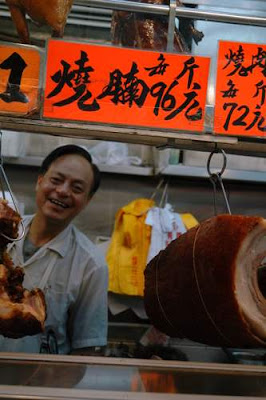
Image of Cantonese BBQ pork being sold from a small store in an alley, in Hong Kong.
Dear Gentle Reader,

Yesterday, I was asked what we have for Thanksgiving in Hong Kong.

This is a more difficult question to answer, for numerous reasons, than you might have expected.

You need to remember that the Hero of this blog, Pommes the Wonder Cat, eats fish.

So, from Pommes' perspective, Fish and Chips is mandatory before anyone starts to even talk about thanks. And the only giving he wants is a one way transaction. Fish to Chips.

(Pommes, the name, is German for chips, what my American friends would call french fries, and what my French friends would call pommes frites.)

And, when it is time to start thinking of thanks, Pommes' idea of giving of thanks is an insouciant feline sniff of 'whatever' whenever that fish has *finally* come his way.

I should note, of course, that Pommes does remove his claws from your leg when you actually hand him the fish; for that, your humble scribe always gives thanks.

The Heroine of this e-house is German. They don't celebrate Thanksgiving.

Finally, your humble scribe, like the Hero, is Canadian. So, technically, my Thanksgiving was a month or so ago.

So the easy answer would be, we don't celebrate Thanksgiving in this house, at least not in November.

But, that would be a cop-out for the question of what do people eat in Hong Kong for Thanksgiving.

The challenge in answering, however, is that that question must be phrased in the conditional future subjective.

Hong Kong, being, previously, a British colony, never had Thanksgiving as a holiday.

And I seriously doubt that the Chinese will be bringing Thanksgiving, as a holiday, to Hong Kong, or to the mainland, anytime soon.

So, the question has to be framed as "What would people in Hong Kong have for a Hong Kong Thanksgiving, if and when they were to celebrate such a thing?".

The Mayflower never stopped in port here.

Hong Kong never had Pilgrims fleeing religious persecution, only to, upon arrival, rob the locals of their cached food and desecrate local burial grounds.

True, Hong Kong had economic migrants, sojourners mostly, that came to Hong Kong for quick cash.

And, sure. Hong Kong's sojourners were willing to rob the locals, and each other, likely, and, presumably, had few concerns for local funerary, or other, customs.

But, there was no Mayflower compact to help us figure out when to start considering setting a date for a Hong Kong Thanksgiving.

And, before we set a menu, we do need to set a date for a Hong Kong Thanksgiving--to know what would be in season.

But, there was a compact that we can go by. One that, in some ways, mirrors the cross-cultural talks between the Pilgrims and the Native Americans...

The earliest agreement that Hong Kong would become British was reached on Jan 20, 1841, during the Convention of Chuenpi.

The Convention of Chuenpi called for the British to remove their men and boats from Chusan and, in return, to receive Hong Kong.

The British negotiator, Captain Charles Eliot, thought the Agreement in Principle would be binding and final so he proceeded to remove his men from the isle of Chusan, southeast of Shanghai, to Hong Kong Island--much farther from both Shanghai and Beijing.

The British landed on Hong Kong Island on Jan 25, 1841 and drank congratulatory toasts. They were thankful for a possession, even if it was a barren rock.

That landing and those toasts were repeated the next day, to be official, at Possession Point on Hong Kong Island.

(Strangely, Possession Point is not signposted anywhere in Hong Kong--I am still searching for clues as to where it was.)

So, maybe one of those two landing dates could be seen as Hong Kong Thanksgiving dates; dates for being thankful for having a harbour, a place to get out of the boats.

Of course the Convention of Chuenpi was renounced by the Chinese and, on Feb 24, 1841, hostilities were resumed by the British, but the British kept Hong Kong, at least until midnight of June 30, 1997.

If I had to choose a date I would go with the unofficial landing, and subsequent libation, of Jan 25.

(Hong Kong has always been a bit unofficial around the edges.)

Having set a date we can now set a menu.

Here, no one celebrates anything with turkey (although the hairy crab festival has just ended).

(Maybe I'll write about hairy crabs next week. Or brothels. They're both related. Take your pick.)

But, returning to the moment, I was asked what we would eat in Hong Kong for Thanksgiving.

MichaelO asked if we would have duck, rather than turkey.

I think not, MichaelO.

I think Hong Kong would go with something more traditional, more historical, and with much more of a kick.

Until Hong Kong finally went cold turkey, the raison d'etre of Hong Kong was opium.

I think a Hong Kong Thanksgiving, to be historically accurate, would have to involve opium.

Possibly shaped like a duck, but then smoked.

Hong Kong, you must remember, was created for one thing only.

The offloading, storage, and transshipment of opium from India into China.

(Sometimes that is shortened, the way things in English can be, to read: Hong Kong, you must remember, was created for one thing only--money.)

Opium helped stem the phenomenal outflow of silver from the British treasury to China.

The Chinese State had refused to purchase any goods from foreigners. The Chinese were happy to export only their own goods, and to receive silver, only, in payment.

The Chinese State controlled all importation and exportation so, for industrial goods, at least, what the State said, went.

The British, like the rest of Europe, liked many things produced in China, but the imperial coffers started to empty themselves, at an accelerating rate, to pay for imports from China.

British merchants then discovered that they could sell Indian opium (especially Bengali opium) to China.

The opium was smuggled into China by British merchants and sold to Chinese partners, illicitly, who completed the logistics of distribution to the masses.

And what did the smugglers receive for their opium? And what did the British Empire receive for its opium, when it sold it in India to private firms?

They received silver.

The British government made money on the sale of opium from its holdings in India and these sales alone reversed the net outflow of silver from the Imperial coffers. Further, that reversed flow of silver became a deluge of silver swamping the British Empire's Imperial treasury.

These revenue inflows afforded the luxuries and development of India, by the British, and of England, and much of the Imperial holdings.

The traders, both British and Chinese, also made fantastic sums.

How much opium are we talking about?

In 1830, the trade of opium into China was around 19,000 chests per year. By 1838, that trade had grown to around 40,000 chests of opium.

A chest held a picul of opium. This translates to between 60-65 kilograms, or 132-143 pounds, ish, of opium, per chest.

At 40,000 chests we are talking about up to 2,600 metric tonnes of opium, or 5.72 million pounds of the stuff.

In Hong Kong, today, and then, what matters is money.

And 5.72 million pounds of opium, per year, brings in a lot of money.

That is what drove the trade, and the founding of Hong Kong, and what people, Chinese and Western both, were thankful for, even when they found the opium trade distasteful.

Opium made the wheels of Empire spin round.

In North America, at Thanksgiving, after consuming the tryptophan glut that is turkey dinner, people pass out.

In Hong Kong, after filling your lungs and gut with opium, you pass out too.

And there is no need to eat.

That is why Opium den habituées are so thin and why Yves Saint Laurent never had to round up plus-sized models for his Opium fragrance collection.

So.

Short question with a long answer.

What would a Hong Kong Thanksgiving look like if there were to be one?

It would look just like an American turkey glut, but with less food, skinnier bellies, and only opium on the menu.

I hope that helps.


Tschuess,
Chris

Amazon.com iTunes

Click to hear 'Nuevo Mexico' from the album 'Opium' by Ottmar Liebert & Luna Negra
Amazon.com