Showing posts with label black death/the Plague. Show all posts

Wednesday, November 26, 2008

Pictures of Body Bags and the Tibetan Connection

Image of a corpse tied in a knot to make a bag, hanging from the side of a horse taken from the wall of a temple, lit by headlamp. Image taken in Tibet.
Dear Gentle Reader,


Nobody asked, but I am guessing somebody out there wants to ask what those body bags looked like.

Your scribe comes prepared because Monday's post relates to things that your heroine and scribe learned while researching our trip to Tibet last year.

The image at that start of Monday's post, and today's post, is a Tibetan Buddhist Bag of Diseases, one of the five weapons of Sri Devi as she fights evil and the opponents of Buddhism.  

Guess why that guy is tied in a knot... 

Guess what his (now) bag-like shape contains... 

And you thought all Buddhists were gentle...

So don't forget to put money in that bowl when you pass a saffron-robed monk or a nun in grey... 

But wait, why do the Mongols have anything to do with Tibet? Besides the fact that their territories were alongside each other.  

And besides the fact that both, and what became Modern China, would control or greatly affect each other, as relative power waxed or waned in the region.  

And besides the fact that the Dalai Lama's position and title was allegedly granted to the first Dalai Lama by a Mongolian.  

Kublai Khan had converted to Buddhism to have a universal religion to bind Tibet, Mongolia, and China.  In 1578 a descendant of Kublai Khan, Altan Khan, an aggressor against China, proclaimed a Tibetan Lama to be "Dalai" (Ocean in Mongolian, symbolizing supreme leader and the Dalai Lama has since been linked with supreme secular power in Tibet).  In return, the Tibetan Lama proclaimed Altan Khan to be the reincarnation of Kublai Khan (Ghengis Khan's grandson).

OK, so that is the connection, and that is why we found depicitions of body bags in Tibet.  

Body bags were used by Sri Devi to combat enemies of Buddhism and Buddhist concepts. While Sri Devi, as a mythological figure, used them figuratively I am guessing that earlier Tibetans, like the Mongolians, used them literally. 

If you enjoyed Monday's and today's posts, you could, as always, mention them to your friends; make them viral...

With smiles from across the water, and a raised, chocolate-covered mango margarita...

Tschuess,
Chris, Regina, and Pommes with a paw covering his mouth

Monday, November 24, 2008

Germ warfare; the Mongols say hello

Image of a corpse tied in a knot to make a bag, hanging from the side of a horse taken from the wall of a temple, lit by headlamp. Image taken in Tibet.
Hello Gentle Reader,  

...Hmm....  Maybe not so gentle.

Some of you liked the post about the Black Death...

...Well, let me follow that post with a family-friendly post on germ warfare.

...First, an apparently stream-of-consciousness diversion.  

There is a human genetic anomaly called Down Syndrome. It is named after the British Doctor, Dr. John Langdon Down, who fully described the disorder in 1866. Later, in 1959, France's Dr. Jérôme Lejeune showed that people with Down Syndrome all had an extra (partial) copy of the twenty-first chromosome.

Of course Lejeune's recognition of the chromosomal nature of the disorder did not change the name of the disorder as characterized by Dr. Down. Similarly, Dr. Down's categorization of the syndrome did not create or change a well known human condition.

I suppose that line of thought could lead us to the question of what is in a name...

In English, today, we talk about people who have Down Syndrome as being mentally challenged.  

When your humble scribe was in high school the descriptive phrase for this condition was mentally disabled. When your scribe was at grade school the descriptive phrase was mentally retarded. 

Going back much further, the descriptive phrase in my grandmother's life was mongolism. Similarly, people who had mongolism were called Mongoloids. 

Finally, older medical texts that your scribe used to use also referred to Mongolism...  

...But I always thought that Mongols were people from Mongolia, like the Great Genghis Khan? Rapacious, yes, but so was Alexander the Great. So why were Mongols singled out in such a way in European history? 

This is where the apparent diversion cease to be a diversion.

In 1346 the Mongols were on one of their raids of conquest and began besieging the port city of Kaffa. Kaffa lies on the Black Sea (Kaffa is now Feodosiya (zoom out to see it better on the map) in the Ukraine's Crimea). 

(Note, by raid, your scribe means a monumental horde of pillage and loot hungry calvarymen.)

The Mongols were fast attackers, horsemen of the steppes. They were not so keen on sieges. Mongol warriors liked to end sieges as quickly as possible.

The Plague was endemic in Mongolia and the higher steppes. In combination with other diseases such as anthrax, dropsy, leprosy, cholera, or dysentery, the Plague was used as a potent weapon by the Mongols.  

The Mongols would gather the corpses of people who had died of these horrific diseases. The corpses would be opened and the innards of the corpses would be scooped out. The scooped out remains would then be mixed up and combined to make a rather pungent and nasty concoction.  

This concoction would then be poured back into the original corpses which were then individually resealed by being sewn and tied up forming individual proto-bodybags; lets call the resulting invention a bag of diseases.

These bags of diseases would either be dropped into local water sources or hurled directly into cities which the Mongols were besieging.  

These bags of diseases were used as germ warfare siege engines and they would dramatically speed up the process of siege conquest.

While besieging the city of Kaffa the Mongols had an outbreak of the plague in their own ranks. The Mongols, of course, made some body bags and hurled these bags of diseases into Kaffa. These bags, as usual, exploded and spattered on impact; the besieged became quite sick.  

Who were the besieged? Kaffites? Kaffians? How do you call citizens of Kaffa? Were there citizens of Kaffa?

Well, at the time, denizens of Kaffa were subject to Genoa.

Genoa was, then, a major trading, naval power in continuous conflict with Venice, the other major naval power in the West. 

Genoa controlled the Black Sea, amongst other areas, and Kaffa was a Genoese trading settlement/fortress.

So what did you call a denizen of Kaffa when the Mongols started lobbing bags of death into the city?

You called them dead, or soon to be dead. 

Unless they were Genoese citizens. Then you called them loudly, waving money in your hands, because they were fleeing Death--who was apparently stalking Kaffa with his scythe in hand.

Genoese citizenship did not provide immunity to the effects of the bags of disease, but it did provide a way out of the city.

Genoese merchants and militamen, in Kaffa, fled the diseases unleashed by the Mongols. 

Well, the merchants thought they had escaped Death, and the mysterious diseases of Kaffa, as they took off in trading and war galleys.  

In the Genoese merchants' flight they landed at various ports in Southern Europe to take on supplies... and, as normal, they off loaded some trading goods, and, incidentally and inevitably, they offloaded some rats (rats were a harmless enought irritant, as perceived at the time, and all ships had them).  

No one wanted rats on a ship, they ate and fouled everything, but they seemed to be endemic to ships. 

In 1346 no one had any clue how the Plague was transmitted. We are talking about a time long before the concept of germ theory, so there was no concern or awareness as to what the merchants and naval men were inadvertently offloading when rats (and rat fleas) made their way onto each deck at each port of call. 

Of course, as the Swiss-cum-French Dr. Yersin discovered in Hong Kong in 1894, rats could spread the Plague. Japan's Dr. Masanori Ogata subsequently showed that fleas had the same bacterial infection as the rats. 

Finally, in 1897, the Frenchman, Dr. Paul-Louis Simond, dispatched by the Pasteur Institute (Institut Pasteur) to India to follow-up on Dr. Yersin's research, showed that rat fleas, Xenopsylla cheopis, were the vector transmitting the Plague bacteria from rats to people.

None of this was known in 1346-1347 in Europe, but people in the port towns visited by the fleeing Genoese recognized that the stories of death told by the Genoese merchants, sailors, and military men were terrifyingly followed by similar deaths after the trading fleets left.

These vessels fleeing Kaffa, and Kaffa's diseases, infected Europe with the Black Death via their ship rats and the fleas on those rats. 

But the Genoese were not blamed for the resulting carnage, The Black Death, that decimated Europe. 

No, the Genoese were not blamed; the Mongols were blamed.

The Mongols, after all, had used abominable bags of disease as weapons of war.

As the Plague was first brought to Europe, at least in the public's consciousness, by Mongols who lobbed putrefying corpses over the walls of Kaffa, gentle Readers (and possibly throughly appalled Readers), this is why your humble scribe thinks that there has been a link between Mongols and things that we fear striking but cannot explain. Such as Mongolism.

Tschuess,

Chris, Regina, and Pommes

PS. Again, to see the genesis of this post was, read here...

Monday, September 29, 2008

A museum & the Plague

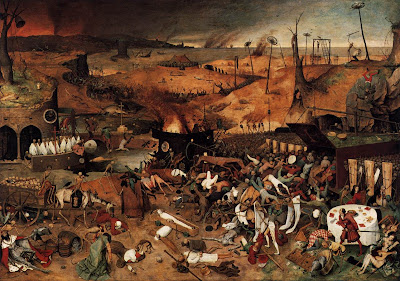
'The Triumph of Death' by Pieter Breugel the Elder. From the public domain and the Wikimedia commons.Hello again,

DISCLAIMER Lord love a duck, that horrific time absorber from HK is back online and clogging up bandwidth again.  Sorry, I'm just built this way, apparently... DISCLAIMER END

So, this post is a bit unlike some of the previous posts; it is serious. Troy in Spain complained about a lack of substance to these posts (he apparently missed the rainpersimmon jam on my windows (see Update No. 5; now there was substance) so, today we delve into death.  I mean, if I am going to be serious, I might as well head straight to a big issue like death.  

(The cover piece, "The Triumph of Death" by Pieter Breugel the Elder is here simply because your Scribe loves it and a post on death is just too good an opportunity to skip for sharing this great painting (click here (and then click again on the image in the new site) to visit a site where you can see it in full screen-sized glory).)

So, back to Hong Kong. 

Your heroine and your scribe found a great museum focused on death (or hope, depending on your perspective) a while ago.  Your hero, Pommes, was feeling a bit under the weather and stayed home, but Regina and your scribe recently(ish) visited the Hong Kong Museum of Medical Sciences, tucked above and beside Soho in Hong Kong. 

The museum is housed in an old medical laboratory and is quite nice, although the walls run with mould and algae in the building out back due to the rain, heat, and humidty. 

Your heroine and your scribe had to wonder how many samples and analyses were contaminated by mould and algae in times past (Sorry Dr. Chin, the ingrown toenail biopsy came back... apparently the patient has a significant algae problem.  We recommend two sucker fishes, leeches, and a good bleeding...), but that is not what was so interesting about this museum.

The Hong Kong Museum of Medical Sciences is located very close to where the community of Tai Ping Shan was before it (the community) was levelled physically and metaphysically. 

In the 1890's 97% of Hong Kong was Chinese, and (so sayeth the museum) most lived in squalor in Tai Ping Shan; no electricity, no running water, no sanitation.  

Well, that was common for much of the urban world of that time period, but Tai Ping Shan was very, very, tiny with a phenomenally high population density. 

If you were (relatively) wealthy for a rather poor Chinese gentleman in 1894, you could buy a license to keep a pig in Tai Ping Shan, as an occupant of Tai Ping Shan yourself.  

The only catch was that you could only keep the pig in your own flat or apartment.  With a pig in the place, you might think everything would be flattened. But no, with livestock in the house comes rats and other things, like waste. So things get lumpy, not flat.  

Now after a while of people having pigs in homes, the story becomes interesting.  

In 1894 the Hong Kong government diagnoses 3 cases of Bubonic Plague in one day. One hundred cases are diagnosed the next day... ...and things only get worse from there.  Thousands die, tens of thousands flee.  

Japanese medical researchers are invited to Hong Kong Island to hopefully determine the cause of the plague; their brief is to determine the vector which allows for the spread of the plague disease.

A Swiss doctor also comes over to Hong Kong because he studies the plague too (everybody needs a hobby; what is yours?).  

The Japanese researchers were not happy with competition so they, allegedly, pay off the hospital to deny the Swiss doctor access to the laboratory, the morgue, the cadavers, and everything else.  

Dr. Alexandre Yersin, the itinerant Swiss doctor, (and I am guessing that "Eureka" moments are occurring for a great number of you right now) is offered space in the hallway, where everyone is passing by; not precisely the best place to conduct medical research on the Black Death.  

So the good Doctor from Vaud (he grew up in Morges!) builds his own straw hut outside the hospital and obtains plague corpses for a fee. Hey, he's Swiss.  He knows what makes the world go around.

Dr. Yersin identifies the "buboes" of the Bubonic plague as the likely site of infection. Buboes are dramatically swollen lymph glands, see below. Engraving of Black Death victims showing buboes from the Toggenburg Bible, 1411, sourced from the Wikimedia commons
By taking samples from the buboes, Dr. Yersin identifies what he thinks the culprit is, a bacteria. Our good Swiss Doctor then isolates the bacteria and injects it into rats.  

The rats get buboes and die. The good doctor takes samples from the rats' buboes and he cultures, looks, and finds the same bacteria as he found in the humans.  

Dr. Yersin repeats this a few times with a few changes, and, upon receiving the same results, within seven days of his arrival in Hong Kong, Dr. Yersin has (a) solved the five and a half century old mystery of what causes the Plague and (b) identified that rats are a vector for spreading the bacterial infection.  

Wow.  

Who knew that up until 1894 nobody had realized that it was a bacteria, now named Yrsinia pestis (that should have been your Eureka moment), that was responsible for the plague? And no one had realized that rats carried it.  

Wow.

This whole bit of history was just fascinating to your heroine and to your scribe. 

Your hero, Pommes, lost all interest in eating rats when he read your scribe's initial report.

Now it would take a few more years to realize that there was an important intermediary, fleas, that transmitted the plague from the rats to people, but still, this knowledge allowed the government to legislate public policy for public health regarding rats.  

Today everyone knows that rats can be dirty and can spread disease, but everyone didn't then. Your humble scribe supposes that a fair bit of people's modern day antipathy to rats is tied up with their being connected with the plague, the Black Death.

Simply finding a vector for the transmission of the Plague, in a metaphysical way, was a bigger deal than realizing that the actual vector was rats. 

The Black Death was big, and no one knew what caused it. It would rise in the population from time to time, and take away significant percentages of people; between 30% and 60% of Europe is estimated to have died in the first strike of the Black Death into Europe which started in the 1340s.  

The Black Death was a Capital Letter Concern, and demonstrated the sway of the unknowable.  Old engraving showing Death as the Grim Reaper, standing victoriously over a pile of harvested bodies, no life appears around. Image from the public domain and taken from course notes package for HISTORY 1140. World Civilizations to 1500 written by and taught by Prof. Robert Brown, Prof. and Chair, History, University of North Carolina Pembroke, used with permission of Prof. Brown.
The terrifyingly swift and massive death toll was seen as a punishment by God; many pogroms against "others", such as thriving Jewish populations in Europe, commenced after the onslaught of the Black Death to "appease" God.

The clergy (the Western Christian Church still being monolithic at this time) were decimated by the disease, suffering even higher mortality rates than other folk, because monasteries and churches were places of refuge and treatment for the afflicted.  

The rapid decline of the clergy meant that an equally rapid increase in the clergy was necessary, but a rapidly replenished clergy was not as well educated, and the educators were dead.  

A decline in the education level of the Church's leadership would let inevitably let in some rot, which would fester, and eventually (ostensibly) lead to the Reformation, and the Counter-Reformation, and a whole new round of bloodshed (cue up Geneva again and the acolytes of John Calvin, although Huldrych Zwingli out of Zurich was much more aggressive, ideologically speaking).

Wow. Was your heroine and your scribe ever pleased to have visited this lovely little museum in HK.  

Oh, and there are also two tiny pictures of "teeth worms" in the museum that were allegedly blamed for caries (cavities) for thousands of years. Very sweet.

Right, there you have it. Serious and informative.  Hopefully informative.  Let me know.  Show me love. Refer the blog on (higher readership "tickers" yield higher writer satisfaction).

And that is probably enough for today. 

Tschuess,
Chris, Regina, and Pommes

Postscript: 

If your humble scribe understood correctly, bubonic plague is still a problem in Hong Kong, albeit at very low levels. 

Further, the Hong Kong government has long had a policy of checking caught rats to determine if and when the problem is resurgent.  

There are certainly many signs indicating highly poisonous rat bait throughout Hong Kong and others noting that people should not touch the killed rats. 

And you thought that chocolate-covered mango margaritas and avian flu were all you had to worry about when you visit us...