Showing posts with label history. Show all posts

Wednesday, July 28, 2010

3WW CXCIX

Entitled 'Dream fish (Tokyo Koi relaxing under reflected cherry blossoms)' this is a blurry image of an orange Koi swimming under a psychedelicesque swirl of reflected cherry blossoms in a wind-kissed lake.Dear Gentle Reader,

It is 3WW and, after a four month absence, I am back.

Hopefully, for a while.

This week the 3WW community received these three words as prompts:
abuse, cramp, and hatred.

As usual, I proffer three haiku, each with an American Sentence title.

So, without further ado... abuse, cramp, and hatred....


Runner's cramps felled her, felled her dreams; she blamed her trainer, not her drinks

cramps hit her mid stride
crampled she crumpled, bellowed
abuse, wild hatred


Heshiveredinthedarkcrevasse, searched for his wits, way out and ice axe.

Abused crampons cracked,
slid off... ... Red.Redhat.Hatred...
Blooddripswet,freezes.


**A stunned climber who fell down a crevasse might work his way from red, red hat, hat red to realising he has a bloody head. Or, at least, a bloody hat...


'Papa' gave kids balloons, then injected death straight into their small hearts.

Hot hatred cramps thoughts;
cold hatred cramps grace, begets
horrific abuse.


**Oswald "Papa" Kaduk was a butcher before the Second World War began.

He became a totally different butcher before that war had ended.

Oswald joined the SS, fought on the Eastern Front, and, injured, ended up at Auschwitz-Birkenau as a guard and moved 'up' the ranks.

The Final Solution was the Nazi plan to rid the world of the "lebensunwertes Leben", those considered by the Nazis to be unworthy of existence. Nazi ideology included gypsies, homosexuals, mentally handicapped people, and, of course, Jews in the list of peoples undeserving of life.

As part of the "Final Solution", 85% of the Jewish population of Europe in Nazi controlled lands were to be murdered as quickly as possible. The other 15% were to be worked to a point just before death and then murdered.

Infamous Auschwitz and lesser-known Birkenau were significant cogs in the Nazi "Final Solution".

Auschwitz warehoused around 30,000 victims being worked to death at any given point in time; adjoining Birkenau warehoused around 100,000 more victims.

Men who survived, after arrival, the selection of the 'lucky' 15%, statistically, survived for six months to a year. Women who survived selection generally survived for four months.

Children almost invariably were not selected and would generally die within an hour of arriving at the camp.

Almost a quarter million children were slaughtered at Birkenau.

Oswald Kaduk (1906-1997) was nicknamed "Papa" because of his 'love' for kids.

Papa gave children who arrived at Birkenau a balloon.

Then Papa would inject a needle, and phenol, through their chest and into their heart.

Papa did this ten times a minute; one child murdered every six seconds.

All for cold, calculating, racial hatred.


Tschuess,
Chris


Postscript about Haiku and American Sentences

First, technical definitions of the poetic forms I play with.

The English language version of the haiku is grammatically stricter (though semantically looser) than the original, Japanese form of this poetical form.

English Haiku are usually required to have three lines with 5 syllables on the first line, 7 syllables on the second line and 5 syllables on the final line.

The American Sentence is a poetical form structurally closer to the Japanese haiku format in some ways. It requires 17 syllables in one sentence and was created by the American poet Allen Ginsberg.

Yes, I know that there are content issues regarding what topics are permissible in Japanese haiku and that Japanese poets don't count syllables as they are generally understood in English.

I am not overly concerned.

If you are, I am sure I have discussed it sometime before. Check the haiku topic listing and have fun.

Thursday, March 18, 2010

3WW CLXXXI (3WW3)

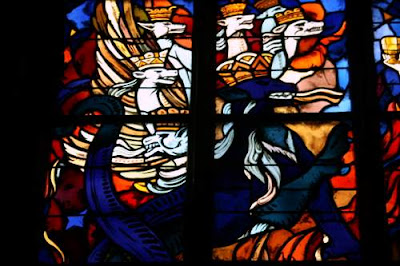
Detail of a stained glass window from a Church in Normandy. From Caen, I believe.
Dear Gentle Reader,

It's 3WW time, again.

This week the prompt words for prose or poetry are pulse, shard, and weary.

Your starter is a titled picture with, as always, descriptions if you run your mouse over the image.

Then, as usual, I serve up three haiku/senryu, each with an American Sentence title.

For dessert, a musical offering.

If you're like me, have dessert first and enjoy it while reading.

So, away.

I have to get back to packing.

We are in the midst of moving and we have too much stuff.

So, sorry if I try to store some words here, on the web, but there is no room in the stables tonight...

And, with that, let the games begin with pulse, shard, and weary...


On safari, the carnivore rules over all--- ROWRRR... (sob) ...CruNCH ... ... ... ... ... ... (...no pulse...)

shards of meat (and bone)
but, no pulse (legume, bean, pea)
weary vegan pales...


The origin of glass, a Western, or a Near (not Far) Eastern, tale...

Pliny's Phoenicians
found proto-shards where weary
sailors' fires throbbed, pulsed.


What is this poem all about?

Well, Gentle Reader, a circuitous explanation ensues. Sorry.

You ought to know, by now, that your humble scribe is (currently) based in Hong Kong.

Hong Kong is right beside China.

Hong Kong is even in China, if you believe the Mainlanders rather than your visa requirements.

Hong Kong is certainly within the media orbit of modern China.

Recent Chinese 'historical' pop culture movies (Red Cliff, for example) extol the fact that ancient China invented almost everything.

Like soccer. (A specious claim, at best).

Your humble scribe and Heroine find themselves amused to note that almost all things are Chinese these days.

Soccer/football?
Surely Chinese.

CERN and the Higgs Boson?
Surely Chinese.

The alphabet?
Mmmhmm.

Crime?
Vice? ...

...Well, those are obviously foreign.

...Especially when you read or hear the news, in China...

But, glass?
The beach at Mont St-Michel, Normandy, France, as seen through transfigured beach... the medieval glass of Mont St-Michel

Glass is definitely not Chinese.

Glass is one of those areas where, if you are a Westerner, you can hold your head high on the origins of innovation front because the ancient Chinese did not invent glass.

The Chinese 'discovered' glass only from overland traders sometime in the end of the Spring and Autumn period of Chinese dynastic history (770 BC - 476 BC) or in the beginning of the Warring States period (475 BC - 221 BC).

Pliny the Elder (23-79), however, gives us the historic/mythic origin theory that Phoenician sailors (Phoenicians are those Fertile Crescent trading folks whom most Lebanese claim as their forebears) discovered glass sometime around 5000 BC.

Pliny's Phoenician sailors/merchants were cooking their meal of reconstituted pulses in pots over fires on the beach as they rested their weary bodies...

Those Phoenician pots, in turn, while cooking the pulses, rested upon blocks of nitrates which the sailors/merchants were carrying.

And, as those blocks of nitrate melted, from the heat of cooking fires, the melted nitrate fused with silica, the sand on the beach, to form 'ur-glass'--the original man-made glass.

This originating glass was not only clear(ish) but, when the half-melted nitrate trading blocks were forcibly removed, this proto-glass would have resolved into shards of glass...

...which would have engrossed the attention of sailors, weariness forgotten, with sharp shards of a novel, transparent solid in front of them and their bellies full of reconstituted pulses.

See how easy this fit into today's 3WW words?

3WW even allowed me to point out Western technical/innovation prowess.

Even Mesopotamian prowess.

For, despite Pliny's tale of the Phoenicans of around 5000 BC, the first archaeological record of glass comes to us from pre-Bronze Age Mesopotamia--from the pre-Sumerian Uruk Period (4000 BC - 3100 BC ).

Sure, this is almost a thousand years before my beloved Akkadians spring to prominence in Mesopotamia, but, for once, I can write about something that was not invented first in China.

Thanks, Thom (Keeper of 3WW and provisioner of words).

Words like these make my day.

(Although, Thom, I would love the challenge of an x, y and z themed 3WW, too--as you suggested on your prompt page...)


To the victors go the spoils, and thanks, of royalty; to the writers...

pusillanimous;
lacking heroes' pulse, courage.
Weary shards of men...


(Of course, today, the writers get royalties.

But, not if they publishes on the web...)


There you go, hepcats.

Maybe when I am less bone weary the haiku will pop out easier.

Tonight, well, this is better than nought.

I hope.


Tschuess,
Chris


Wednesday, March 3, 2010

3WW CLXXIX

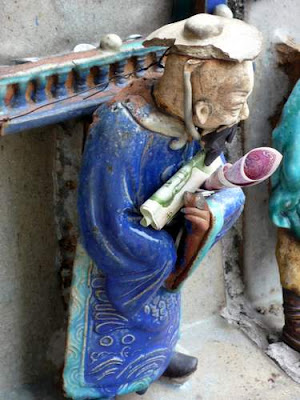
Detail of a ceramic frieze atop the Dragon Mother's Temple, Guang Dong Province, China. People lean over the upper balcony to tuck money into the sculptures to help lubricate the passage of their wishes to reality.Dear Gentle Reader,

It's 3WW.

This week the prompt words are amaze, frail, and sacred.

Your starter is a titled picture with, as always, descriptions if you run your mouse over the image.

Then, as usual, I serve up three haiku/senryu, each with an American Sentence title.

For dessert, I close off with a musical offering.

So, promptly, away.

Let the games begin with amaze, frail, and sacred...


Amazing Grace, Newton's sweet sound--though he'd sold men, bound, in slavery...

frail prayers waft up,
borne with sacred incense swirls;
plead amazing grace


** True, John Newton (1725-1807) did end life campaigning with John Wilberforce for the abolition of slavery, but he started life as a slaver, and, though he had changed careers to become a curate, he had not denounced slavery when he penned 'Amazing Grace' in 1779.

The British Slave Trade Act of 1807, which Wilberforce and Newton campaigned for, became law little more than 9 months before Newton's death and abolished slavery in the British Empire.

Britain would take until 1833 to determine that slavery as an institution was inherently illegal.

That said, the Western world would not see slavery as being a jus cogens, an international legal wrong, or, more specifically, that a jus cogens itself could exist until the conventions for drafting the Vienna Convention on the Law of Treaties were commenced in 1949 and the text finally adopted in 1969 (see Article 53). It would still take until 1980 for the Vienna Convention on the Law of Treaties, 1969, to enter into force.

This whole 'aside' merely is my way of pointing out the frailty of some prayers, especially those implicitly contained within 'Amazing Grace', penned at the time by an unrepentant ex-slaver and slave trader.


Forget storge, philia, and agape; give me eros each day.

frail hearts quail, tremble.
love is sacred? hah! Violent!
stunned, amazed, we pant.


** Storge, philia, agape, and eros are the four forms of love in Classical Greek thought.

Storge, στοργή, refers to loving, familial affection.

Philia, φιλία, refers to friendship--the love between friends.

Agape, αγάπη, refers to an abiding, deep love and contentment.

Eros, έρως, finally, refers to passionate love. Eros doesn't have to be sexual, but Plato's modification of love, Platonic love, a non-sexual love, is a modification of eros--which point to the importance of sexuality in the non-Platonic eros.


Crowds queued (Paris-style) for her; Quasimodo tried to save her; she died.

frail Esmeralda's
sacred sanctuary fails;
amazed Q's heart breaks


** If you haven't read Victor Hugo's (1802-1885) 'Notre-Dame de Paris', or, 'The Hunchback of Notre Dame" then this little piece will surely fail. The only thing I will point to here is the ambiguity of 'Q' in the last line.

Normally this 'Q' would clearly refer to Quasimodo, but, with the title of this poem, 'Q' could also be the Parisian crowd which 'queued' outside of Notre-Dame to show its support of Esmeralda--fabulously misread by Louis XI, the King of France, in the book....


*** As per queuing 'Paris-style', don't think Paris of Hector, or of Helen, think French Revolution.

Think Eugène Delacroix and 'La Liberté guidant le peuple', or, 'Liberty guiding the people'...

Image of painting by Eugène Delacroix (1798-1863) entitled ' La Liberté guidant le peuple', or 'Liberty guiding the People'. This image is in the public domain and is sourced from the Wikimedia Commons.

An aside and a query. Does "to hector" in English come from Homer's Iliad?

Hector (eldest son of King Priam [of Troy] and Hecuba), who berated his brother, Paris, with lines like "Paris, you pretty boy, you woman seducer, why were you ever born? Why weren't you killed before your wedding day"...


Tschuess,
Chris

Ah... and the music for today is...

Hmm. My data storage site appears to be down...

I'll have to try to add the music later...


Wednesday, February 17, 2010

3WW CLXXVII

Image of a bouquet of roses, made from some foamed plastic, with glowing snippets of fibre optic cable sticking out. This image is titled 'Alien Bouquet hot from Victoria Park's Chinese New Year Fair (Hong Kong, 2010)'Dear Gentle Reader,

It is 3WW. Again.

Not so much love for my loose id postscript for last week's 3WW, but I take what I get, and I did like what I did receive. (What a suck, no?)

Anyway, thanks are due to Thom, as usual.

This week the 3WW word prompts are occur, ragged, and tidy.

As usual, I present three haiku/senryu, each with an American Sentence title.

So, let the games begin with occur, ragged, and tidy....

OH! You might note that I have gone with aural interpretations of the words, and visual sleight-of-hand, too, just for fun. (Mine.)

And, lastly, the Heroine of this site recommended that folks read the green explanations under two of the poems... ...and, without further adieu...


William shakes fist, spear; shivers the air with his tempestuous anger...

Oh cur! Oh ragged
Cur! Hang cur! Hang you whoreson...
[Tidy curse for foes!]


**The Tempest, Act 1, Scene 1
Antonio: "Hang cur! Hang, you whoreson, insolent noisemaker!"
William Shakespeare (1564-1616)


In soft, modern days and ages the old lives on, even if not here...

(D)ragged over thresholds--
out of tidy home to hell;
forced weddings occur.


To test his theory the new priest undressed her, removed her rags, and then...

Tidy ochre scraps
swept into neat piles by priest.
D-ragged... ...Mummy gone...


**Mummies, those fabulous Egyptians whose bodies were rendered less mortal, ultimately derive their name from bitumen, a heavy petroleum product, once worked into devotional art by the Medes, early Persians, and by others.

It was believed, from the colour of the preserved corpses, that bitumen, mum in Persian, thence mumia in Latin, thence Mummy in English, had been used in the mummification process.

The modern priestly caste, sometimes known as scientists, de-ragged, or removed the wrappings on the corpses--the Mummies--to check, and found no trace of bitumen in the Mummies' corpses.... so, linguistically, the Mummy was a Mummy no more (no bitumen).


Tschuess,
Chris


PS. As an aside the baroque musical style 'Ciaccona', possibly more familiar to most through its French name, chaconne, always reminds me of modern dance music; it has a driving bass line with a series of short harmonic variations which dance around that beat. I enjoy dance music (I enjoy dancing) and tend not to be too epochcentric... Hopefully some of you will enjoy this selection.

(Admittedly, the beat per minute rate of this Ciaccona is slower than most modern dance and electronic music, but most ravers and dubsteppers are wearing clothing easily weighed in micrograms, not the kilograms of baroque outfits, not to mention those Lady GaGa-esque baroque wigs...)


Tschuess,
Chris