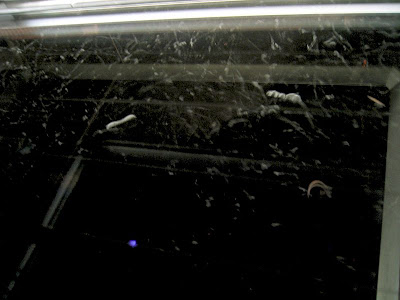
This image is of a cloud chamber used to track and observe the course of charged subatomic particles.
The cloud chamber was invented by a Scottish physicist, Charles Thomson Rees Wilson, after he observed spectral (spectre-like might be more appropriate) shadows magnified and cast upon clouds while mountain climbing.
Charles had been working on Ben Nevis, Scotland's (and Britain's) tallest mountain peak in 1894, when he was 24 or 25 years old. It was on Ben Nevis that he observed his shadow cast upon the clouds.
Charles was fascinated by clouds and studied how clouds form. His experiments found that charged particles could seed or stimulate the production of clouds.
Thirty-three years later, in 1927, Charles Wilson, with Arthur Compton, received the Nobel Prize for Physics as a result of his work on clouds.
Particle physicists used Wilson's cloud chambers to track the path of charged particles like cosmic rays, electrons, or muons.
Who cares what the paths of cosmic rays or electrons look like? I will save a post or two about that branch of science, and the benefits of CERN or TRIUMF or SLAC or the proposed CLIC for another day.
Today your humble scribe will take a different perspective because he comes, in a literary sense, from the perspective of making the invisible visible.
Cuneiform is a type of script, one of the very first scripts.
Sepiru, as I have mentioned before, is Akkadian cuneiform for "scribe". To see what Sepiru, or scribe, looks like in Akkadian cuneiform script, visit here.
The point of scripts is that they make invisible language visible.
With a script, words do not just leave a shadow on our psyche. Written words can leave a shadow on a society, like Mao's Little Red Book.
The written word can also illuminate a society, like the Book of Kells which helped re-introduce literacy to medieval Europe and which kept the spark of light, literacy, alive to lead Europe out of the Dark Ages.
Giving depth and solidity to the invisible and intangible, the imagined or envisioned, is what makes writers write.
Your scribe's favourite words made visible would be a toss-up between Milton's Paradise Lost which has shaped English literature for 400 years and the Roman Emperor Justinian's legal writings which have shaped Europe and the world for almost 1600 years.
In yesterday's post your scribe talked about tracking interest, on the Internet, in postings.
Your scribe finds it fascinating to watch how people connect over the Internet.
This post started with a cloud chamber because cloud chambers allows the observer to track the invisible.
Browser software allows your scribe to track and "see" interest, which previously your scribe considered invisible.
(Your scribe notes this could be gender related. Most women seem astonished that men can be so oblivious to 'obvious' interest and attention generated by the same woman, or by another woman. This apparently indicates that, maybe, women can see 'invisible' interest. The scientist in me is willing to consider this a possibility.)
While tracking 'invisible' interest across the internet, it is amazing how short physical distances can become, at least from the perspective of e-conversations.
Periodically, through the cloud chamber magic of software, I see splotches of attention focused on one of these posts crop up regionally, which may demonstrate the general truth that you are closest to those whom you are closest to.
This reflects the idea that physical proximity is a closer indicator of friendship than shared interests are. At university, your roommate or your dormitory friends may be your closest friends, even though there are likely many people with stronger and more congruent interests to yours; these others just do not happen to be as physically close to you as your roommate.
Sometimes the cloud chamber software revealed global chains of referred interest in a post, but the chamber also reveals linguistic similarities between the people presumably sharing the post.
These linked readers and referrers might be people that were once physically close but, with globalisation, are now chasing opportunities far apart from where they met.
To your scribe, however, the magic of the Internet is that frequently I cannot discern or guess at the connection between various voyeurs, even with the magic cloud chamber software.
When the connections are not obvious I happily believe that these readers share interests despite their far-flung physical distance from their apparent e-friends.
To me, that is e-magic.
E-contact through the e-aether, made e-visible by e-clouds.
E-amazing...
e-Tschuess,
Sepiru Chris

 Dear Gentle Reader,
 Without it he would not be able to do his work.
 This bike is like the one behind it.


 Posts
Posts