Monday, June 22, 2009

Tuen Mun, A city contained...

Image of a rusted container with a 'Transamerica Leasing' leasing logo on it.
Dear Gentle Reader,

The Korean War was active from 1950 to 1953, but, it never really ended.

An armistice was signed in 1953 though peace was never declared.

Further, North Korea recently declared its withdrawal from that armistice on May 27, 2009.

But, this article is not about a home for peace, or war, on the Korean Peninsula, or anything on the Korean Peninsula.

It's not even about the Korean War, except tangentially.

This post is tangentially about the Korean War as the Korean War saw the first great growth of metalized containerisation for shipping.

The USA found that metal containers, instead of wood, once standardized, were harder to destroy, more difficult to pilfer from, and quicker to load, unload and transport.

With these insights, CONEX, the CONtainer EXpress project of the USA's Department of Defense, began and thus the Korean War marks the dawn of modern containerisation (as opposed to the twilight of (wooden) transport containerization which started in the late eighteenth century; it was a long twilight, baby).

Nineteen years after the start of CONEX, 1972, in turn, saw the dawn of containerisation in international, civil (as opposed to military) trade in Hong Kong.

In 1972, the first dedicated container ship to arrive in Hong Kong, the Tokyo Bay, docked in Kwai Chung.

By 1975/1976, container cargo was already accounting for 51% of the total dead weight tonnage of cargo exported or imported in the world (today more than 90% of non-bulk cargo is shipped via containers).

By 1980, Hong Kong had eclipsed Osaka, Japan, to become the third largest container port in the world.

By 1987, Hong Kong had eclipsed both Rotterdam, the Netherlands, and New York, USA, to become the number one container port in the world.

Of course, when those containers aren't being shipped out, they sit empty.

Idle.

And land is not cheap in Hong Kong, as your humble scribe found out when looking for a container for his life, and the belongings of the Hero and the Heroine.

Image of stacked, empty containers in Tuen Mun, Hong Kong.Containers that are not filled with goods to be shipped frequently end up in Tuen Mun, a suburb city of a half million people outside of Hong Kong.

Tuen Mun started off its days as defensive gate city (channel gate is what Tuen Mun translates to).

Tuen Mun formed a defensive channel to stop foreign threats; not that it was ever effective against non-Chinese threats, like the British...

But, now, all threats to Tuen Mun are contained...

For, you see, Tuen Mun is where many of the unused shipping containers sit.

Recently, China's export trade has dropped by over 26% in dollar terms. That represents a lot of containers.

This means that the number of containers sitting idle has grown...

Second image of stacked, empty containers in Tuen Mun, Hong Kong.
So, some are used in novel ways.

Like this lovely house,

Image of a house made of containers.
with a carport, and a covered garage/workshop (the landscaping, admittedly, leaves much to be desired, but it is low maintenance).

Image of a carport and garage made of containers.
Some structures, of course are more downmarket.

Image of a container rancher with room to grow, for a growing family, and space for a dovecote for those avian fanciers...

Image of a container shack/hunting blind (in Tuen Mun). A fixer-upper in need of some TLC, but perfect, already, for back-to-nature unabomber types...Some structures are almost hillbilly market (or hillybilly, as the Heroine likes to say).

While others are more mid-market.

Image of a two-story walk-up container unit with shade and a back yard (in Tuen Mun, Hong Kong). Perfect for growing families. Must be seen to be believed.
The flip side of reduced trade is, apparently, increased housing.

And I have long thought that much housing, in Hong Kong, is simply containerization of people.

Now, in Tuen Mun, my suspicions have been confirmed.


Tschuess,
Chris

Postscript

Speaking of containers, and Tuen Mun, my mysterious scholarly Buddhist reader (but never commentator?) in California would likely not forgive me if I didn't mention Pui To.

And, having seen the tools that Buddhism reserves to use against its enemies (go back into the archives...) ...I want to stay on the right side of Buddhists...

So.

The great Buddhist missionary, Pui To, arrived in Tuen Mun in 428 AD in his own drinking cup, transformed into a vessel for travelling the drink (the waterways of the Pearl River Delta).

(In comparison, I drink and travel, or travel and drink, but rarely do I travel my drink. Your humble scribe is so déclassé...)

Pui To, however, did more than experiment with containers (drinking cups) and their efficacy as travelling objects.

Pui To, as a very devout Buddhist, would go to the local markets, buy live fish destined for the kitchens, and release those same live fish back into the water.

Further, the fish that never made it back to their watery homes, the dead ones, well, Pui To would inter these fish in specially constructed mausoleums... ...architectural containers to hold and memorialize the dead. (Why? Because Buddhists generally respect all life as sacred.)

So, Tuen Mun has not only had a long history, but has had a long relationship with containers transformed.

Friday, June 19, 2009

Carrot teeth and bulging eyes of death... Spider of the Apocalypse, redux

First image of a fearsome Cambodian spider.Dear Gentle Reader,

A face like this is just another reason why these guys give your humble scribe the creeps.

I mean, look at those teeth...

This guy is like a monster drawn by a three-year old child with carrot teeth and bulgy eyes.

(Note, I am referring to the drawn monster as having the carrot teeth and bulgy eyes.)

(Further note, were the three-year old child to have carrot teeth and bulgy eyes, and be drawing a picture of the same, your humble scribe would be afraid of the three-year old child, too...)

The above-pictured beast is decidedly real, although he also inhabits my nightmares...

Come on, Harry...

Smile for the camera...

Second image of a fearsome Cambodian spider.
If Little Red Riding Hood had described this guy, instead of the the wolf, I really don't know how I would have made it through childhood, especially the nights.

Heck, even the frogs are hiding from this guy in the daytime...


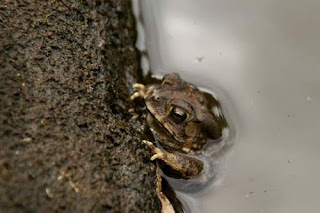
Third image of a fearsome Cambodian spider.Image of a Cambodian frog cowering in a water tank


So, mental imagery time...

It's hot.

Really hot.

And humid.

Really humid.

You go to bed au naturel because it's so hot and humid.

Feral noises come from the jungle outside your building, until silence coccoons you in the tight embrace of sleep.

And then you wake in the middle of the night.

You wake in a panic, but, also,
and wisely,
you wake, frozen in place...

For Something is upon you...

And, by the pricking of my thumbs, something wicked this way comes...

That Something is moving...

That Something is heavy...

That Something is the size of a plate...
...and on your chest...

And,

and here I save the best for last...
that Something has no body heat...

although you know It moves quite fast
by Its quick, twitching, spiky feet...

It's as if fluid night has coagulated into prickly substance.

A lethal bit of dark matter has congealed and been extruded from the night and dripped upon your body, discernible only by the pressure it exerts on your ever tightening psyche and skin...

...It is another spider of the apocalypse.

My questions to you are:

Do you open your eyes to see impending doom... and show the spider of the apocalypse where you keep the wet, juicy morsels to quench its thirst?

Do you move at all?

Do you hope it goes sideways? (Rather than towards your head, or towards a warm site further south...)

Do you let your partner know now, or later?

I remember these questions flitting across my fevered brain through the horror of one sweat-drenched night.

Spiders of the apocalypse; one of the lesser joys of Taiwan.

Thank goodness this Cambodian cousin didn't know the standard operating procedure for his ilk.

And, hopefully, nothing snuck into my luggage...


Tschuess,
Chris, Regina, a wide-eyed Pommes who used to like hiding under the furniture, and a visiting Dad who doesn't know that those spiders I showed you last year are fattening up, as I write, as they prepare for this year's inspection tour, and a possible sacrificial offering...

Wednesday, June 17, 2009

3WW (CXLII)

Image of a Taoist magic protective charm outside a house in Hong Kong's New Territories.Dear Gentle Reader,

It's 3WW time, again.

This week (CXLII) the words are arresting, rhythmic, and wicked.

Further, each haiku gets its very own American sentence title.


Hypocrite Halos; We're all bad sometimes, the good ones just don't show it

Arresting wicked
thoughts before rhythmic glee bursts
out--half the battle


Bounce, the quicker picker upper, of what? I leave that to you; enjoy.

Wicked away by fresh
towels, rhythmic motions clean,
arresting the spread of filth


Ng--down for the count in the girlie bar, ticker couldn't take tock it

Wicked pleasure (pump)...
rhythmic dancer (pump pumt pump)...
...(cardiac arrest).


Tschuess,
Chris


A cheapness in my soul

Small image of a copy of the Goddess of Democracy statue, which was originally constructed by the Tiananmen Square students. This copy stands at the University of British Columbia in Vancouver, Canada. This image was taken outside of Student Union Building of the University of British Columbia by Dr. Kwan and uploaded to the Wikimedia Commons on 2007-04-27 when it was placed by Dr. Kwan into the public domain.Dear Gentle Reader,

I do not prize cheap. It is not a word of hope; it is not a word of comfort; it is not a word of cheer; it is not a word of inspiration! It is the badge of poverty; it is the signal of distress... Cheap merchandise means cheap men and cheap men mean a cheap country.

William McKinley, Jr. (1843-1901)
25th President of the USA (1897-1901)

President McKinley was a protectionist, although this speech was from his prior time as a Senator, and, from a Senate campaign that he lost.

I do not agree much with protectionists, but, I do agree with some of Senator McKinley's campaign lines; I agree with his analysis of cheap.

I also believe that there is a cheapness in some souls and beliefs, including your humble scribe's.

In the West, Wal-Mart has championed cheap, at the cost of paying people what they need to survive, not what they need to thrive.

And, here in the East, there are many that self-censor themselves, your humble scribe included, because the price of not self-censoring is high, and it is hard to see the benefits of one's actions.

It is almost two weeks past the twentieth anniversary of the crackdown on the students in Beijing.

The power brokers of Beijing were quite protectionist, then.

They are still parsimonious with non-economic liberties.

And your humble scribe was too parsimonious with his convictions to publicly note the anniversary.

There was a cheapness in my soul.

I cannot remedy that. But, I can ask you to remember.

Large image of a copy of the Goddess of Democracy statue, which was originally constructed by the Tiananmen Square students. This copy stands at the University of British Columbia in Vancouver, Canada. This image was taken outside of Student Union Building of the University of British Columbia by Dr. Kwan and uploaded to the Wikimedia Commons on 2007-04-27 when it was placed by Dr. Kwan into the public domain.

Tschuess,
Chris

Monday, June 15, 2009

Empty tanks

Image of a roadside gas, or petrol, station in Cambodia...Dear Gentle Reader,

Feeling lethargic? Torpid? Hebetudinous?

Overwhelmed by stuporous lassitude?

Listless and dull?

You, too, could be running on an empty tank, like the gentleman in the picture, above, on the streets of Phnom Penh.

Oh, for an empty tank.

I long for such a thing.

A nipple-grazing, body-hugging belly leaped out and attacked me last week.

I have no idea where it came from, but it symbiotically attached itself to my otherwise svelte body in a near-seamless grafting procedure.

This likely happened while I slept.

I woke one morning, and there it was.

The Heroine merely laughed when I asked where this monstrosity had come from.

So the exercise regime in the gym has increased (a fancy word meaning begun) and the weekend was spent rock climbing, cliff-jumping, and swimming in the ocean all in the noble effort of both leaving the Heroine to study in peace and quiet for some upcoming exams and trying to convince the torpid belly that it had attached itself to the wrong body.

Oh, and food intake has stopped, or dramatically diminished.

If I can't work the belly off, I'll starve it off.

So, empty tank?

I know whereof I speak.

And, vaguely related, what happens if you are driving in Cambodia and run out of gas?

You pull over at the side of the road.

And buy a bottle or two. Of fuel.

You don't "fill 'er up" because that is likely not in the budget, but, you do what you can.

This is the gas stall attendant in Cambodia filling up the "tanks" which she then sells to customers.

Image of a roadside gas, or petrol, station operator in Cambodia...
As you can see, very little infrastructure is required for this gas/petrol station.

The owners of these stalls have low overheads. They don't need underground tanks or fancy pumps.

They also don't need to worry about, or plan for, environmental remediation, because they are not tied or even linked to the land that extra gas spills upon.

This attendant just fills up a Johnny Walker bottle with gasoline and sells it to a scooter or taxi driver.

The driver pours the contents into their tank, immediately, and hands back the bottle. (The driver pours the fuel in so that the driver, alone, is responsible for spilled fuel.)

The owner/attendant may put the empty into the rack to be refilled or she might hand the bottle to her infant child to sniff and play with.

(I could not bring myself to take a picture of that. Taking the bottle from the child, I even tried to explain why this was a bad idea to the stall attendant, but she spoke no French and I spoke no Khmer. And she gave the bottle back to her little girl...)

Eventually, the attendant refills her bottles, again, from her reservoir tank...

Image of a roadside gas, or petrol, stand and station operator in Cambodia...
As an aside, Cambodia has some of the best environmental laws and regulations on the planet.

I didn't draft them, but I know folks who did.

Civil society projects have helped them draft great worker safety and health standards, too.

Cambodia has some of the best environmental laws and regulations on the planet; but they aren't enforced very often.

They tend to be trotted out only when a joint-venture or foreign enterprise is making too much money and somebody wants a bigger cut.

Then infractions matter...

Of course, this cheap, private-sector provisioning of fuel is not just a health and environmental hazard.

It also puts money directly into the pocket of the stall owner so she can put food into the mouths of her children.

This cheap, private-sector provisioning of fuel is also a great way to effectively and quickly allow for increased transport and logistical provisioning in Cambodia.

Taxis and scooters get goods in and out of regions, quickly, which yields increased economic activity and better living standards, eventually, to workers.

Medical services and medical supplies are also delivered faster when roads, engines, and fuel are all available--and these service centres are cheap to set up; anyone can do it.

So what is right and what is wrong?

I'm running on empty, still, so I leave that to you to answer, but, where are the moral dichotomies in your town, this morning?


Tschuess,
Chris