Dear Gentle Reader,
This morning I was adjured to cease abnegating my e-life and return to posting.
Hmm?
"You'll extirpate your readership!" your Heroine exclaimed.
...
Who knew that your Heroine read this humble scribe's scratchings?
Who knew that she knew the word extirpate?
Now I have to get the Heroine to start saying aberuncate, as it sounds nicer than extirpate.
(Also, I could claim that I was merely pruning my readership, although aberuncate can mean extirpate, too...)
Anyway, I am back. ...and am pulling an e-Lazarus stunt.
(For clarity, I would consider myself on par with Lazarus, not the other guy...).
...
Why had I forsaken you, Gentle Reader?
...
Out of the country, out of mind, out of health, out of wit, out of words.
Oh, and we had a couple more raft loads of guests at the house.
I also received some unfortunate exam results, a bit late, and, I HATE taking medications. (Although I am, for the record, dramatically pleased with the benefits that Western medicine provides.)
Basically, I was exhausted. (I still am, but never mind.)
So, my absence wasn't really an abnegation of my responsibilities to my e-self, or to you.
At least, it was not a willful abnegation.
It just happened.
Sorry. Please forgive me.
Hopefully some of you will come back, and, hopefully, I will be able to go visiting myself, soon, although I am dreadfully low on an energy level basis.
And, we leave the country again in a couple of days; that may do wonders for my energetic morale, though--travel usually perks me up.
So, today, my apology, my none-too-convincing apologia, and a brief musing on translations. And the first two topics have already been covered, leaving translation, alone.
But it is hard to leave translation alone, when it has, and has had, such a multiplicity of meanings.
In mathematics, a translation is a shifting of co-ordinate values. (Does that show a great deal or a minimum shifting in meaning from how you normally use the word? Hmmm...)
In physics, a translation is a non-rotational shifting of a body from one place to another.
When I travel up to Pingyao, in Shanxi Province, China, or up to the Longmen Grottoes near Luoyang, in Henan Province, my representational location, on a map, will be translated from one series of points to another, but there may be some rotation.
I am hopeful that, as per the method of translation, that there will not be too much rotation on the plane, however, and, especially, on the train...
There are other conceptualizations of 'translation' moving out there in the aether of meaning, too.
When I was visiting Venice, at the New Year, I remarked upon how two medieval Venetian merchants translated the body of St. Mark from its prior resting place in Alexandria, Egypt, to San Marco's Basilica in Venice.
In medieval Europe, translation referred to the movement of the remains of a Saint (like Mark) or of a Hero.
(The Cathedral in Venice claimed the body of St. Mark for itself (for its glory and for the stream of pilgrims who would need to be serviced and sold goods), but the merchants, dispatched to the task of translation by the secular rulers of Venice, 'discovered' that the body would not allow itself to be moved beyond the private chapel of St. Mark's Basilica...beside the Doge's palace...the secular site of power in Venice... and thus San Marco's Basilica became the site of pilgrimage, veneration, and receipts of fees, rather than the Cathedral. Funny how that happens...)
Translation also, in medieval times, referred to the movement of a bishop from one Apostolic See (one dominion of religious and, then, secular power of one particular Bishop) to another.
In later medieval times, translation involved removing the seat of a disease from a sufferer.
Personally, I wouldn't mind that type of translation, but I am happy with the removal of symptoms.
As an aside, many people consider medieval times the "Dark Ages" but there was a significant blossoming of thought, and a rediscovery of much that had been lost.
The Renaissance didn't come from nowhere; it developed with and from , and, in some measure, in reaction to, medieval thought.
Medieval scholars, mostly priests, did a lot of translation as they shifted from one locale, really one Apostolic See, to another.
They didn't need passports for their translations, as there were no border guards, per se, at that time. The monks simply needed funds and/or the ability to feed themselves, or to arrange to be fed, and transported, and sheltered.
Most medieval scholars, however, didn't need to do much translation. They could stay in their cloister, or stay advising their King or Lord or Bishop in his Hall, as ideas moved to them with the few men who travelled. Thus were great ideas translated across Europe.
That geographical shifting of location was all the translation that was required, in the beginning. After all, all educated men (and they mostly were men) spoke and read the same language--Latin.
The unilingualism of academic thought in Europe was one reason why Europe developed European culture.
All European ideas could become known freely throughout the continent as ideas could be readily translated; the geographic locus of awareness of an idea could be readily shifted, or translated, from one Apostolic See to the next and the new idea could be readily understood in its new locale without too much rotation of the underlying concepts.
The reality that the underlying concepts would be unlikely to be rotated in the course of their geographical translation meant that translation, as most of us know it now, was not required.
The translation that most of us know of is that alchemical wonder of imagination and scholarship whereby the expression of an idea is turned from one language to another.
In this way the leaden lump of cross-linguistic incomprehensibility is transmuted to the golden glow of understanding for the listener, or a reader, of a different language than the language in which an idea was initially expressed in.
Your humble scribe loves words.
He just has a problem with language. s.
Your humble scribe is terribly jealous of those who can readily and expertly transform the incommunicable to the communicable (which would be a dangerous things in a bio-medical weapons lab, but is oh so good for the mental meatboxes traipsing around this earth...)
So, today, jealous schadenfreude at a translation gone wrong. (This pettiness explains why I am merely a humble scribe, and not a Hero.)
I frequently see signs, or shirts, or slogans, or descriptions in China that have been translated with unfortunate effects.
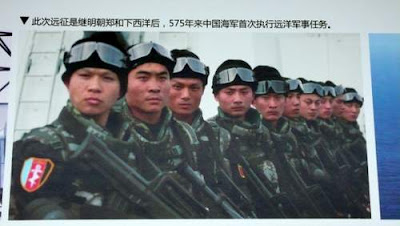
But, the following placard, in a museum, took the cake for the most unintelligible translation I have yet discovered, although the underlying gist of Chinese nationalism and cultural pre-eminence is unmistakable...

(In a rare move, by me, you can click on this image to see it larger, to read it in all of its glory.)
Sorry for being away, Gentle Reader.
I'll try to translate myself back through e-space to you, if you will still have me and come visit. And I'll try to make sense.
Tschuess,
Chris








 Posts
Posts