Wednesday, June 10, 2009

3WW (CXLI)

A blurred image of Hong Kong Island's skyline, lit up at night.Dear Gentle Reader,

Hello, again, from Hong Kong.

It's 3WW time, again.

This week (CXLI) the words are dangerous, keepsake, and restless.

Further, each haiku gets its very own American sentence title.


Those loves we dare not speak or name... ...will burst, roar out, be mighty, inflame...

Dangerous passions
held tight, close, like prized keepsakes
are restless; burst cages


A screed against maudlin materialism from a nihilist...

Keepsakes? Dangerous--
for restless men and women--
they'll hold your heart back.


Kobe earthquake, nineteen ninety-five, seven point two on the Richter scale...

restless bottles fall
keepsakes in Kobe totter
dangerous Japan


Tschuess,
Chris


Tuesday, June 9, 2009

On Division, or, an excuse to throw 10 haiku at you

Image of a plate of soft cheeses.Dear Gentle Reader,

Division, the process of dividing, is an odd duck.

In math, division makes things smaller.

Simultaneously, however, in biology, division makes things more numerous.

After all, division, as in meiosis, deals with the propagation of the species.

Similarly, though not identically, division, as in mitosis, sees the replication of whole cells, the propagation of a part; one mother cell becomes two identical daughter cells.

Division, like sex, can also lead to many challenges.

Seemingly sidling away from the topic of division, the Heroine, the Hero, and your humble scribe all love cheese, hard and soft cheeses both.

This hardly seems related to division, let alone problems.

Humble scribe, you may say, first, cheese is a mixture, not a separation; no division is required to make cheese, no, things are added. Second, you may say, if you like cheese, then cheese is hardly a problem.

But, gentle reader, you will, I am sure, concede that the hard/soft cheese dichotomy is clearly a categorical division.

And, on closer inspection, cheese is the product of physical division.

Yes, cheese is derived from a protein, fat, and water slurry, but, the special feature of cheese production is how that slurry is modified by dividing, and hence expanding, colonies of bacteria.

Division abounds and division is at the heart of the creation of cheeses (especially soft cheeses, where the bacteria at their centres, their hearts, are frequently most active).

So, where lies the problem?

The problem lies not in the creation of cheese, gentle reader, but in the division of the same.

For most cheeses, most people use knives to split cheeses, to divide them, to share them.

Almost all soft cheeses have to be cut to properly get to the fruits of their constituent bacterial guests' lives' labours, the steamy, fragrant divisional product of bacterial culture.

Now, usually, soft cheeses are cut into wedges prior to further division then consumption.

And, this is where the sexual problems of division begin, or, more accurately, the problems between the sexes, in our house, begin.

One divisional problem, portion equity, is well documented by that great Dane, Piet Hein (1905-1996).


SOCIAL MECHANISM (by Piet Hein)

When people always
try to take
the very smallest
piece of cake
how can it also
always be
that that's the one
that's left for me?

It should be noted that while Piet Hein was talking about (just) desserts, I believe that the same principle can be applied to cheeses.

After all, a savoury cheese platter may precede, follow, or even substitute for a sweet dessert.

It should also be noted that the Danes know whereof they speak, when they speak of division.

In the beginning, Danes acquired by dividing others' lands and things. They then amalgamated these divisions (from others' holdings) to their own holdings.

For a long while, the Danes never saw any problem with this.

It was when the Swedes started dividing Danish spoils, for their Swedish selves, that the joy of division was spoiled for the Danes.

(Here, one could note, is where Einstein's propositions on the importance of the observer, in physical dynamics, and relativity in general, make their application in social dynamics, long before Einstein was even around to observe or remark...)

Back to the present day and to the cheese.

Your Heroine, though of Northern European extraction, is relatively scrupulous regarding portion size when she creates fromage frontiers.

She steers clear of the Piet Hein Problem.

The Heroine's failing, from your humble scribe's perspective, is that she keeps the best parts for herself; she high grades; she takes the central part of soft cheeses.

The central part, the thin edge of the wedge, is, of course, where the bacterial culture, in soft cheeses, has had its strongest and greatest effects on flavour and on texture.

One must remember, though, that the Heroine is German; cultural high-grading is in her blood.

Germans love all things to do with culture; Goethe, Schiller, Cranach, Flanders, France...

Hurriedly skipping back to the cheese plate, your humble scribe has fulminated greatly on divisions, especially as a recipient of the outer, lesser graded sections of wedges of soft cheese.

So, today, I indulge myself and divide my thoughts ten ways to generate ten haiku along the simple theme of division.

For my pleasure, here they are:


If you take your cheese v. seriously...

divorce might be right
this separation? no good.
i want high grade too


Early biological classification

animalia
and vegetabilia
Aristotle's split

*** Humble scribe's note of the use of poetic license.

It was the great Swedish classifier Carl von Linné (1707-1778), better known by his Latinized name, Carolus Linnaeus, who divided living organisms under the specific descriptors animalia and vegetabilia. But, Aristotle (384-322 BC) did separate the world into animals and vegetables, too (and almost 21 centuries earlier).

Aristotle just did it in Greek.


Animalia

multicellular
soft cell walls and motile, too
heterotrophic


Plantae

multicell(s/ulose)
meiosis yields haploid cells
photosynthesis


Innie and outie

100 "k" "m"
lowest earth orbit that works
inner/outer space


Western expansion in the USA, where does it begin?

Demarcation, here.
one hundredth meridian
wet east/arid west


Peace, Order, and Good Government (POGG) versus Life, Liberty, and the Pursuit of Happiness
or, duelling values in constitutional residual clauses
or, communalism (community values) vs. individualism (individual values)

Canada: POGG (rules)
the forty-ninth parallel
US: U. Party


How China, with Hong Kong, or Macau, copies Canada's handling of difference...

deux cultures, un pays
je me souviens, mais oui...
two systems, one state

For the non-Canadian scholars, Canada not only has two languages, English and French, enshrined in the constitution, it also uses the continental legal system in its second biggest province, by population, Quebec.

Much of past-Prime Minister Brian Mulroney's testimony in a recenty inquiry was predicated upon a totally different legal regime than what Anglo Canada is used to, and I fear that these legal distinctions were lost on the majority of the populace judging by the polemical online comments on news articles posted in the national, public news media.

A further examples of demagoguery, in extremis...

Political religious divides on the great subcontinent

Hindu/Muslim split
partition '47
nation rent; two form...


*** Author's aside: I prefer this haiku orally when the "two" could equally be heard as "to"...


A division of colonial power alone

African land/lord
uti possedetis; change
lord not boundaries

And ten is more than enough, I am sure.

Tschuess,
Chris

Monday, June 8, 2009

My Town (as it is), by Pommes

Image of Pommes showing off his neck ruff.Dear Gentle Reader,

Your humble scribe slept like a log, last night.

A log harassed and harried by both a rabid, toothless beaver and a lumberjack without the requisite skill or understanding for his trade.

He, the humble scribe, is currently passed out. So, today, I will take you on a quick tour of my world.

First, though, I need to address some concerns that I have seen raised.

The humble scribe and the Heroine take adequate care of my needs.

Not brilliant care, of course, ...diet? Really. Salmon allowances could always be upped. But, certainly, adequate care.

When I came back from the clinic, they made me a lovely herbal tea and brought me flowers, although I eschewed the tea for my regular cuppa fish sauce.


Image of Pommes at the window, drinking, back home in Hong Kong.
Anyway, they try.

So, today, I thought that I would give you a very quick tour around my town which is this apartment, as the denizens of Hong Kong apparently eat anything with a back that points to heaven.

I asked to go outside on my own, and told the humble scribe that I would do this whenever locals came along...

Image of Pommes lying on his back.

The humble scribe then broke down the math on the numbers of people in Hong Kong, their prevalence in the streets, and the number of restaurants per block.

We both decided that it was best if I stayed in.

So, here is my world, at least the salient bits...

Here is my bed.

Image of Pommes' first bed.


Here is my daybed.

Image of Pommes's daybed, number one, from the floor.
Well, that is what it looks like from the ground. Supposedly it is a sofa or a chesterfield, but by the time I leap up there it feels just right for a daybed.

Here is a closer look... it's padded just right for settling down into...

Image of daybed number one, up close.
Image of Pommes on his second daybed.Here is daybed number two. I set the camera on timer, and gave myself a good half hour for a snooze, and woke up a bit disoriented.

This bed is nice, although the Heroine and the humble scribe hog it at night.

I could show you daybeds three, four, five, and six...

...But, I don't want to give you the wrong idea, so I might skip those, today.

Some people ask about the cuppa fish sauce.

(Miss Kitty? Dylan? Take notes...)

The daily cuppa fish sauce is what keeps my coat glossy and my physique rippling with good health.

Image of my favourite drinking glass.Actually, it is more than just a cuppa fish sauce, it is a cuppa liquid papyrus extract, just right for an ancient Akkadian writing cat, supplemented with essence of fish.

The humble scribe thinks that the fish are there to eat any mosquitoes that might try to breed in the tanks.

What bumpf.

The fish are there for the same reason there are worms in tequila.

Flavouring.

I like my water tasty.

Image of a water flavouring agent.
Now, don't worry. I don't eat these flavour sticks.

Nor the ones in the other rooms.

All these flavour sticks are too strong.

I prefer salmon.

Or, as salmon is not fresh here, koi.

Look at this smorgasbord I found the other day, on my way back from the clinic... I am hoping someone will take me here for lunch, or I start complaining to the readers... hint, hint...


Image of a pool of koi in a feeding frenzy... Pommes wished he were in the feeding frenzy, too...
Anyway.

I could show you more, my secret cave, the chemical weapons factory, or my favourite places to watch pigeons. But I'm a bit sleepy now, and bed number five is calling me with its dulcet siren call.

But, hopefully, this gives you an idea of my world.

Miao,
Pommes

Wednesday, June 3, 2009

3WW (CXL)

Image of an older man in Hong Kong.Dear Gentle Reader,

Hello, again, from Hong Kong.

It's 3WW time, again.

This week (CXL) the words are folly, hostile, and ordinary.

Further, each haiku gets its very own American sentence title.


What Truman Capote knew and wrote of; 'True Crime', of the heart, oh yeah.

Holly Golightly.
Folly, hostile, flighty; no
ordinary girl?


Thllee seasons only, fllom a deciduous leaf's life expellience...

Summer folly spring
In the ordinally way
with hostile fall, next.


Sigmund Freud oversimplified... Him or Me? That is the question, no?

Ego, 'Super', Id.
Ordinary folly, split...
Hostile in/a part.


Tschuess,
Chris


Tuesday, June 2, 2009

Hong Kong workers part deux; people's appetites must be fed (and Pommes...)

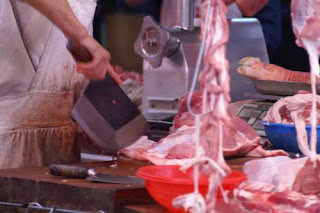
Image of a Hong Kong butcher's shop at a wet market.Dear Gentle Reader.

First, a continuation of worker shots from Monday.

Construction workers have to eat. This man helps.

Now, after that photo, pressing business.

Some of you have noted that Pommes has not appeared for a while.

Speculation is rampant.

Fear is rife.

It is time for me to end the speculation.

...

Definitively.

...


Image of a butcher in Hong Kong with a big cleaver.

...

.
.
.


Ashes to ashes.

Dust to dust.

We all return to what we are from...

...

.

.

.


Pommes was gone, but now has come home...


Image of your Hero, Pommes, on top of The Economist, May 30th to June 5th, 2009, edition. Close-up.
I trust this puts your mind at ease.


What.

You want more?

With Pommes there is always more...


Image of your Hero, Pommes, on top of The Economist, May 30th to June 5th, 2009, edition. Or is that a sheepskin.

Oh.

Wait.

Wrong photo.


Image of your Hero, Pommes, on top of The Economist, May 30th to June 5th, 2009, edition.
Ok. There you are.


The delay was caused by intellectual property rights issues.

Pommes was holding out for more salmon before he would permit me to publish his likeness on the site.

Last time he goes to a clinic; he comes back knowing too much.

Jailhouse lawyers.

Sheesh.


Speaking of trash, back to Hong Kong.

Lots of blue collar workers means lots of butchers and lots of restaurants.

And that means that lots of rubbish is generated every day.

And, with those rats, and the heat, and the threat of the Bubonic Plague, rubbish has to be dealt with quickly, every day, especially from the wet markets.

Here is another blue collar worker in Hong Kong.

A rubbish hauler.


Image of a rubbish hauler in Hong Kong.

And with that, I am off for the day, until 3WW tomorrow.


Tschuess,
Chris