Dear Gentle Reader,
Feeling lethargic? Torpid? Hebetudinous?
Overwhelmed by stuporous lassitude?
Listless and dull?
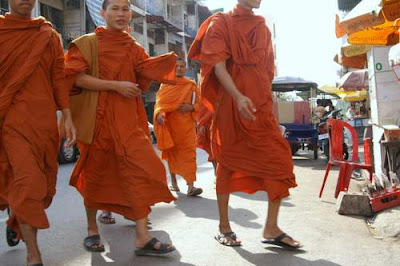
You, too, could be running on an empty tank, like the gentleman in the picture, above, on the streets of Phnom Penh.
Oh, for an empty tank.
I long for such a thing.
A nipple-grazing, body-hugging belly leaped out and attacked me last week.
I have no idea where it came from, but it symbiotically attached itself to my otherwise svelte body in a near-seamless grafting procedure.
This likely happened while I slept.
I woke one morning, and there it was.
The Heroine merely laughed when I asked where this monstrosity had come from.
So the exercise regime in the gym has increased (a fancy word meaning begun) and the weekend was spent rock climbing, cliff-jumping, and swimming in the ocean all in the noble effort of both leaving the Heroine to study in peace and quiet for some upcoming exams and trying to convince the torpid belly that it had attached itself to the wrong body.
Oh, and food intake has stopped, or dramatically diminished.
If I can't work the belly off, I'll starve it off.
So, empty tank?
I know whereof I speak.
And, vaguely related, what happens if you are driving in Cambodia and run out of gas?
You pull over at the side of the road.
And buy a bottle or two. Of fuel.
You don't "fill 'er up" because that is likely not in the budget, but, you do what you can.
This is the gas stall attendant in Cambodia filling up the "tanks" which she then sells to customers.
As you can see, very little infrastructure is required for this gas/petrol station.
The owners of these stalls have low overheads. They don't need underground tanks or fancy pumps.
They also don't need to worry about, or plan for, environmental remediation, because they are not tied or even linked to the land that extra gas spills upon.
This attendant just fills up a Johnny Walker bottle with gasoline and sells it to a scooter or taxi driver.
The driver pours the contents into their tank, immediately, and hands back the bottle. (The driver pours the fuel in so that the driver, alone, is responsible for spilled fuel.)
The owner/attendant may put the empty into the rack to be refilled or she might hand the bottle to her infant child to sniff and play with.
(I could not bring myself to take a picture of that. Taking the bottle from the child, I even tried to explain why this was a bad idea to the stall attendant, but she spoke no French and I spoke no Khmer. And she gave the bottle back to her little girl...)
Eventually, the attendant refills her bottles, again, from her reservoir tank...
As an aside, Cambodia has some of the best environmental laws and regulations on the planet.
I didn't draft them, but I know folks who did.
Civil society projects have helped them draft great worker safety and health standards, too.
Cambodia has some of the best environmental laws and regulations on the planet; but they aren't enforced very often.
They tend to be trotted out only when a joint-venture or foreign enterprise is making too much money and somebody wants a bigger cut.
Then infractions matter...
Of course, this cheap, private-sector provisioning of fuel is not just a health and environmental hazard.
It also puts money directly into the pocket of the stall owner so she can put food into the mouths of her children.
This cheap, private-sector provisioning of fuel is also a great way to effectively and quickly allow for increased transport and logistical provisioning in Cambodia.
Taxis and scooters get goods in and out of regions, quickly, which yields increased economic activity and better living standards, eventually, to workers.
Medical services and medical supplies are also delivered faster when roads, engines, and fuel are all available--and these service centres are cheap to set up; anyone can do it.
So what is right and what is wrong?
I'm running on empty, still, so I leave that to you to answer, but, where are the moral dichotomies in your town, this morning?
Tschuess,
Chris

 Dear Gentle Reader,








 Posts
Posts