Showing posts with label French. Show all posts

Tuesday, March 17, 2009

Ugly American was not intended; an explanation

Image of a Bank of Hell banknote; I am worried that people will view your humble scribe the wrong way and cast aspersions of nationalistic vitriol, withdrawn from the Bank of Hell, on your humble scribe based upon yesterday's posting...Dear Gentle Reader,

Mea culpa.

I wrote some long notes to yesterday's post

But, just as I know that very few roll their mouse over the images to see what messages or titles I have left, almost nobody goes back to look at comments. 

So, I will repackage them because it is important.

Yesterday's post could be seen as an easy attack on three self-centered Americans who happened to be girls. Classic ugly Americans in action. That was not my intention.

The post was meant to be a sardonic look at the actions of three young people, three young girls, who happened to be American.

The posting does me no credit as I had to have an Oscar Wilde line at the end; I couldn't just walk away. 

But, I feel worse if people think I harbour anti-American sentiments.

So, I will risk further assaults on my character and revisit yesterday.

In yesterday's post I meant to highlight the profligate silliness, obtuseness, and self-centered nature of youth (compared, of course, to the foil of my helpfulness, reasonableness, and cleverness.)

First, ugly Americans do exist.

As do hooligan Brits, lager lout Dutch, culturally self-centered and self-righteous French, towel-wielding beach-reserving Germans, et cetera. And snide Canadians, too.

There are, statistically and in my experience, almost as many ugly Canadians as ugly Americans.

But, thankfully for Canadians, there are ten times more Americans than Canadians, which skews the number of ugly Americans as opposed to ugly Canadians that other countries' citizenry get to meet.

Then, we can further skew the ratio because more than ten times the number of Americans, compared to Canadians, have the disposable income to send their kids, or themselves, abroad.

That results in more than the 10:1 ratio of ugly Americans:ugly Canadians abroad that you would expect.

And the ugly idiots always stand out, if only for their idiocy and ugliness. 

Everyone remembers the idiots; their impacts crowd out the memories of the lovely people. 

Now add international resentment to the USA's wealth and power... 

Still, today, a vast amount of the world's GDP (GDP is Gross Domestic Product--the total value of all final goods and services produced with the national borders of a political economy within a particular year) is generated inside the USA. 

Yes, the EU generates a similar GDP, but that is the entire EU... not just one country... (The EU is the European Union whose countries now include all of Western Europe less Switzerland, all of Northern Europe less Norway, all of Southern Europe, and most of Eastern Europe...)

I just crunched the numbers. 

If we use 2007 IMF (International Monetary Fund) numbers then the US produces 25% of world GDP and the EU produces almost 31% of world GDP.

If we use 2007 World Bank numbers then the US produces 25% of world GDP and the EU produces 22% of world GDP.

If we use 2007 CIA world factbook numbers then the US produces 18% of world GDP and the EU produces 24% of world GDP.

Whichever numbers you use, the US is wealthy. 

This wealth provides the US federal government the ability to fund military and economic activities to create and project power.

The USA is still the only global superpower as it has been from the end of the cold war to today. 

It still is the world's policeman, and it struts accordingly, some days. 

It has also taken on the role of the world's judge through the doctrine of extra-territorial jurisdiction which is the US doctrine that US laws apply anywhere and everywhere... ...a bit of a slap in the face to the sovereignty of every other country on the planet.

So, people like to latch onto the idiots and tar the rest with their cultural misdeeds. It allows people to feel better, nationalistically, when innately comparing their country to the might, power, and wealth of the USA.

It's too easy to make fun of the ignorant few. 

Hence my big mea culpa, today; I do not want to be considered anti-American.

I am just intolerant of fools, no matter what their nationality.

I had not intended to raise the spectre of ugly Americans in yesterday's post, I was just poking fun at three vapid, self-centered young girls. 

And, heck, they were likely exhausted, jet-lagged, culture-shocked, and unprepared to hear people tell them hotel rack rates in dollars in English and they might have been confusing the HKD prices with USD prices. 

The ten dollar (USD) per night hell holes in Chungking Mansions might have been interpreted by them as 78 USD per night, instead of the 78 HKD per night that would have been meant when the reception staff would have leered and said "78 dollars, Missie" to their breasts.

What bothered me about the three girls was the way they were trying to control me with orders and their gravity-defying breasts. And the slyness of the looks they gave each other when they thought I had given up some state secrets of housing to them...

Tschuess,
Chris

Monday, February 16, 2009

The portcullis and other modern conveniences

Image of a portcullis in a gate, from the backside, from the Palazzo d'Accursio, Bologna, Italy. This image was taken by Georges Jansoone and is used with permission, from Wikipedia Commons under a GNU Free Documentation License, Version 1.2 or any later version published by the Free Software Foundation; with no Invariant Sections, no Front-Cover Texts, and no Back-Cover Texts. (I think I can put this as an alternative title and a mouseover title, otherwise, how do I credit the photographer?)Dear Gentle Reader,

How often do you see a portcullis in modern buildings?

The word portcullis is derived from the old French porte coleïce, meaning sliding door.

A portcullis is suspended in the air by a counter weight; it's a rapid-response defensive mechanism that falls into place when the restraining force of the counter weight is removed.

When enemies approach, the portcullis is dropped to obstruct the ingress of attackers.

A portcullis is heavy so, when dropped, it's an impediment to enemies attempting to access the castle's keep.

This part of the portcullis' task, forming an obstruction, or a blocking door, against attackers, is where the 'porte', or door, part of the portcullis' name comes from.

The fact that the portcullis slides vertically, downwards, into place is where the 'coleïce', or sliding, part of its name comes from.

The porte coleïce, or portcullis, also doubles as an offensive weapon; it may impale some attackers underneath its heavy, iron-clad oak or metal frame.

Once dropped, it also keeps any enemy attackers inside the castle's keep from escaping so that they can be slaughtered by the defenders at the defenders' relative leisure.

So where would you see one of these babies today, in a modern building?

Would you even see one today?

While you are thinking, let us move to my town, Hong Kong.

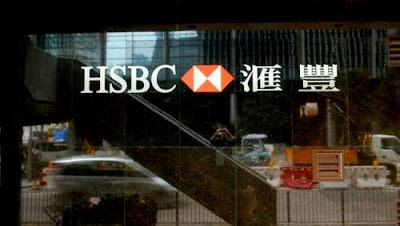
Image of HSBC's ubiquitous logo set into the marble cladding on a regular HSBC bank branch in Hong Kong.
HSBC is the shorthand name for the Hong Kong Shanghai Banking Corporation which was founded in Hong Kong and Shanghai, in 1865, after the second Opium War.

HSBC was founded to fund trade (especially the burgeoning and lucrative opium trade) and its flagship operation was in Hong Kong.

HSBC was well-capitalised and held a lot of cash.

As HSBC was so well capitalised and so well connected in Hong Kong, that gleaming bastion of swashbuckling privateer capitalism, HSBC won the contract to be the central bank for the colony of Hong Kong.

Not only did HSBC offer private citizens, and joint-stock companies, the opportunity to bank with them, and not only did HSBC have the right to print the bank notes for the colony, but HSBC also held the colony's money for the British Crown.

Image of HSBC's (Hong Kong Shanghai Banking Corporation's) flagship headquarters and banking centre in Hong Kong, seen towering over the old Bank of China headquarters beside it on the left of the picture.Not a bad job; I am sure it paid well.

Of course, the security had to be tight.

Let's take a selective look at the third generation of the HSBC headquarters in Hong Kong, the one built from 1979-1985 by Sir Norman Foster. This is the current HSBC headquarters in Hong Kong.

(Aside: Your humble scribe notes that, after the handover of Hong Kong from British to Chinese control in 1997, he does not believe that HSBC remained the central banker to Hong Kong.)

Still, what high-tech, ingenious security solutions would HSBC's flagship Hong Kong headquarters, the most expensive building in the world, when it was built, incorporate into its design?

First off, HSBC made it a lengthy procedure for crooks to get to the money.

Anyone going to a banking floor, and anyone coming down, has to go up (or down) two very long escalators that go up two stories.

(Or take the heavily guarded elevators that can be locked in position with the would be burglars inside...not such a good idea to use those...)

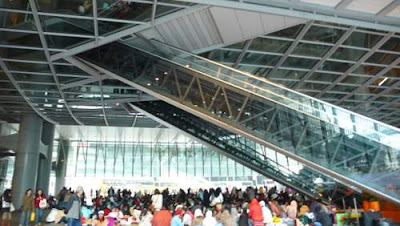
Image of the escalators and the glass barrier separating the banking halls from the foyer down below in the main foyer of the flagship HSBC branch in Hong Kong.
Supposedly these escalators are angled to make the geomancers happy (the gentlemen who work out the feng shui of the building).

These escalators may be positioned with geomancy-friendly angles... They also slow would-be robbers down and isolate the points of ingress and egress to and from the bank.

Further, you can see that burglars cannot set up trampolines or rappel out quickly with ropes after robbing the joint (retail banking starts at the top of the escalators) because what should be an open atrium has been covered with a floor of thick glass...

(For those of you who worry that this glass partition cuts up the interior space, don't worry. There is an eleven floor atrium above this glass partition.)

This building is nothing if not glass and transparency... so where is the security?

Stop, and look down.

Image of piece of sturdy stainless steel set in the ground.
What could that be for?

And look up...

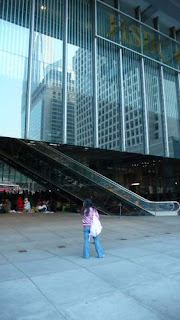
Image of the exterior of HSBC's HQ and main branch in Hong Kong.
OK. That is not too useful.

Step forwards again, into the light, and away from the building...

Image of something in the ceiling of the main foyer of the flagship HSBC branch in Hong Kong, as seen from outside the building.
Hmm. There seems to be something up there.... Something metallic, but there is too much glare from the glass. Let us try looking up from inside.

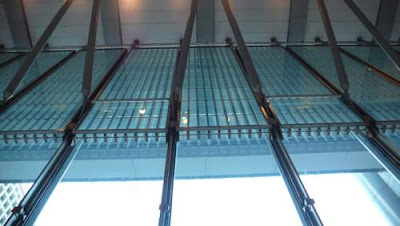
Image of something in the ceiling of the main foyer of the flagship HSBC branch in Hong Kong, as seen from inside the building. It's a stainless steel portcullis!
There you have it.

See that stainless steel grate? That is the portcullis.

Rob HSBC Hong Kong and the portcullis drops down, locking you inside the building until the police arrive.

Image of police vehicles in Hong Kong.
Maybe you'll even be impaled, in which case you ought to continue waiting for an ambulance.

If you know of other, normally archaic architectural features that are used in modern buildings, your scribe would love to know. Welcome to my town...

Tschuess,
Chris

Friday, December 12, 2008

Revenge is best served cold...

Image of a plate of sauteed tarantulasDear Gentle Reader,

Your fearsome scribe is back from Cambodia.

What is that picture, you ask?

Success.

Success in the ongoing struggle against the spiders of the apocalypse (first encounter in Taiwan here, Hong Kong encounter here).

Success was had in Cambodia.

This time, the spiders lost...

After Wednesday's post on bouillabaisse (updated in the comments section to deal with the base of French bouillabaisse) your humble scribe considered a post on one of his culinary heroes.

Who would these be? Chef Carême, Chef Brillat-Savarin, Chef Denis, and Chef Chanavat, of course. 

Antonin [Marie-Antoine] Carême, 1783-1833, or Chef Carême, was a brilliant sauce maker and pastry chef extraordinaire. 

Carême was both the founder of classical French grande cuisine and the Chef to, among others, Charles Maurice de Talleyrand-Périgord, 1st Sovereign Prince of Beneventum, better known as the Prince of Diplomats, and the father of gastronomical diplomacy...

Jean-Anthelme Brillat-Savarin, 1755-1826, or Chef Brillat-Savarin, was the author of the splendiforous Physiologie du goût ou Méditations de gastronomie transcendante, ouvrage théorique, historique et à l'ordre du jour, dédié aux gastronomes parisiens par un professeur, membre de plusiers sociétés littéraires et savantes. (I admit to only reading it in translation, and I cannot even find that these days.)

The eponymous Denis (Lahana Denis), 1909-1981, of Chez Denis was motivated to cook by his love of food. 

My favourite line of Denis', when responding to jibes from chefs from poorer backgrounds who felt that he had parachuted in at the top, was "I have eaten my way through six inheritances in the great restaurants, so I know what good cuisine is all about." 

I only wish. 

Heirs and heiresses who want to learn how to eat, and spend an inheritance or six, contact me now...

Chef Jean Chanavat is still alive, and his age will remain a mystery. Stolen from France by the Swiss, Chef Jean worked his magic in Geneva for years before stealing away, himself, to Ticino. 

Now retired, Chef Chanavat still works his traditional magic and has been known to share secrets with the very lucky... among whom your scribe counts himself.

Instead of writing of French chefs, your humble scribe will write about our last dinner in Cambodia because it is closest in memory. Success has a habit of staying with you, sometimes.

Your scribe admits that spicy, sauteed tarantulas may not be the height of French gastronomy, but, like Carême, I also am a devotee of foreign cuisine.

Image of your humble scribe eating a tarantula
These tarantulas were cooked a bit long; two had overly chewy legs. 

The tarantulas were also a bit big, which meant that their bellies were too bitter for your scribe to really enjoy, but the first tarantula had a lovely, delicate woodland flavour with deeper, meatier tones and hints of floral, acidic notes high up the palette in fleeting after-tastes.

Also, tarantula feet stick to human tongues like burrs to a sweater on a walk through the woods... an intriguing sensation, to say the least.

Combined with a peanut-based dipping sauce, with notes of galangal, Thai basil, and the lightest touch of hot pepper, these tarantulas were a lovely first course.

Your Heroine did not approve. 

Apparently fish, cheese, and egg eating vegetarians like her avoid spiders. 

Go figure.

Having a vegetarian wife is probably why I never had poulet demi-deuil in Lyon, France, one of Lyon's most famous dishes. I could not justify the expense if I could not share the delicacy with her. 

Poulet demi-deuil, or half-mourning chicken, is cooked with white and black ingredients... white chicken flesh, a white suprême sauce, and contisés avec les truffes (encrusted with black truffles).

But who knew that a vegetarian would avoid spiders on the table?

As you, my gentle reader, know, I generally avoid spiders, including ones found on the table--unless they are cooked.

Wisely, I think, I refuse to cook the blighters myself. 

More accurately, I give live spiders of the apocalypse the proximity that they deserve. At least the length of a broom, if not a room.

But I am quite happy to eat them, after they are cooked.

Thank goodness I am an omnivore, I say. 

Thank goodness I am too paranoid to cook tarantulas, dinner guests say.

The tarantula first course was followed by a pumpkin-squash and Tonlé Sap freshwater fish prepared Amok style with a light coconut green curry. 

The fish was an unknown fresh-water white fish with firm flesh, not oily, and with very few bones. Its actual name, in English, Khmer (Cambodian), French, or Latin remains a mystery. 

Your scribe thoroughly enjoyed this dish, but your Heroine had had enough of Cambodian fermented fish sauce by now.

Your scribe notes that your Heroine might as well have said that she was tired of Cambodian food by now, because almost everything there is flavoured with fermented fish sauce... 

Melamine in China, fish sauce in Cambodia...

Next came a jackfruit and green mango salad, followed by a deep-fried taro root spring roll in, essentially, a bed of ultra-fine Cambodian coleslaw with a vinaigrette heavy on the vinegar and with maximal cane sugar dissolved along with crushed and lightly sauteed hot red peppers.

Mmm. 

I doubt the rest of the menu needs a great deal of flavour explanation, but the tarantulas deserved their own paragraph.

Enjoy your day and try not to dream of tarantulas coming back from the dead in your belly, while you sleep... mmm, zombie spiders of the apocalypse...

Tschuess,
Chris, Regina, and Pommes who wonders when we can share. 

Wednesday, October 22, 2008

Swiss cow belles

Image of the partial coat of arms of the Canton of Geneva, Switzerland for is flag from the Wikipedia Commons
Dear Gentle Reader,

Maybe I should round out my comments on the Swiss and on the remarkable bravery of one particular Swiss which I made in a previous posting on spiders in Hong Kong.

Originally, the Swiss were fighters. 

There was nothing to do in the mountains, so they fought.  

They thought it was hard to sell their cheeses, so they sold their men as mercenaries, and they were good. (The men. The cheeses were pretty good too, but they hadn't made a market for those, yet.)

Actually, the Swiss were too good.

In the end, everyone hired Swiss pikesmen to be their mercenaries, until a particularly violent battle where the main contestants on both sides were Swiss mercenaries, hired from the same villages, and the Swiss overlords said "Enough".

So the Swiss ceased being fighters and, eventually, the Swiss became lovers.

Not as quick as the English... ...not as good as the French... ...but, lovers nonetheless.

Of course, what the Swiss loved were cows.

And bear in mind, that I am not talking about Swiss belles, who are very belle indeed.

While much could be said about the Swiss predilection for money, much more should be said for their enjoyment of cows, and things that come from cows.

Namely cheese and chocolate.

(Though some could say that their thirst for banks, corporate headquarters, and OPM (Other Peoples' Money) is also an offshoot of their love for cows, in this case, cash cows. Hmmm...)

One of the biggest holiday festivals in Switzerland is their cow belle festival.  

This is the festival to welcome home the cows at the end of summer.  

In spring, Swiss cow belles (and bulls and heifers too) climb into the alpine meadows with their cowherders and cowherderesses, looking for love, tender shoots of grass, and alpine flowers.

At the end of summer they return to their home village, sated in every regard.

Here is a quick clip showing a typical, wild, Swiss party... when the cows come home...


What fine flanks. Such luxurious tails. And what great, big bells.

But, again, the reason that the Swiss love these cows is not for their fine physiques, it is for their milk.  

For Swiss cow milk can be turned into Swiss cheeses and Swiss chocolate now that the markets have been made.

Below is a traditional folk dance and song detailing the love Swiss have for their cows, and how everything else must be relegated to obscurity, even dreams of being troubadours, as the Swiss abandon everything else to go to their cows, their lovely and much loved cows, and put their cows into their fields.  

I note that this traditional Swiss folk dance and song is in French, and is a bit long. No need to watch the whole thing.  Your humble scribe will not know, so no embarassment will ensue... But, catch the leg movement.  You can see how this might predate those interesting Bavarian feet-slapping, knee-knocking moves...


Hopefully I have now given you a fuller and more accurate understanding of traditional Swiss culture, dance, and their bovinephillic society.  

(For clarity, as Swiss slang (aka Matin Bleu Editorial French) is a tetch bit on the hard side to understand, "fokj' rentre les vaches" is actually "Il faut que je rentre les vaches" which means "I have to take the cows back to the stable/field" although in popular parlance it means "I have to go".) 

(The French-speaking Swiss have obviously been taking spelling lessons from the German-speaking Swiss to come up with "fokj'". The German-speaking Swiss, of course, take spelling lessons from no one--and they really ought to not give any lessons either...)

Fuller posts on Swiss cheeses might arise from time to time. It depends on the predilections of the muses when they visit your humble scribe. But your humble scribe has been told to keep post-lengths down, so they cannot fit in here.

But this still does not explain to me why Fab was so unafraid of the giant death-spiders of Hong Kong. I still have no idea how this fearlessness could be so. 

It baffles me.  

Fab must have the blood of mercenaries running through her veins.  

I have it on good authority, hers, that Fab was out hunting wild mushrooms just the other day with the inimitable Jean, Chef Extraordinaire et Pére to the redoubtable Fab.  

And everyone knows how tricky hunting wild mushrooms can be.  

Ferocious little beggars; one wrong bite and you could be a goner. 

So maybe Fab's feckless fearlessness of poisonous spiders comes from her history of hunting down wild (not tamed, domesticated, or farmed, mind you, but wild...) mushrooms.  

Maybe.

For those that are interested, here are the only pictures that your scribe can find on his hard drive from our life in Geneva, hiking in the mountains, visiting alpinage festivals (the return of the cows) and so on and so forth. Two portraits of your humble scribe and the fearsome warrior Fab are found, on the back balcony of our flat in Geneva, and one portrait of your heroine. The tag lines (as always, run your mouse over the images) tell the full story.


Picture of feet lounging on a balcony wall in Geneva with a carafe of wine and some plates visiblePicture of Regina pouring herself some wine on the balcony in GenevaPicture of Fab and Chris' torso visible on the balcony in Geneva


Tschuess,
Chris, Regina, and Pommes (labouring to open a bar of Toblerone in the back room)

Thursday, October 9, 2008

How Hero Pommes (mit Mayo) received his name

Image of an elderly Uighur gentlemen sitting outside the mosque in Kashgar, Xinjiang, China

Hello Gentle Reader,

A couple of you have made bold stabs at your Hero's, Pommes', name, in vain, and come to the conclusion that he is "Apple".

But you might be wondering why Pommes would be mit (German for with) Mayonnaise (Mayo in German) as per the subject line in today's e-pistle.  

(Well, not if you have been to Japan.  Everything can be had with mayo in Japan (Kewpie Mayo, to be precise).  From octopi to mice, Kewpie is King, but that is a digression best left for another day.)

...So, a couple of you have put one and one together (your scribe being Canadian and therefore English/French bilingual (?! hmmm...) and Geneva being a French-speaking Canton, to determine that your lovely hero Pommes was named Apple because Pommes is French for apple, so you might be rightish.  

But Pommes, besides being the apple of our eye, is an apple of the earth, a potato-head, pommes de terre in French (technically, pommes de terre is only a potato).  

Pommes Frites are what the French call fries (or what the English call chips), and England (plus China) is where your heroine did her undergraduate studies and her graduate work.  Image of cut and deep-fried potato strips

Furthering the confusion, in Germany, after previous cultural exchanges, like Alsace and Lorraine, the avuncular Germans have sort of developed an understanding of the French.

So the Germans call fries/chips "Pommes" and it is pronounced in Canadian English very similar to "pumice", as in the stone.

So what, Scribe?

Well, in Taiwan, where your heroine and scribe met, they had an Italian cat named "Chips".  

When your heroine and scribe had returned/moved to Canada, a new cat bought the rights to your heroine and scribe.  

Regina wanted to call the new cat Chips too, or Chips 2 (it was verbal and therefore ambiguous).  

Your scribe thought that this was outrageous, an egregious suggestion; "You can't name two animals the same name, even if you use numbers for differentiation" exclaimed your scribe.  

"Why not?" pouted your heroine, "I had Dini and Dini too (2?) before I met you..."  

Well, you will doubtless be reassured to know that your scribe asserted his manorial rights in feline naming. Your scribe declared that under no conditions would any hero cat be called Chips...

Your heroine, recognizing the power of the pen, dutifully acceded to the wishes of the all-mighty scribe.

She then suggested "Pommes" as a name.  

"What an unusual name; I like it!" said your scribe in a pleased, magnanimous, and surprised acceptance. Your scribe did not look a gift horse in the mouth, he was just pleased to have won.  But the gift horse was Giftig (German for poisoned)...  

The next morning your scribe realized his error, remembering that Pommes was German for Chips, but it was too late.  

So that explains Pommes' name for you, Gentle reader.

Tschuess,


Chris, Regina, and Pommes (mit Currywurst)

Postscript: A couple of you have wondered why your Heroine is called Regina.  That's easy, because, of course, she is the Queen.