Showing posts with label Egypt. Show all posts

Wednesday, February 17, 2010

3WW CLXXVII

Image of a bouquet of roses, made from some foamed plastic, with glowing snippets of fibre optic cable sticking out. This image is titled 'Alien Bouquet hot from Victoria Park's Chinese New Year Fair (Hong Kong, 2010)'Dear Gentle Reader,

It is 3WW. Again.

Not so much love for my loose id postscript for last week's 3WW, but I take what I get, and I did like what I did receive. (What a suck, no?)

Anyway, thanks are due to Thom, as usual.

This week the 3WW word prompts are occur, ragged, and tidy.

As usual, I present three haiku/senryu, each with an American Sentence title.

So, let the games begin with occur, ragged, and tidy....

OH! You might note that I have gone with aural interpretations of the words, and visual sleight-of-hand, too, just for fun. (Mine.)

And, lastly, the Heroine of this site recommended that folks read the green explanations under two of the poems... ...and, without further adieu...


William shakes fist, spear; shivers the air with his tempestuous anger...

Oh cur! Oh ragged
Cur! Hang cur! Hang you whoreson...
[Tidy curse for foes!]


**The Tempest, Act 1, Scene 1
Antonio: "Hang cur! Hang, you whoreson, insolent noisemaker!"
William Shakespeare (1564-1616)


In soft, modern days and ages the old lives on, even if not here...

(D)ragged over thresholds--
out of tidy home to hell;
forced weddings occur.


To test his theory the new priest undressed her, removed her rags, and then...

Tidy ochre scraps
swept into neat piles by priest.
D-ragged... ...Mummy gone...


**Mummies, those fabulous Egyptians whose bodies were rendered less mortal, ultimately derive their name from bitumen, a heavy petroleum product, once worked into devotional art by the Medes, early Persians, and by others.

It was believed, from the colour of the preserved corpses, that bitumen, mum in Persian, thence mumia in Latin, thence Mummy in English, had been used in the mummification process.

The modern priestly caste, sometimes known as scientists, de-ragged, or removed the wrappings on the corpses--the Mummies--to check, and found no trace of bitumen in the Mummies' corpses.... so, linguistically, the Mummy was a Mummy no more (no bitumen).


Tschuess,
Chris


PS. As an aside the baroque musical style 'Ciaccona', possibly more familiar to most through its French name, chaconne, always reminds me of modern dance music; it has a driving bass line with a series of short harmonic variations which dance around that beat. I enjoy dance music (I enjoy dancing) and tend not to be too epochcentric... Hopefully some of you will enjoy this selection.

(Admittedly, the beat per minute rate of this Ciaccona is slower than most modern dance and electronic music, but most ravers and dubsteppers are wearing clothing easily weighed in micrograms, not the kilograms of baroque outfits, not to mention those Lady GaGa-esque baroque wigs...)


Tschuess,
Chris


Monday, July 13, 2009

Architectural aspects in a state of police, if not in a police state...

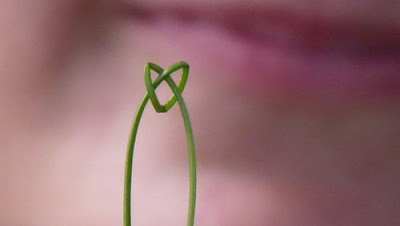
Image of a shoot tied in a knot.Dear Gentle Reader,

The police state bit comes lower down in today's post.

Bear with me, please.

I am still a bit tied up in knots (the Heroine sends her love, though, as seen in the picture) and I will explain my recent e-absence.

First, the Heroine and your humble scribe are back in town.

That is a blurry Heroine in the background.

She is all smiles, as you can see from the photograph.

I am still all grimaces.

Sorry for the delays; I have no recollection of typing up that haiku after surgery a couple of weeks ago--I wouldn't normally post about that stuff.

Surgery, that is. It seems to me that nobody else would be interested.

But, I don't know why, but some of you seem to want some info.

Yes, I have just received your emails.

Thank you very much for your concern.

So...

Some complications set in after I wrote haiku under the influence and out of consciousness.

The surgery was simply a highly invasive checkup (45 internal biopsies! Plus extra things!), but it wasn't that big a deal.

The bad things the specialists feared were not found.

They (the specialists) just couldn't explain what they did find.

All is neither better nor worse, and I am relatively happy with the status quo.

Things, after all, could be much blacker.

For the politically correct legions out there, black has been correlated with the opposite of life, goodness and health in every major religion and mythology that I am aware of, including most African mythologies and religions.

I do use the word most, because, of course, there is one great exception which is also located on the African continent.

That exception, of course, is found in the resident Gods of the mythologies of Egypt, particularly of the lower Nile (the region around Cairo and Alexandria).

There, the black banks of the Nile yielded fecundity and fertility and life.

Benevolent Hor, or Horus, the sky God, is black and his opposite, his nemesis, is Seth.

Seth is red and, throughout the Egyptian Empire, red was associated with the burning, inhospitable sands bordering the life-giving black banks of the Nile.

Anyway, enough self-justification for saying that things could be blacker.

There is much life flowing through your humble scribe, and I am not in denial.

From your perspective, no worries, I am back in the e-saddle and looking forward to both e-writing and e-reading.

So, seeing as how the doctors found nothing particularly vile and unpleasant to tell me, merely unfortunate and importune news, off we all went to China as we had previously decided to take my Dad and another house guest to Yunnan Province, China.

Let me tell you, though, just in case you might not have suspected it... recuperating from surgery during a cross-country jaunt in rural China is not exactly restful.

Also, I would have posted from China, but even when I found Internet access, I could not access my blogger account.

I had no idea why, at the time.

Now that we are out of China, and know all that is happening in Xinjiang, we know why I couldn't access my accounts.

Maybe I will post at some point in time on past trips into Xinjiang.

Lovely part of China.

Lovely people.

Fearsome repression, and that was in the police state that existed in Xinjiang then...

I shudder to imagine it now.

Being back in Hong Kong, now, I am meditating a bit on the nature of the police state. I might well start posting, but my natural reticence is still high with regards to China.

My thoughts did stray, however, to the nature of civil liberties and police states in other places.

Where did my thoughts stray?

Well, I thought of the degree of e-invasion of official, state-installed, closed-circuit cameras in "good, old England".

England, of course, once released a black slave held on an American trading ship which merely docked in an English port.

This, of course, was after England finally criminalised slavery.

The judge freed the slave as he had been in a safe harbour and he determined that England's freedoms had attached themselves to the slave and had transformed the slave into a free man.

Great concern had been raised, during the trial, regarding the international repercussions of the freeing of a person that was seen as a thing, specifically a person seen as an American chattel stored continuously on the vessel flying the flag of a sovereign state, the American flag.

Despite the dire warnings and imprecations delivered through the defense trial lawyer, the judge said, in his decision, "fiat justitia ruat coelum". Translated from Latin the judge said "let justice be done though the heavens (or the sky) may fall".

The power of civil liberties, then, in England, were such that those civil liberties would accrue to a poor, huddled misery that was a man held in indentured slavery. Further, those civil liberties released his shackles.

Now, those same civil liberties have been sacrificed on an e-altar of security, safety, and video surveillance cabling.

That is one architectural illustration of a state of police, if not a police state.

The architectural element here is, of course, the closed circuit television camera.

Another architectural element found in a state of police, albeit more metaphorical, would be the structural wood in the American edifice of criminal justice.

Wood from the forbidden tree.

The famous caveat to the use of evidence gathered by the state in criminal prosecutions via illegal search and seizure law, in the United States of America, is the use of the fruit of the forbidden tree.

This relates to the state's inability to use, in court proceedings, evidence, or fruit, which was unlawfully obtained--which came from a forbidden tree.

This exclusionary doctrine was first developed in Silverthorne Lumber Co. v. United States, 251 U.S. 385, 40 S. Ct. 182, 64 L. Ed. 319 (1920) and was fleshed out, with the famous "fruit of the forbidden tree" tag line, in Nardone v. United States, 308 U.S. 338, 60 S. Ct. 266, 84 L. Ed. 307 (1939).

But, metaphorical architectural elements do not produce good pictures, except maybe in the mind's eye.

So, finally, and still shying away from China, which actually is a police state, and its use of force in Xinjiang, I think of home, today.

Hong Kong...
Image of a concrete turret in Hong Kong.
Wherever this is, it certainly looks well fortified.

This image comes from Stanley Village on the backside of Hong Kong Island.

This image is repeated at each corner of the Stanley police office...

Image of the Stanley Police Office, Hong Kong.Many police stations in Hong Kong are this fortified.

One does not just enter a police station, here, to make a complaint or to bring cookies.

Presumably there is a reason for these extra architectural pillbox/garret/turret elements...

And Hong Kong is not a police state.

Although it does have a lot of police, and a lot of quasi-police in various other branches of the state, and a lot of state-sanctioned closed-circuit television cameras.

And, Hong Kong also has a lot of private security...

Group 4 Securicor, a private security company, has over 4,700 security officers in Hong Kong and there are about 900 other licenses issued in Hong Kong for other private security companies...

Anyway, those are some architectural details (cameras, metaphorical wood, and fortified garrets) found in states of police, if not police states.

In absolute police states one just sees things like this...

Image of a tank...
While these mobile units are not architectural aspects, per se, they make very short work of architectural units. Even Hong Kong garrets.

And dissent, too.

Tschuess, all.
Chris


PS. That previous post on the signal tower in Hong Kong? That was just a draft I had started to work on, and it went up without any further input from me. Sorry about that one, folks, it was still to be worked on and escaped from the lab...

Friday, April 3, 2009

The wondrous number seven...

Image of the Kreativ Blogger award. Origin unknown. Presumed to be in the public domain as it has been shared notoriously.Dear Gentle Reader,

The lovely Floreta, of Solitary Panda, has bestowed an award (!) upon your humble scribe.

An award with dubious spelling, true, but many is the time that my comments have included dubious spellings--ooh, that slip between the mind and the fingers. 

(Aside:

That, your humble scribe shares, is the true purpose of slip, that slick, clay/water/deflocculant suspension, sometimes with bentonite, used conventionally to join bits of clays or to paint some ceramics or to make castings. 

Slip fills in, and serves to erase, cuneiform slips of the stylus in the heavy, clay tablets.

Mind you, it works horribly on computers. 

It gums up the keyboards and smears up the screen... although I could not see the e-slips for want of the dried slip, for a while, at least.

That was also the day I learned that you were not meant to really boot, let alone re-boot, a computer. Who knew? 

Far less sturdy than tablets. 

Image of cuneiform written on a tablet, from the public domain, sourced from http://karenswhimsy.com/cuneiform-writing.shtm

But, I digress.)


I am to list seven things I love.


Seven? That is a lot of things to list...


Fine....


1. I love words. 

Take the word seven, for example.

Seven is short for 7. 

Well, I guess seven is long for 7, but it represents the word seven.

Septem in Latin. 
Sedmi in Old Slavonic. 
Saptá in Sanskrit. 
Septm in Indo European. 
Sebun in Germanic. 
Sibun in Gothic.
Sjau in Old Norse.
Sibun in Old High German.
(Sieben in German.)
(Zeven in Dutch.)
(Sept in French.)
Sibun in Old Saxon.
Soven in Old Frisian.
Seofen in Old English.

Seven in English.

Looks familiar, doesn't it?

All those ages of men and women and languages in various parts of the world.

And the number seven is quite recognisable in them all. 

(Well, except in Old Norse. 

But, nobody ever expected to understand Old Norse. 

All that went through anybody's mind when they saw a Norseman was:

Oh! There's an Norseman coming over the water. Great he's speaking. It's a flood of Old Norse... ... it sounds like death. Mine. 

And then translations stopped because the next thing to go through the mind was a sword or a club or a fist.) 

But, in the other languages, seven has not changed much. 

This is a central word. 

An important word.

A word you don't mess with.

While all numbers have long been venerated by the thinking class, and, sometimes, feared by the rest, some numbers have been seen as more sacred or lucky than others. 

All numbers are not equal.

Obviously. 

(If they were, you loan me a million dollars and I'll repay you seven.)

Seven, the additive product of the Pythagorean lucky numbers three and four, has long been seen as special which is possibly related to why, as a sound construing a word, the word for seven has been largely unchanged around the Western world and through time.

Let me skip through some key Western fixations with seven...

As your Sepiru, (a Sepiru is a scribe in ancient Akkadian) I can instantly remind you that seven numbered the holy planets in the Fertile Crescent civilisations.

These were the seven planets visible to the eye and useful for dead reckoning navigation on the sands and over the seas.

What were those seven holy planets? 

Why the Sun, the Moon, Mercury, Venus, Mars, Jupiter, and Saturn; these seven heavenly bodies ruled men's lives.

Ishtar ("DINGIR INANNA") was another heavenly body.

Ishtar was (is?) the Akkadian goddess of sexual love, warfare, and fertility (they seem to go together to me...she loved the legendary Gilgamesh (an antediluvian hero, as we Akkadians inscribe the story), and that love turned to warfare when he would not marry her).

Ishtar would go visit her elder sister, Ereshkigal, in Irkalla--the Akkadian, Babylonian, and Sumerian Underworld. 

To visit her elder sister, Ereshkigal the Queen of the Underworld, Ishtar would pass the seven gatekeepers and deposit a piece of clothing with each until she arrived, stark naked, in front of her Sister in front of the throne. 

(My kind of girl.)

Was this the precursor of the dance of the seven veils? 

I'll ask, the next time I see her.

Mankind's first recorded monotheistic religion, Zoroastrianism, sprang up in the Fertile Crescent, too.

Image of Faravahar (or Ferohar), one of the primary symbols of Zoroastrianism, believed to be the depiction of a Fravashi (guardian spirit). Created by Kevin McCormick on 2007-10-31 (original upload date); Original uploader was Ploxhoi at en.wikipedia, sourced from Wikimedia and released under the GNU Free Documentation License.

In Zoroastrianism, mankind's job is to honour the Lord, and the Seven Bounteous Creations.

What are these seven bounteous creations, you ask? 

Sky, water, earth, plants, animals, man, and fire. 

Of course.

(What is Zoroastrianism? Besides the first credal religion and the wellspring of Western culture? Another post, I suppose...)

Let's bounce forward in time.

In Hebraic times, to swear an oath, a sheba, להישבע, was to swear on seven objects.

The first great Talmudic covenant, found in Genesis, is the Noahic Covenant celebrating the few antediluvian ones to survive, with, you guessed it, seven elements, which were that:
  1. The Lord blesses Noah and his sons, and tells them to populate the earth;
  2. The Lord places all plants and animals under human command;
  3. The Lord forbids eating meat with the blood still in it;
  4. The Lord forbids murder (funny how often this one has to be forbidden...);
  5. The Lord commands humankind to shed the blood of those who shed blood;
  6. The Lord promises that He will never again destroy all life on earth by flood; and
  7. The Lord creates the rainbow as the sign of this covenant for all ages to come.
(As a total aside, and a complete digression, I get a bit misty-eyed to think that the enoshi ha shem, the heroes and men of renown from the Antediluvian era, the Gibborim, would have been allowed to sink beneath the waves. 

Yeats would have appreciated it, but I do not.

Judaism, and, later, Christianity, both have a lot to answer for in the hero generation department. 

Job? A hero? 

[Explaining Job as a hero birthed spin doctors, I sheba, (I להישבע).]

Islam managed heroism quite well. 

But, no one compares to Lord Rama Krishna's heroic exploits with the gopis [the forty thousand cowherdesses in a single night of truly heroic passion], or Krishna's advice to the mythical Indian warrior Arjuna. 

But, I really ought to return to seven...

Aside over.)


After all, Gentle Reader, who can forget the seven Hebraic names of God? El, Elohim, Adonai, Yahweh/Jehoveh, Ehyeh-Asher-Eyeh, Shedai, and Zebaot.

Classical Greece, through writers and historians like Herodotus, provided written records of the seven classical wonders of the world: the pyramids of Egypt, the hanging gardens of Babylon, the statue of Zeus at Olympia, the temple of Artemis at Ephesus, the tomb of King Mausolus at Halicarnassus, the Colossus at Rhodes, and the Pharos of Alexandria.

Classical Greece also gave us the seven against Thebes, those Argive champions Adrastus, Amphiaraus, Tydeus, Parthenopaeus, Hippomedon, Capaneus, and Polynices.

And Classical Rome, while also founded on heroes, was called the City of Seven Hills (Urbs Septicollis) because Servius Tullius surrounded Rome with protective fortifications on the seven surrounding hills (the Palatinus, the Capitolinus, the Quirinalis, the Caelius, the Aventinus, the Viminalis, and the Esquilinus).

And Classical Rome's strong sons studied the seven sciences, the liberal arts (artes liberales), consisting of grammar, logic, rhetoric, arithmetic, geometry, music, and astronomy.

Christian eschatology is replete with seven thises and thats in the Apocalyptic portions of the Gospels (e.g. seven churches of Asia, seven candlesticks, seven plagues, seven vials, seven trumpets, the seven headed monster, the Lamb with seven eyes... et cetera). 

(As another aside, if you like your eschatology and messianism, go back to Zoroastrianism, as that is where Western eschatology and messianism seems to stem from...)

Continuing seven's sacred appearances, many Christians reflect on the seven last words of Christ:
  1. Father, forgive them; for they know not what they do.
  2. Today shalt thou be with Me in paradise.
  3. Woman, behold thy son!...
  4. My God, My God, why has Thou forsaken Me?
  5. I thirst.
  6. It is finished.
  7. Father, into Thy hands I commend My spirit.

Muslims and Christians share the legend of the seven sleepers of Ephesus (Constantine, Dionysius, John, Maximian, Malchus, Martinian, and Serapion) (the Muslim tradition includes a faithful dog, Katmir, too) who fell asleep in a cave, following the Deccian persecution, and slept for 250-309 years, depending on the story. They can (allegedly) be found in Marseilles, today.

And, of course, one of the centrepieces of the Hajj (حجج), the sacred pilgrimage for all devout Muslims, is the Tawaf (طواف), the seven-fold circumnabulation, with prayer, around the Kaabah (الكعبة), the holiest of holies in Islam. The Kaabah is the massive black cube in the photo below.


Image of: English: A picture of people performing Tawaf (circumambulating) the Kaaba. This picture taken from the gate of Abdul Aziz seems to divide the Kaaba and the minarets into mirror images of one another. Français : Pélerins en train de réaliser la Circumambulation (ou Tawaf) autour de la Ka'ba. Photo prise depuis la porte Ibn Saud, d'où la vue présente une symétrie en miroir presque parfaite.. Image created in 2007 by Muhammad Mahdi Karim (www.micro2macro.net); edited by jjron. It has been shared via Wikimedia under a Creative Commons Attribution ShareAlike 2.5, Attribution ShareAlike 2.0 and Attribution ShareAlike 1.0 License. In short: you are free to share and make derivative works of the file under the conditions that you appropriately attribute it, and that you distribute it only under a license identical to this one.. The rights holder has been contacted as he has indicated that he wished, via his page via wikimedia.
Why don't I stop there and swiftly complete my list of seven things that I love...

2. I love reading histories. 

The Father of History is Herodotus, though he really started with inquiries, likely at someone else's knees. (The knees of someone who didn't make it into the books, even if they started Herodotus onto the path of inquiries.) 

(And what is history if it is only stories? What is truth? The sharp-tongued Marcus Tullius Cicero (106 BCE - 43 BCE) vilified Herodotus as the Father of Lies...)

Herodotus (484 BCE - c. 425 BCE) started out with inquiries (ἱστορίαι) which the Romans converted into historia which translates to a narrative, an account, a story, or a tale. 

A history was generated by inquiries, generated to answer inquiries, and hopefully went on to generate more inquiries. 

At the very least, a Herodotussian inquiry would hopefully generate more inquiries like "Won't you tell that story again...I'll fill your cup with wine, your pouch with silver, and your food with salt..."

3. I love telling histories. 

(I consider it sharing. The Heroine corrects me and asserts that telling is far more accurate.)

4. I love reading stories. (For verification of this, and point two, see the sidebar on books completed this year...)

5. I love telling stories. (I blog therefore I am? ...I hope not...)

6. I love synthesis.


and...


7. I love connecting to people, known and unknown, like you.


(Oooh. What a suck!)


Gentle Reader, 

I am supposed to forward this award onto others.


I will let others determine what they want to do, but here are some writers of poetry or fictional prose whom I enjoy:


I just found the poem "If" and it spoke truly to me.

I just came across this gentleman (I think) and he is a master prestidigitator with words and ideas and allusions crossing literary and cultural boundaries, collecting and redistributing the same into his writings.


(Rose is one of a few voices that live inside a shared body and she is serializing a book on her site that Brian, Diane, PB, and Rose were unable to find a publisher for. I admit it took me a couple of chapters to appreciate the shifting perspectives and the fact that it is not a literary conceit. I consider it a fascinating perspective and insight into her, Diane's, PB's, and Brian's life.)

And that is too many, already. 

I have to stop. 

I have to stop because...

I have to get to an elevator
to get to the street
to get to a taxi 
to get to a train 
to get to a plane 
to get to India
to get to a wedding... 

and this needs to be set onto auto-post before I go, because I will not be stopping by an Internet cafe...

So, apologies to all I missed, and grateful thanks, again, to Floreta.


Tschuess,
Chris