Showing posts with label religion. Show all posts

Thursday, August 5, 2010

3WW CXCX

Image of metal and paper lanterns, by night, outside a temple in Kyoto, Japan.Dear Gentle Reader,

This week the 3WW writing community received these three words to ignite inspiration: drink, feeble, and predict.

I find these three words difficult, but, I proffer three haiku (OK, senryu), each with an American Sentence title.

So, without further ado... drink, feeble, and predict....


Drinking in her honey pot is better than in your cups, but, beware...

Drink in her curves, but
I predict her tequila
laced honey's feeble...


**A paraphrase of the title could be "If you are going to get drunk, make love not war, but, be careful..."

For English as a second-language readers, a honey pot can be an attractive woman, but, really, it is a synecdoche as the honey pot itself refers to the salty-sweet sexual centre of a woman.

To drink in a honey pot could mean to gaze at a beautiful woman. It could also be something more visceral, more graphic.

The second half of the title, being in your cups, refers to drunken fighting (from the Apocrypha, I Esdras 3:22 "And when they are in their cups, they forget their love both to friends and brethren, and a little after draw out swords:").

From there, after a title exhorting us to, when drinking, make love, not war, is a warning to be careful of the company that too much alcohol may bring...


Sneering command to the old to stand aside and die, ignored, forlorn.

Fade, senescent shade--
predict thine obsolescence;
drink feebly to death.


Leary never dreamed of chemical precogs, but fascists did, with glee.

Drink the future! Pre-
-dict, -pare, -judge, -kill. Keep: future
crime feeble; us safe!


**Timothy Leary (1920-1996) was a futurist and an American countercultural icon who is best known in the popular press for his advocacy of LSD (it was legal when he started his experiments in consciousness-raising with LSD) and for the phrase, that he popularized, "Tune in, turn on, drop out".

Though Dr. Leary was anti-establishment, the establishment took note and undertook its own tests on hallucinogenics to see how they could manipulate patients' understanding of reality.

This poem looks at the concept of a class of chemically-induced precognitives (precogs) and the use that they could be put to in search of pre-crime investigation, enforcement, and punishment.


Tschuess,
Chris


Postscript about Haiku and American Sentences


First, technical definitions of the poetic forms I play with.

The English language version of the haiku is grammatically stricter (though semantically looser) than the original, Japanese form of this poetical form.

English Haiku are usually required to have three lines with 5 syllables on the first line, 7 syllables on the second line and 5 syllables on the final line.

The American Sentence is a poetical form structurally closer to the Japanese haiku format in some ways. It requires 17 syllables in one sentence and was created by the American poet Allen Ginsberg.

Yes, I know that there are content issues regarding what topics are permissible in Japanese haiku (Yes, I know that I write senryu, not haiku, subject-wise.) and that Japanese poets don't count syllables as they are generally understood in English.

I am not overly concerned.

If you are, I am sure I have discussed it sometime before. Check the haiku topic listing and have fun.

Thursday, March 25, 2010

3WW CLXXXII (3WW3)

Nice decolletage... Image of a Khmer apsara, garbed in skin-tight algae, from a temple complex near Siem Reap, Cambodia.Dear Gentle Reader,

It's 3WW time, again.

This week the prompt words (for prose or poetry) are brazen, hunger, and nuzzle.

...I think I know what Thom, keeper of the words for 3WW, was thinking about this week...

Your starter is a titled picture with, as always, a description if you run your mouse over the image.

Then, as usual, I serve up three haiku/senryu, each with an American Sentence title.

Sometimes the poetry is annotated, in green (sometimes heavily, sometimes not).

For dessert, a musical offering.

If you're like me, have dessert first and enjoy it while reading.

So, away.

...I have to get back to unpacking...

...And rebuilding furniture...

...And moving boxes only to move other boxes in a maddening, real-life Tower of Hanoi puzzle in Hong Kong...

We are in the midst of moving and we have too much stuff.

At least the Internet was reinstalled today...

And, with that, let the games begin with brazen, hunger, and nuzzle...


Glance, gaze, hunger; eros pants, desire trips up logic, andweleavequick

slicksideslipslideslicks
brazennuzzlelovehunger
...and the night's still young...


Better than a cup of no tea is a breast with no cover; pop Zen.

Tantric zen hunger;
Zen--bra or no bra (zen-ness).
Nuzzle breasts. Or not.


I have had fun playing with (the ideas of) religions for the last few years, and am heading off, shortly, for Japan, land of Zen and Zen koans.

The Japanese, like your humble scribe, have been known to enjoy both fleeting moments and the expression of ideas regarding those moments.

From the Zen practice 'The Art of Tea' we get the famous Japanese saying "Ichi-go ichi-e" which relates to the idea that every moment is transient and that mindfulness is important as after a moment has passed it is gone forever.

Even the art of drinking tea allows a Zen adept to found schools of thought devoted to simple moments, like making or consuming tea... the Art of Tea.

After all, mindfulness allows one to find beauty and awareness in everything, even in the preparation and enjoyment of tea.

The Japanese love their tea; one Japanese proverb is that "If a man has no tea in him he is incapable of understanding truth and beauty".

In Japanese zazen philosophy, words are encumbrances to the expression of thought. The idea itself is considered central and physical experience can no longer be adequately expressed by words--or be as powerful as the ideas about that physical experience.

This is where I, sometimes, part ways with Japanese zazen philosophy.

The concept of ideas trumping experienced reality is why zazen monks extol the virtues of drinking, and savouring (in their mind), a cup of no-tea.

These monks are concentrating on the essence of tea without worrying about the minutiae of actually drinking tea.

I know that these are monks, but what would they think of sex? This is what I want to know.

So, I started wondering, as one does, and as I was playing with words for 3WW, what tantric Zen sex would be like.

Would Zen monks even need to touch?

Would they enjoy the idea of sex as much as the Zen adept enjoys his cup of no tea?

And how much enjoyment would that really provide?

Would the idea more than compensate for the actual experience?

I, Gentle Reader, know that I would never accomplish this--I like the real thing.

I know my limitations.

I would play with Zen but stay with sophistry and try to trick girls out of their bras, insisting that the Zen bra, the idea of a bra negating the need for a 'real' bra, was sufficient.

(I think that a young Plato might have appreciated this idea in the dark cave of his mind...)

And, then, I would likely leave the monastic life once I had convinced young women of the beauty of no Bra.

And that was the sole point of this particular haiku.

Much ado about nothing, some would say.

Or about everything, as I might say.

I might not be mindful of every moment, but some... well... enough said.


Every day, every hour, desire consumes, hunger wracks mind, soul, body...

Clean Hunger. Honest
greed, desire. Brazen nuzzle.
Sucks teat, milks Mom's love.


Tschuess,
Chris


Wednesday, March 10, 2010

3WW CLXXX

Beauty wants to be seen. It needs to peek out! But, is this gecko seen? Or unseen? Veiled or viewed? And I cannot believe that Thom, of 3WW, did not know what he was hoping for when he came up with the 3WW word, this week. Good on him.Dear Gentle Reader,

It is 3WW time.

This week the prompt words are modify, obedient, and veil.

Your starter is a titled picture with, as always, descriptions if you run your mouse over the image.

Then, as usual, I serve up three haiku/senryu, each with an American Sentence title.

For dessert, a musical offering.

If you're like me, have dessert first, and enjoy it while reading.

So, away.

Let the games begin with modify, obedient, and veil...


Please, Sir, up or down, in or out, fast or slow, ..., ...how do you like it, sir?

A veil keeps sin out.
But, modified, with shimmies...
...obedience in...


** Bearing in mind that not everyone speaks English as a first language, all my poems are meant to be read aloud.

The last line of this haiku has a greater effect, I think, when these two words are in the same eigenspace of comprehension as their oral/aural equivalent...

...'obedient sin'...

...then shimmy the two in your mind...

...obedient sin/obedience in...

...then tell me what is obedient, and to whom, and you're a better man than I am, Gunga Din.


Sarkozy wants her to be strong (obedient); "Modify thy veil!"

Obedience or
Obeisance? Try my veil./? It
modifies me?/. Thee?/.


** With a Gallic shrug, and a governmental tug, her veil could be gone... ...Sarkozy, President of France, declared that the burqa, the full body 'veil', is not welcome in France. Six months later, a French parliamentary committee recommended banning full veils from public buildings.

Now your humble scribe is not going to be drawn into a discussion of the nuances between purdahs and burqas, hijabs and niqabs.

One bottom line is that either people have freedom to choose their elements of expression in apparel or they do not.

And, of course, properly, both sides of the debate can argue that they are for the
freedom to choose elements of expression in apparel and that the other side is against the same proposition.
Which, in a way, is part of the wonderful duality of life. Long live the differences.
Point and counterpart sometimes produce harmony, but, today, in France, they produce dissonance. And the score has not even been finished--it is certainly not settled.
I've tried, in the poem, to shimmy between the interrogative and the declarative and it is meant to feel dissonant.
I'm just not so sure that it works.
Like France's policy.


At 'de Ent o' days, when 'de Taliban come, sleepin', not fightin's, sin!

Oh Bee, 'de Ent' comes!
Modify 'dose bad ways quick!
I won't wear no veil!


Tschuess,
Chris


Click to hear 'At an Arabian House Party' by Raymond Scott and his Orchestra

Amazon.com


Tschuess,
Chris


Wednesday, March 3, 2010

3WW CLXXIX

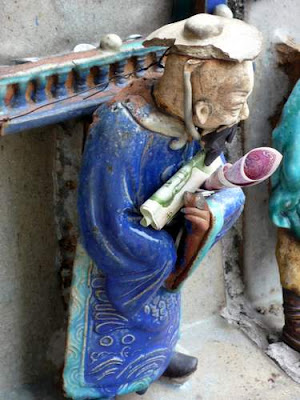
Detail of a ceramic frieze atop the Dragon Mother's Temple, Guang Dong Province, China. People lean over the upper balcony to tuck money into the sculptures to help lubricate the passage of their wishes to reality.Dear Gentle Reader,

It's 3WW.

This week the prompt words are amaze, frail, and sacred.

Your starter is a titled picture with, as always, descriptions if you run your mouse over the image.

Then, as usual, I serve up three haiku/senryu, each with an American Sentence title.

For dessert, I close off with a musical offering.

So, promptly, away.

Let the games begin with amaze, frail, and sacred...


Amazing Grace, Newton's sweet sound--though he'd sold men, bound, in slavery...

frail prayers waft up,
borne with sacred incense swirls;
plead amazing grace


** True, John Newton (1725-1807) did end life campaigning with John Wilberforce for the abolition of slavery, but he started life as a slaver, and, though he had changed careers to become a curate, he had not denounced slavery when he penned 'Amazing Grace' in 1779.

The British Slave Trade Act of 1807, which Wilberforce and Newton campaigned for, became law little more than 9 months before Newton's death and abolished slavery in the British Empire.

Britain would take until 1833 to determine that slavery as an institution was inherently illegal.

That said, the Western world would not see slavery as being a jus cogens, an international legal wrong, or, more specifically, that a jus cogens itself could exist until the conventions for drafting the Vienna Convention on the Law of Treaties were commenced in 1949 and the text finally adopted in 1969 (see Article 53). It would still take until 1980 for the Vienna Convention on the Law of Treaties, 1969, to enter into force.

This whole 'aside' merely is my way of pointing out the frailty of some prayers, especially those implicitly contained within 'Amazing Grace', penned at the time by an unrepentant ex-slaver and slave trader.


Forget storge, philia, and agape; give me eros each day.

frail hearts quail, tremble.
love is sacred? hah! Violent!
stunned, amazed, we pant.


** Storge, philia, agape, and eros are the four forms of love in Classical Greek thought.

Storge, στοργή, refers to loving, familial affection.

Philia, φιλία, refers to friendship--the love between friends.

Agape, αγάπη, refers to an abiding, deep love and contentment.

Eros, έρως, finally, refers to passionate love. Eros doesn't have to be sexual, but Plato's modification of love, Platonic love, a non-sexual love, is a modification of eros--which point to the importance of sexuality in the non-Platonic eros.


Crowds queued (Paris-style) for her; Quasimodo tried to save her; she died.

frail Esmeralda's
sacred sanctuary fails;
amazed Q's heart breaks


** If you haven't read Victor Hugo's (1802-1885) 'Notre-Dame de Paris', or, 'The Hunchback of Notre Dame" then this little piece will surely fail. The only thing I will point to here is the ambiguity of 'Q' in the last line.

Normally this 'Q' would clearly refer to Quasimodo, but, with the title of this poem, 'Q' could also be the Parisian crowd which 'queued' outside of Notre-Dame to show its support of Esmeralda--fabulously misread by Louis XI, the King of France, in the book....


*** As per queuing 'Paris-style', don't think Paris of Hector, or of Helen, think French Revolution.

Think Eugène Delacroix and 'La Liberté guidant le peuple', or, 'Liberty guiding the people'...

Image of painting by Eugène Delacroix (1798-1863) entitled ' La Liberté guidant le peuple', or 'Liberty guiding the People'. This image is in the public domain and is sourced from the Wikimedia Commons.

An aside and a query. Does "to hector" in English come from Homer's Iliad?

Hector (eldest son of King Priam [of Troy] and Hecuba), who berated his brother, Paris, with lines like "Paris, you pretty boy, you woman seducer, why were you ever born? Why weren't you killed before your wedding day"...


Tschuess,
Chris

Ah... and the music for today is...

Hmm. My data storage site appears to be down...

I'll have to try to add the music later...