Dear Gentle Reader,
My chest still hurts.
Sitting, standing, lying...
All positions are uncomfortable.
It reminds me of when I had altitude sickness in the high Karakorum between China and Pakistan.
Lucky me.
That memory twigs me to the pills I took to avoid altitude sickness when I went to Mt. Everest.
Or, Mt. Sagarmatha (सगरमाथा) as the Nepalese call it.
But, Mt. Sagarmatha is a political name chosen for internal, political reasons in the 1960s with no real historic or linguistic or cultural ties to Mt. Everest; the Nepalese who lived near Mt. Everest used the same name for the mountain that the Tibetans did.
We could call Mt. Everest what the Chinese call it on the theory that a billion people can't be wrong (I used to call this the Coca Cola argument).
The Chinese call the mountain Zhumulangma Feng (珠穆朗玛峰 in (Mainland) China, or 珠穆朗瑪峰 elsewhere [spot the difference? The 'horse' radical, ma, 馬, is simplified to 马 in (Mainland) China]).
But, Zhumulangma Feng is simply the Chinese transliteration of the Tibetan name for Mt. Everest.
Qomolangma (ཇོ་མོ་གླིང་མ), the Saint Mother, is what the Tibetans call Mt. Everest.
The British, via the Royal Geographic Society, would have called Mt. Everest Qomolangma if they had been allowed to enter either Tibet or Nepal to survey it...
(As, again, the Nepalese who lived close to Mt. Everest called it Qomolangma just like the Tibetans did.)
...But, the British surveyors were given access to neither Nepal nor Tibet. They, also, were given no information about the mountains' names which they wanted to survey--that was top secret stuff.
To be fair, in a sense the names of the mountains was top secret to the Nepalese and the Tibetans as the mountains were variously seen as homes of the Gods, in the Hindu tradition, or Gods themselves worthy of veneration and offering.
And the British surveyors were not questing for religious edification and purification and so were unworthy.
The British were on a purely secular mission, surveying the mountains of the Indian sub-continent in the mid-nineteenth century. Further, the Tibetans and the Nepalese were worried that maps could be used for political and military campaigns of annexation.
Not that the British ever hankered after empire...
Anyway.
Why is that mountain called Mt. Everest in English?
The Surveyor General of India, who surveyed the mountain, in the absence of any hope of finding out the local name, named it after his predecessor, Col. Sir George Everest.
Now you know.
Every day, during the season that we visited, Mt. Everest is shrouded by clouds.

On some days, however, you are lucky and the clouds blow away just before dusk to return just after dawn.
On the last day of the road trip to arrive at Mt. Everest we drove through a massive cloud bank.
And then we parked under the cloud bank.
Worse, a storm blew into base camp.
At two in the morning I was woken by distant thunder.
 I dressed, put some more yak dung in the fire for everyone else, and stepped outside.
 The night was black and stars twinkled faintly--the storm had passed by as had the clouds, but I still couldn't make out the outline of Mt. Everest against the night sky.
Just then lightning branched across the horizon, in the distant darkness, zig-zagging through a monumental arc of the sky.
...Except for one chunk of sky that stayed black... a mountain shaped chunk...
...The storm had moved to Nepal and the lightning was behind the backside of Qomolangma.
As I stood, counting while waiting for the thunder to work out how far away the lightning strike had been, another fork of light split and lit the sky, except for the Everest-shaped patch of blackness in the night.
I raced back into the hut to wake your Heroine and our two traveling companions.
We all rushed outside and quietly froze, chattering softly, waiting in wonder for lightning until neck fatigue and bitter winds forced an eventual retreat to the warmth of the hut and the yak dung fire.
We, however were glowing; we had seen Everest, or, at least, her silhouette.
At 4:30 I awoke again, stoked the fire, warmed your Heroine's clothes, and eased her out of a sleep which she clung strongly to.
We woke our companions and we all went softly out of camp, hoping for some private time with Qomolangma, Mother Saint, when the sun would, hopefully, reveal her.
The other couple decided to walk to a slightly higher stone valley where everyone else would also head, later.
We worried that sunrise might come before we crested the hill so your Heroine and humble scribe chose to traipse across the valley floor, amidst a herd of previously sleeping yaks, until we found the angle which we thought would be best for us.
We hung out in the chilled darkness waiting for the sun's messengers to visit amongst the quiet huffs of softly remonstrating yaks and the sparkling, improvised melody of a glacial stream.
When the sun's first messengers finally did arrive they were followed by a (light) cavalry charge that caught Mt. Everest in profile and then ricocheted to us.
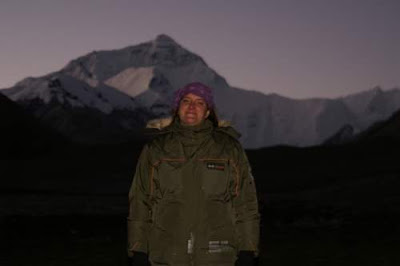
Each photon seared itself into a memory which in turn is hardwired to what your humble scribe calls the Everest grin, a manic manifestation of joy on the face.
Science tells me that that manic state is related to the lack of oxygen at high altitude; I prefer the experiential explanation of just being at Everest at dawn.
Dawn's crash troops kept racing up the near face of Everest and then cascaded, reflected, into our valley.
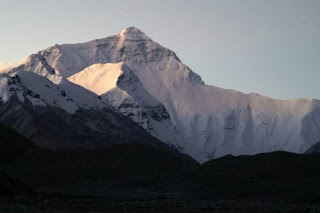
Soon we saw Qomolangma in all her glory.

Even then, of course, although Mt. Everest was lit up and gleaming, our valley was still in shadow; direct sunrise for the valley floor was still a short time away.
The scientific consequences of the sun hitting the Himalayan valley floors, however, was inimical to visibility.
As the sun's heat started to directly penetrate the valleys, especially lower down in the Himalayas, the close-hanging, thick, condensed, ground-hugging fog warmed up.
Warmth, of course, is merely a proxy measurement for the activity of atoms and molecules.
The hotter things are the faster their component parts and particles are moving.
Fog, when it warms up, like everything else, takes up more space and becomes more energetic. Further, as relatively hotter things do, like steam or hot air balloons, warmed fog rises.
So, the sun that gifted us with a vision of Qomolangma would also provide the engine, hot streams of photons, to raise an opaque veil and prevent us from seeing her, shortly.
One hour after sunrise the Himalaya's valleys' cloud banks had already risen to just below the feet of base camp.

Within another ten minutes this rising fog would swallow base camp and, finding thermal equilibrium a few hundred meters higher, would hang, as if pinned, as a cloud around the base of Mount Everest.
For the rest of the morning these clouds would shroud the Saint Mother from prying eyes so that she could attend to her morning toilette in peace.
And then they would stay to provide her with solitude and peace to nap the day away.
And, maybe, maybe they would let us peek into her boudoir again, that evening.
Only time would tell.
Tschuess,
Chris
Today's music is by an unknown, possibly renegade group of Tibetan musicians. The cd was a compilation cd called "Cuckoo's Love Sang" (sic) and it has no identification of the singers, or the publishers, or the distributors.
Further, the sellers were unwilling to tell us anything, especially when we asked in Chinese.
That means I know of nowhere to send you to get more information.




 Posts
Posts