Showing posts with label China. Show all posts

Monday, August 2, 2010

Chinese wages, fashion and factories

Image of Chinese workers in a market in Lijiang, Yunnan Province.Dear Gentle Reader,
I wrote about how an hour and a half visit to a high-end beauty salon to get a full hair wash, cut and styling, blow dry, and an obligatory head and neck massage, all with the latest fashion styling trends costs a client the princely sum of 13 RMB (renminbi), also known as 13 yuan.

Which is approximately 1.47 euros.
Or 1.91 USD.
Or 1.98 CDN.
Or 2.03 CHF...

Which should help explain why Western factories have flocked to China over the last 30 years, and, simultaneously, why Chinese workers are, now, starting to strike.

I don't know exactly how hair salons are run in China, but, I assume that they are run similarly to how they are run in the West.

In the West, the salon owner builds the salon and markets the salon.

Stylists (barbers) then rent a chair from the salon; the rental price usually is half the price of services rendered by the hair stylist.

I suspect that the same system is in place in China.

If this is so, the hairstylist at the high-end beauty salon I profiled on Friday takes home half of that 13 yuan charged for each hour and a half (approximately) that the stylist spends on a client.

That amounts to 6.5 yuan.

Which is approximately 0.74 euros.
Or 0.96 USD.
Or 0.99 CDN.
Or 1.02 CHF...

Let us assume that the stylist gets ten paying clients, back to back, in a day.

That means that for 15 hours work the stylist would keep 65 yuan...

...approximately 7.35 EUR.
Or 9.55 USD.
Or 9.85 CDN.
Or 10.15 CHF...

(The rates for 1 1/2 hours, one client visit, were all rounded up.)


...Of course, clients are not lined up out the door for the most exclusive beauty salon in town...

Image of the whole frontage of the hairstylist's shop in Kaifeng, Guangzhou Province, China. The characters in red read 'Ming Fa Lang' which translates, roughly, to 'Famous Hair Corridor' (Corridor as in the Long Corridor in the Summer Palace, outside of Beijing... if that makes things easier).
...Stylists might spend the whole day at the salon...

...At least 15 hours...

...But, only one of the seats had a client getting a haircut when your humble scribe poked his head in; the other chairs were empty...

...So, these hair stylists were living on much, much less than 65 yuan for a day's work...

And, please remember that they have to buy all of their own supplies out of that gross amount.

Stylists need to supply their own scissors, hair dryers, shampoo that they use on clients, hair supplies, et cetera...

And, as this is a high-end boutique, the hair stylists have to look upmarket and buy fancier clothes so that their clientele know that they are truly visiting an upmarket salon...

This is why Western industrialists shifted production to China.

It costs less to live in China, if you live life according to average Chinese standards.

For comparison, the 2010 federal minimum wage in the U.S.A. is $5.15 USD/hour.

If our hairdresser worked for a salary in the USA, and received the federal minimum wage for that 15 hours work, then our hairdresser would make $77.25 USD for 15 hours work in a day, assuming no overtime pay.

Again, for comparison, our hypothetical Chinese hairdresser could make a maximum of $9.55 USD for that same 15 hours of back to back work on ten clients in China...

These 'cheap' 13 RMB haircuts are not actually cheap to Chinese workers; these haircuts are only cheap to foreigners who receive far more than the unobtainable $9.55 USD for 15 hours of work.

As workers do not make a lot of money, prices can remain depressed--including the price of labour in China.

But, the Chinese factory workers, who have been making the baubles and the necessary items for the wealthy West, have become more keen to be able to afford and possess these same baubles and necessities for themselves.

And, they have become jealous of the Chinese factory owners who have become rich off the sweat of their bodies.

And, Gentle Reader, this goes a long way to explaining why we are finally starting to read about strikes in Chinese factories.

Strikes have been going on for years, but were always kept controlled, and hidden--even during the Asian Economic Crisis (1997-1999).

But, worker discontent is so widespread that strikes cannot be hushed up anymore.

Besides, the existence of strikes (and their possible recurrence in the future) are useful for applying pressure on foreign companies during future negotiations regarding future investments... ...and regarding future technology transfer agreements for access to cheap labour...

...Especially if the state guarantees to keep workers more in line, in the future, as workers have been kept in check in the past...

Now, however, Chinese factory workers want and expect to receive more for their blood, sweat and tears.

Otherwise, those factory labourers will turn their backs on their foremen, and on their employers, and head back to their originating villages...

Second image of Chinese workers in a market in Lijiang, Yunnan Province. This image is titled 'Having seen the good life being produced in the factories they toil in, these workers are willing to turn their backs on all, unless they start to get a piece of the good life
Which is happening now.

Which is why cheap labour is flooding into southern China from neighbouring countries in South-east Asia....

The bright side of the coin for the foreign firms who have invested in Chinese factories is that if they start paying factory workers more then that mythical Chinese market of over one billion consumers will finally start to become a reality... ...and the factories will be able to sell to Chinese, not just to overseas markets.


Friday, July 30, 2010

What to do on a sultry day...

Line image of a Western beauty...(black hair, tanned skin, tiny eyes) entitled 'Black hair, small nose, tiny eyes... ...Who could this raven-haired beauty be?'Dear Gentle Reader,

OK.

I am trying to get back into the e-swing of things.

Baby steps.

Even shaky babies can walk.

Eventually.

So, how does that connect with the title image today?

It's advertising.

I'm advertising my shakiness, at least as regards to posting reliability.

And that girl is advertising her beauty.

Which you can get, too.

From a tiny little hairstylist's place of business, in a rural town--Kaifeng, China.

...


Shot of the whole frontage of the hairstylist's shop that the title image comes from. The characters in red read 'Ming Fa Lang' which translates, roughly, to 'Famous Hair Corridor' (Corridor as in the Long Corridor in the Summer Palace, outside of Beijing... if that makes things easier).

...Hair stylists for her...

As you can read, they offer a full wash, cut, blow dry, and the obligatory head and neck massage, all with the latest fashion styling trends.

The head and neck massage, at least twenty minutes long, is so obligatory that it's not even listed.

But, it's there or this business wouldn't be since all of their competitors offer it.

And all this for the princely sum of 13 renminbi, sometimes known as 13 yuan.

Which is approximately 1.47 euros.

Or 1.91 USD.

Or 1.98 CDN.

Or 2.03 CHF.

...You are going to the top hairstylist in town, after all...

(That's real red brick; not some cheap linoleum facade.)

...Hence the high price...


Now, I could discuss the other commercial aspects of hairdressers throughout Asia.

How barber poles with rotating spirals mark out places to lose your tension... ...after letting it build a bit first...

But, maybe I'll leave brothels for another day.

After, all would need to figure out what the going rate is these days...

That post would, however, put a whole new spin onto the idea of a barbershop quartet.

...Wicked, torrid thoughts... (obedient sin--for Murat)...


Tschuess,
Chris


Ah... and the music for today, being a warm summer day, is...


Click to hear 'Cicadas' by the Cowboy Junkies

Amazon.com


Tschuess,
Chris

Thursday, March 18, 2010

3WW CLXXXI (3WW3)

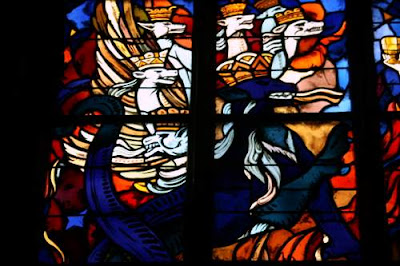
Detail of a stained glass window from a Church in Normandy. From Caen, I believe.
Dear Gentle Reader,

It's 3WW time, again.

This week the prompt words for prose or poetry are pulse, shard, and weary.

Your starter is a titled picture with, as always, descriptions if you run your mouse over the image.

Then, as usual, I serve up three haiku/senryu, each with an American Sentence title.

For dessert, a musical offering.

If you're like me, have dessert first and enjoy it while reading.

So, away.

I have to get back to packing.

We are in the midst of moving and we have too much stuff.

So, sorry if I try to store some words here, on the web, but there is no room in the stables tonight...

And, with that, let the games begin with pulse, shard, and weary...


On safari, the carnivore rules over all--- ROWRRR... (sob) ...CruNCH ... ... ... ... ... ... (...no pulse...)

shards of meat (and bone)
but, no pulse (legume, bean, pea)
weary vegan pales...


The origin of glass, a Western, or a Near (not Far) Eastern, tale...

Pliny's Phoenicians
found proto-shards where weary
sailors' fires throbbed, pulsed.


What is this poem all about?

Well, Gentle Reader, a circuitous explanation ensues. Sorry.

You ought to know, by now, that your humble scribe is (currently) based in Hong Kong.

Hong Kong is right beside China.

Hong Kong is even in China, if you believe the Mainlanders rather than your visa requirements.

Hong Kong is certainly within the media orbit of modern China.

Recent Chinese 'historical' pop culture movies (Red Cliff, for example) extol the fact that ancient China invented almost everything.

Like soccer. (A specious claim, at best).

Your humble scribe and Heroine find themselves amused to note that almost all things are Chinese these days.

Soccer/football?
Surely Chinese.

CERN and the Higgs Boson?
Surely Chinese.

The alphabet?
Mmmhmm.

Crime?
Vice? ...

...Well, those are obviously foreign.

...Especially when you read or hear the news, in China...

But, glass?
The beach at Mont St-Michel, Normandy, France, as seen through transfigured beach... the medieval glass of Mont St-Michel

Glass is definitely not Chinese.

Glass is one of those areas where, if you are a Westerner, you can hold your head high on the origins of innovation front because the ancient Chinese did not invent glass.

The Chinese 'discovered' glass only from overland traders sometime in the end of the Spring and Autumn period of Chinese dynastic history (770 BC - 476 BC) or in the beginning of the Warring States period (475 BC - 221 BC).

Pliny the Elder (23-79), however, gives us the historic/mythic origin theory that Phoenician sailors (Phoenicians are those Fertile Crescent trading folks whom most Lebanese claim as their forebears) discovered glass sometime around 5000 BC.

Pliny's Phoenician sailors/merchants were cooking their meal of reconstituted pulses in pots over fires on the beach as they rested their weary bodies...

Those Phoenician pots, in turn, while cooking the pulses, rested upon blocks of nitrates which the sailors/merchants were carrying.

And, as those blocks of nitrate melted, from the heat of cooking fires, the melted nitrate fused with silica, the sand on the beach, to form 'ur-glass'--the original man-made glass.

This originating glass was not only clear(ish) but, when the half-melted nitrate trading blocks were forcibly removed, this proto-glass would have resolved into shards of glass...

...which would have engrossed the attention of sailors, weariness forgotten, with sharp shards of a novel, transparent solid in front of them and their bellies full of reconstituted pulses.

See how easy this fit into today's 3WW words?

3WW even allowed me to point out Western technical/innovation prowess.

Even Mesopotamian prowess.

For, despite Pliny's tale of the Phoenicans of around 5000 BC, the first archaeological record of glass comes to us from pre-Bronze Age Mesopotamia--from the pre-Sumerian Uruk Period (4000 BC - 3100 BC ).

Sure, this is almost a thousand years before my beloved Akkadians spring to prominence in Mesopotamia, but, for once, I can write about something that was not invented first in China.

Thanks, Thom (Keeper of 3WW and provisioner of words).

Words like these make my day.

(Although, Thom, I would love the challenge of an x, y and z themed 3WW, too--as you suggested on your prompt page...)


To the victors go the spoils, and thanks, of royalty; to the writers...

pusillanimous;
lacking heroes' pulse, courage.
Weary shards of men...


(Of course, today, the writers get royalties.

But, not if they publishes on the web...)


There you go, hepcats.

Maybe when I am less bone weary the haiku will pop out easier.

Tonight, well, this is better than nought.

I hope.


Tschuess,
Chris


Monday, December 7, 2009

Boats on the Water

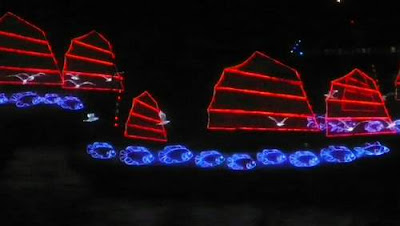
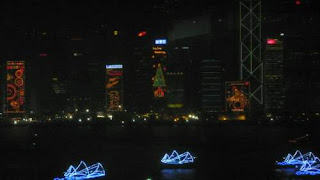
Image of a neon-lit 'Chinese Junk' on the water for the opening of the 2009 East Asian Games in Hong KongDear Gentle Reader,

The other day your humble scribe looked up and out the window and, amidst a low-hanging fog, saw a mysterious boat cruising into Hong Kong harbour...

And this image shows, possibly, ten percent of the flotilla which your humble scribe saw.


Image of an armada of neon-lit 'Chinese Junks' on the water for the opening of the 2009 East Asian Games in Hong Kong

This fleet came into Victoria Harbour, Hong Kong, to celebrate the opening of the 2009 East Asian Games; it was the on-water portion of a spectacular laser, lights, and fireworks show to open the East Asian Games.

These junks were representative of one of two Hong Kong-style junks that used to be very common in the seas of East Asia, especially around Hong Kong.

The term junk for a vessel is, contrary to accepted popular wisdom, not a pejorative, colonial term for Asian boats.

The name 'junk', for these ocean-going vessels, is derived from an old Javanese word, 'jong', which described a large shipping vessel; it described the class of Chinese merchant vessels which date back to the Han Dynasty (206 BC - 220 AD).

First, a digression on Java...

Java is an old kingdom whose people speak Javanese.

The Kingdom of Java was centred on the island of Java which is now a part of Indonesia.

Jakarta, the capital of modern Indonesia, is located on the island of Java which happens to be the 13th largest island on the planet.

Java is 67% of the size of Great Britain by land area (as in England, Wales, and the bulk of Scotland).

Of course, in 2005, the island of Java, alone, had a population of approximately 124 million people while Great Britain had approximately 58.5 million people.

To put this in context for my American friends, the island of Java, alone, by area, is bigger than Louisiana, Alabama, or Arkansas.

Java is almost the exact same size as North Carolina and is a bit smaller than New York state.

And Java had 124 million people in 2005 which was almost 42% of the population of the USA in 2005.

Java has had a long, distinguished history befitting its relative size and regional impact.

The same can be said of junks.

Junks have cruised the waters of Asia for over two thousand years.

In the early 15th century, Venetian galleys carried around 50 tons of cargo per galley.

At the same time Zheng He's treasure junks carried two thousand tons of cargo, each, on their trips to Hormuz and to India.

There are vast differences in the scale that junks were built to, and there were many regional variations on the junk, fine-tuned over the centuries for local conditions, but, the basic design lasted for millenia because it worked.

Hong Kong had two regional junk styles, fishing junks and trading junks.

Most junks had square sails that would be affixed to numerous masts and stiffened with bamboo battens.

These relatively rigid sails were easily reefed and adjusted.

Image of many neon-lit 'Chinese Junks' on the water for the opening of the 2009 East Asian Games in Hong KongHong Kong fishing junks were the one notable exception in sail design. They didn't have a square sail like all the other junks; they had the readily identifiable sail shape that we see here.

Ivan Donnelly, in his 1924 classic "Chinese Junks and other native craft", when writing about 'Hongkong Fishers' notes that:
The rake of the masts and the well rounded shoulder of the leech of the sail are distinctions by which one can easily distinguish this type of junk at sea.
As an added aid to identification, these festive 'junks' used in the opening ceremonies of the East Asian Games were also festooned with neon blue fishes.

Fishes not only help you note that these are fishing junks, but fishes also symbolize wealth and plenty, which is why one always includes steamed, whole fish in the menu to conclude successful business transactions and for other celebratory dinners.

And, presumably, each participating country in the games was hoping for a haul of gold, silver, and bronze as they showcased the athletic wealth of their country's youth.

Hong Kong loves colour and light and display and these gaudy, bright junks, recreated with neon lights arranged on modern fishing vessels, provided heady colours, from afar, on the water at night.

Further, junks are a symbol of water-going traders and of empire, both mercantile and political, throughout East Asia.

So, it made sense that they were used in the light show put on by the hosts...Hong Kong, China.

With the ubiquity of diesel motors, however, no one, in Hong Kong, uses wind-powered junks any more.

Now they are just ghosts.

Memories of a forgotten time.

And, as I thought that, the bright red sails and blue fishes of the junks disappeared, to be replaced by the ghostly white outlines of square junk sails reefed into lateen sails.

Image of a neon-lit 'Chinese Junk' transformed into a ghostly white junk on the water for the opening of the 2009 East Asian Games in Hong Kong

And then the junks turned and sailed out of sight, and out of the marine light show site.

And with that, I depart until Wednesday, too.


Tschuess,
Chris

Click to hear '龍船 (The Dragon Boat)' by 瞿冰心 (Kui Bing-Sum, Yangqin)

Sadly, I cannot find an online site to buy this cd or this mp3. This is offered as a sample for you to scour your record stores for, or ask them to find it for you.

Friday, December 4, 2009

On Everest

Image of the Himalayan plateau rising above vast cloud banks; Qomolangma is on the right.Dear Gentle Reader,

My chest still hurts.

Sitting, standing, lying...

All positions are uncomfortable.

It reminds me of when I had altitude sickness in the high Karakorum between China and Pakistan.

Lucky me.

That memory twigs me to the pills I took to avoid altitude sickness when I went to Mt. Everest.

Or, Mt. Sagarmatha (सगरमाथा) as the Nepalese call it.

But, Mt. Sagarmatha is a political name chosen for internal, political reasons in the 1960s with no real historic or linguistic or cultural ties to Mt. Everest; the Nepalese who lived near Mt. Everest used the same name for the mountain that the Tibetans did.

We could call Mt. Everest what the Chinese call it on the theory that a billion people can't be wrong (I used to call this the Coca Cola argument).

The Chinese call the mountain Zhumulangma Feng (珠穆朗玛峰 in (Mainland) China, or 珠穆朗瑪峰 elsewhere [spot the difference? The 'horse' radical, ma, 馬, is simplified to 马 in (Mainland) China]).

But, Zhumulangma Feng is simply the Chinese transliteration of the Tibetan name for Mt. Everest.

Qomolangma (ཇོ་མོ་གླིང་མ), the Saint Mother, is what the Tibetans call Mt. Everest.

The British, via the Royal Geographic Society, would have called Mt. Everest Qomolangma if they had been allowed to enter either Tibet or Nepal to survey it...

(As, again, the Nepalese who lived close to Mt. Everest called it Qomolangma just like the Tibetans did.)

...But, the British surveyors were given access to neither Nepal nor Tibet. They, also, were given no information about the mountains' names which they wanted to survey--that was top secret stuff.

To be fair, in a sense the names of the mountains was top secret to the Nepalese and the Tibetans as the mountains were variously seen as homes of the Gods, in the Hindu tradition, or Gods themselves worthy of veneration and offering.

And the British surveyors were not questing for religious edification and purification and so were unworthy.

The British were on a purely secular mission, surveying the mountains of the Indian sub-continent in the mid-nineteenth century. Further, the Tibetans and the Nepalese were worried that maps could be used for political and military campaigns of annexation.

Not that the British ever hankered after empire...

Anyway.

Why is that mountain called Mt. Everest in English?

The Surveyor General of India, who surveyed the mountain, in the absence of any hope of finding out the local name, named it after his predecessor, Col. Sir George Everest.

Now you know.

Every day, during the season that we visited, Mt. Everest is shrouded by clouds.


Image of clouds shrouding Mt. Everest / Qomolangma.
On some days, however, you are lucky and the clouds blow away just before dusk to return just after dawn.

On the last day of the road trip to arrive at Mt. Everest we drove through a massive cloud bank.

And then we parked under the cloud bank.

Worse, a storm blew into base camp.

At two in the morning I was woken by distant thunder.

Image of yak dung burning in a fire for heat at Everest Base Camp.I dressed, put some more yak dung in the fire for everyone else, and stepped outside.

The night was black and stars twinkled faintly--the storm had passed by as had the clouds, but I still couldn't make out the outline of Mt. Everest against the night sky.

Just then lightning branched across the horizon, in the distant darkness, zig-zagging through a monumental arc of the sky.

...Except for one chunk of sky that stayed black... a mountain shaped chunk...

...The storm had moved to Nepal and the lightning was behind the backside of Qomolangma.

As I stood, counting while waiting for the thunder to work out how far away the lightning strike had been, another fork of light split and lit the sky, except for the Everest-shaped patch of blackness in the night.

I raced back into the hut to wake your Heroine and our two traveling companions.

We all rushed outside and quietly froze, chattering softly, waiting in wonder for lightning until neck fatigue and bitter winds forced an eventual retreat to the warmth of the hut and the yak dung fire.

We, however were glowing; we had seen Everest, or, at least, her silhouette.

At 4:30 I awoke again, stoked the fire, warmed your Heroine's clothes, and eased her out of a sleep which she clung strongly to.

We woke our companions and we all went softly out of camp, hoping for some private time with Qomolangma, Mother Saint, when the sun would, hopefully, reveal her.

The other couple decided to walk to a slightly higher stone valley where everyone else would also head, later.

We worried that sunrise might come before we crested the hill so your Heroine and humble scribe chose to traipse across the valley floor, amidst a herd of previously sleeping yaks, until we found the angle which we thought would be best for us.

We hung out in the chilled darkness waiting for the sun's messengers to visit amongst the quiet huffs of softly remonstrating yaks and the sparkling, improvised melody of a glacial stream.

When the sun's first messengers finally did arrive they were followed by a (light) cavalry charge that caught Mt. Everest in profile and then ricocheted to us.

Each photon seared itself into a memory which in turn is hardwired to what your humble scribe calls the Everest grin, a manic manifestation of joy on the face.

Science tells me that that manic state is related to the lack of oxygen at high altitude; I prefer the experiential explanation of just being at Everest at dawn.

Dawn's crash troops kept racing up the near face of Everest and then cascaded, reflected, into our valley.


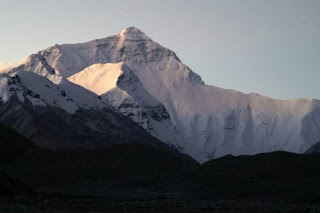
Image of Qomolangma (Mt. Everest) at dawn from the Tibetan side.
Soon we saw Qomolangma in all her glory.


Image of Everest in the morning from the Base Camp valley.

Even then, of course, although Mt. Everest was lit up and gleaming, our valley was still in shadow; direct sunrise for the valley floor was still a short time away.

The scientific consequences of the sun hitting the Himalayan valley floors, however, was inimical to visibility.

As the sun's heat started to directly penetrate the valleys, especially lower down in the Himalayas, the close-hanging, thick, condensed, ground-hugging fog warmed up.

Warmth, of course, is merely a proxy measurement for the activity of atoms and molecules.

The hotter things are the faster their component parts and particles are moving.

Fog, when it warms up, like everything else, takes up more space and becomes more energetic. Further, as relatively hotter things do, like steam or hot air balloons, warmed fog rises.

So, the sun that gifted us with a vision of Qomolangma would also provide the engine, hot streams of photons, to raise an opaque veil and prevent us from seeing her, shortly.

One hour after sunrise the Himalaya's valleys' cloud banks had already risen to just below the feet of base camp.


Image of fog streaming up from the valleys to become clouds that will shroud Mt. Everest from view.

Within another ten minutes this rising fog would swallow base camp and, finding thermal equilibrium a few hundred meters higher, would hang, as if pinned, as a cloud around the base of Mount Everest.

For the rest of the morning these clouds would shroud the Saint Mother from prying eyes so that she could attend to her morning toilette in peace.

And then they would stay to provide her with solitude and peace to nap the day away.

And, maybe, maybe they would let us peek into her boudoir again, that evening.

Only time would tell.


Tschuess,
Chris


Today's music is by an unknown, possibly renegade group of Tibetan musicians. The cd was a compilation cd called "Cuckoo's Love Sang" (sic) and it has no identification of the singers, or the publishers, or the distributors.

Further, the sellers were unwilling to tell us anything, especially when we asked in Chinese.

That means I know of nowhere to send you to get more information.

But, you can click here to listen to what we call 'Plucked Strings and Chanting Monks / the Second Song of the Tibetan Road Trip to Everest Mix' by unknown Tibetan musicians...