Showing posts with label festival. Show all posts

Monday, December 7, 2009

Boats on the Water

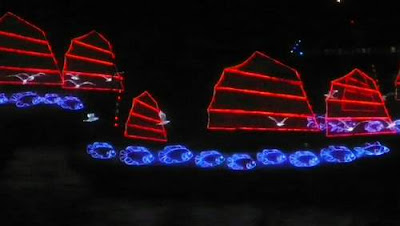
Image of a neon-lit 'Chinese Junk' on the water for the opening of the 2009 East Asian Games in Hong KongDear Gentle Reader,

The other day your humble scribe looked up and out the window and, amidst a low-hanging fog, saw a mysterious boat cruising into Hong Kong harbour...

And this image shows, possibly, ten percent of the flotilla which your humble scribe saw.


Image of an armada of neon-lit 'Chinese Junks' on the water for the opening of the 2009 East Asian Games in Hong Kong

This fleet came into Victoria Harbour, Hong Kong, to celebrate the opening of the 2009 East Asian Games; it was the on-water portion of a spectacular laser, lights, and fireworks show to open the East Asian Games.

These junks were representative of one of two Hong Kong-style junks that used to be very common in the seas of East Asia, especially around Hong Kong.

The term junk for a vessel is, contrary to accepted popular wisdom, not a pejorative, colonial term for Asian boats.

The name 'junk', for these ocean-going vessels, is derived from an old Javanese word, 'jong', which described a large shipping vessel; it described the class of Chinese merchant vessels which date back to the Han Dynasty (206 BC - 220 AD).

First, a digression on Java...

Java is an old kingdom whose people speak Javanese.

The Kingdom of Java was centred on the island of Java which is now a part of Indonesia.

Jakarta, the capital of modern Indonesia, is located on the island of Java which happens to be the 13th largest island on the planet.

Java is 67% of the size of Great Britain by land area (as in England, Wales, and the bulk of Scotland).

Of course, in 2005, the island of Java, alone, had a population of approximately 124 million people while Great Britain had approximately 58.5 million people.

To put this in context for my American friends, the island of Java, alone, by area, is bigger than Louisiana, Alabama, or Arkansas.

Java is almost the exact same size as North Carolina and is a bit smaller than New York state.

And Java had 124 million people in 2005 which was almost 42% of the population of the USA in 2005.

Java has had a long, distinguished history befitting its relative size and regional impact.

The same can be said of junks.

Junks have cruised the waters of Asia for over two thousand years.

In the early 15th century, Venetian galleys carried around 50 tons of cargo per galley.

At the same time Zheng He's treasure junks carried two thousand tons of cargo, each, on their trips to Hormuz and to India.

There are vast differences in the scale that junks were built to, and there were many regional variations on the junk, fine-tuned over the centuries for local conditions, but, the basic design lasted for millenia because it worked.

Hong Kong had two regional junk styles, fishing junks and trading junks.

Most junks had square sails that would be affixed to numerous masts and stiffened with bamboo battens.

These relatively rigid sails were easily reefed and adjusted.

Image of many neon-lit 'Chinese Junks' on the water for the opening of the 2009 East Asian Games in Hong KongHong Kong fishing junks were the one notable exception in sail design. They didn't have a square sail like all the other junks; they had the readily identifiable sail shape that we see here.

Ivan Donnelly, in his 1924 classic "Chinese Junks and other native craft", when writing about 'Hongkong Fishers' notes that:
The rake of the masts and the well rounded shoulder of the leech of the sail are distinctions by which one can easily distinguish this type of junk at sea.
As an added aid to identification, these festive 'junks' used in the opening ceremonies of the East Asian Games were also festooned with neon blue fishes.

Fishes not only help you note that these are fishing junks, but fishes also symbolize wealth and plenty, which is why one always includes steamed, whole fish in the menu to conclude successful business transactions and for other celebratory dinners.

And, presumably, each participating country in the games was hoping for a haul of gold, silver, and bronze as they showcased the athletic wealth of their country's youth.

Hong Kong loves colour and light and display and these gaudy, bright junks, recreated with neon lights arranged on modern fishing vessels, provided heady colours, from afar, on the water at night.

Further, junks are a symbol of water-going traders and of empire, both mercantile and political, throughout East Asia.

So, it made sense that they were used in the light show put on by the hosts...Hong Kong, China.

With the ubiquity of diesel motors, however, no one, in Hong Kong, uses wind-powered junks any more.

Now they are just ghosts.

Memories of a forgotten time.

And, as I thought that, the bright red sails and blue fishes of the junks disappeared, to be replaced by the ghostly white outlines of square junk sails reefed into lateen sails.
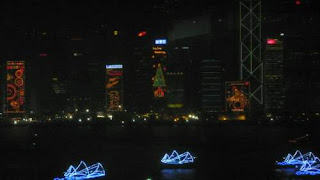
Image of a neon-lit 'Chinese Junk' transformed into a ghostly white junk on the water for the opening of the 2009 East Asian Games in Hong Kong

And then the junks turned and sailed out of sight, and out of the marine light show site.

And with that, I depart until Wednesday, too.


Tschuess,
Chris

Click to hear '龍船 (The Dragon Boat)' by 瞿冰心 (Kui Bing-Sum, Yangqin)

Sadly, I cannot find an online site to buy this cd or this mp3. This is offered as a sample for you to scour your record stores for, or ask them to find it for you.

Thursday, November 26, 2009

On Thanksgiving in Hong Kong

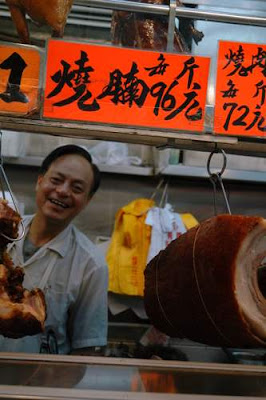
Image of Cantonese BBQ pork being sold from a small store in an alley, in Hong Kong.
Dear Gentle Reader,

Yesterday, I was asked what we have for Thanksgiving in Hong Kong.

This is a more difficult question to answer, for numerous reasons, than you might have expected.

You need to remember that the Hero of this blog, Pommes the Wonder Cat, eats fish.

So, from Pommes' perspective, Fish and Chips is mandatory before anyone starts to even talk about thanks. And the only giving he wants is a one way transaction. Fish to Chips.

(Pommes, the name, is German for chips, what my American friends would call french fries, and what my French friends would call pommes frites.)

And, when it is time to start thinking of thanks, Pommes' idea of giving of thanks is an insouciant feline sniff of 'whatever' whenever that fish has *finally* come his way.

I should note, of course, that Pommes does remove his claws from your leg when you actually hand him the fish; for that, your humble scribe always gives thanks.

The Heroine of this e-house is German. They don't celebrate Thanksgiving.

Finally, your humble scribe, like the Hero, is Canadian. So, technically, my Thanksgiving was a month or so ago.

So the easy answer would be, we don't celebrate Thanksgiving in this house, at least not in November.

But, that would be a cop-out for the question of what do people eat in Hong Kong for Thanksgiving.

The challenge in answering, however, is that that question must be phrased in the conditional future subjective.

Hong Kong, being, previously, a British colony, never had Thanksgiving as a holiday.

And I seriously doubt that the Chinese will be bringing Thanksgiving, as a holiday, to Hong Kong, or to the mainland, anytime soon.

So, the question has to be framed as "What would people in Hong Kong have for a Hong Kong Thanksgiving, if and when they were to celebrate such a thing?".

The Mayflower never stopped in port here.

Hong Kong never had Pilgrims fleeing religious persecution, only to, upon arrival, rob the locals of their cached food and desecrate local burial grounds.

True, Hong Kong had economic migrants, sojourners mostly, that came to Hong Kong for quick cash.

And, sure. Hong Kong's sojourners were willing to rob the locals, and each other, likely, and, presumably, had few concerns for local funerary, or other, customs.

But, there was no Mayflower compact to help us figure out when to start considering setting a date for a Hong Kong Thanksgiving.

And, before we set a menu, we do need to set a date for a Hong Kong Thanksgiving--to know what would be in season.

But, there was a compact that we can go by. One that, in some ways, mirrors the cross-cultural talks between the Pilgrims and the Native Americans...

The earliest agreement that Hong Kong would become British was reached on Jan 20, 1841, during the Convention of Chuenpi.

The Convention of Chuenpi called for the British to remove their men and boats from Chusan and, in return, to receive Hong Kong.

The British negotiator, Captain Charles Eliot, thought the Agreement in Principle would be binding and final so he proceeded to remove his men from the isle of Chusan, southeast of Shanghai, to Hong Kong Island--much farther from both Shanghai and Beijing.

The British landed on Hong Kong Island on Jan 25, 1841 and drank congratulatory toasts. They were thankful for a possession, even if it was a barren rock.

That landing and those toasts were repeated the next day, to be official, at Possession Point on Hong Kong Island.

(Strangely, Possession Point is not signposted anywhere in Hong Kong--I am still searching for clues as to where it was.)

So, maybe one of those two landing dates could be seen as Hong Kong Thanksgiving dates; dates for being thankful for having a harbour, a place to get out of the boats.

Of course the Convention of Chuenpi was renounced by the Chinese and, on Feb 24, 1841, hostilities were resumed by the British, but the British kept Hong Kong, at least until midnight of June 30, 1997.

If I had to choose a date I would go with the unofficial landing, and subsequent libation, of Jan 25.

(Hong Kong has always been a bit unofficial around the edges.)

Having set a date we can now set a menu.

Here, no one celebrates anything with turkey (although the hairy crab festival has just ended).

(Maybe I'll write about hairy crabs next week. Or brothels. They're both related. Take your pick.)

But, returning to the moment, I was asked what we would eat in Hong Kong for Thanksgiving.

MichaelO asked if we would have duck, rather than turkey.

I think not, MichaelO.

I think Hong Kong would go with something more traditional, more historical, and with much more of a kick.

Until Hong Kong finally went cold turkey, the raison d'etre of Hong Kong was opium.

I think a Hong Kong Thanksgiving, to be historically accurate, would have to involve opium.

Possibly shaped like a duck, but then smoked.

Hong Kong, you must remember, was created for one thing only.

The offloading, storage, and transshipment of opium from India into China.

(Sometimes that is shortened, the way things in English can be, to read: Hong Kong, you must remember, was created for one thing only--money.)

Opium helped stem the phenomenal outflow of silver from the British treasury to China.

The Chinese State had refused to purchase any goods from foreigners. The Chinese were happy to export only their own goods, and to receive silver, only, in payment.

The Chinese State controlled all importation and exportation so, for industrial goods, at least, what the State said, went.

The British, like the rest of Europe, liked many things produced in China, but the imperial coffers started to empty themselves, at an accelerating rate, to pay for imports from China.

British merchants then discovered that they could sell Indian opium (especially Bengali opium) to China.

The opium was smuggled into China by British merchants and sold to Chinese partners, illicitly, who completed the logistics of distribution to the masses.

And what did the smugglers receive for their opium? And what did the British Empire receive for its opium, when it sold it in India to private firms?

They received silver.

The British government made money on the sale of opium from its holdings in India and these sales alone reversed the net outflow of silver from the Imperial coffers. Further, that reversed flow of silver became a deluge of silver swamping the British Empire's Imperial treasury.

These revenue inflows afforded the luxuries and development of India, by the British, and of England, and much of the Imperial holdings.

The traders, both British and Chinese, also made fantastic sums.

How much opium are we talking about?

In 1830, the trade of opium into China was around 19,000 chests per year. By 1838, that trade had grown to around 40,000 chests of opium.

A chest held a picul of opium. This translates to between 60-65 kilograms, or 132-143 pounds, ish, of opium, per chest.

At 40,000 chests we are talking about up to 2,600 metric tonnes of opium, or 5.72 million pounds of the stuff.

In Hong Kong, today, and then, what matters is money.

And 5.72 million pounds of opium, per year, brings in a lot of money.

That is what drove the trade, and the founding of Hong Kong, and what people, Chinese and Western both, were thankful for, even when they found the opium trade distasteful.

Opium made the wheels of Empire spin round.

In North America, at Thanksgiving, after consuming the tryptophan glut that is turkey dinner, people pass out.

In Hong Kong, after filling your lungs and gut with opium, you pass out too.

And there is no need to eat.

That is why Opium den habituées are so thin and why Yves Saint Laurent never had to round up plus-sized models for his Opium fragrance collection.

So.

Short question with a long answer.

What would a Hong Kong Thanksgiving look like if there were to be one?

It would look just like an American turkey glut, but with less food, skinnier bellies, and only opium on the menu.

I hope that helps.


Tschuess,
Chris

Amazon.com iTunes

Click to hear 'Nuevo Mexico' from the album 'Opium' by Ottmar Liebert & Luna Negra
Amazon.com

Monday, February 9, 2009

Dragons in the street

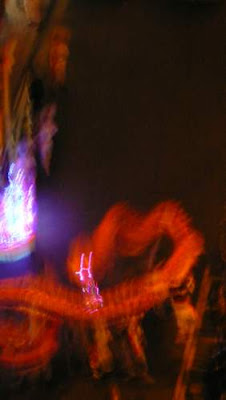
Image of a Chinese New Year Dragon writhing in the night around hapless dancers, Kowloon, 2009.Dear Gentle Reader,

Chinese New Year, and the Spring Festival, ended over a week ago.

It has taken me this long to find the courage to relate what I saw that night.

Brace yourself for panic; see that picture?

Feel the fear of the people being swept up in the sinuous curves of a dragon who will swiftly collapse their bodies and consume their souls...

You see, Chinese dragons come out to play on Chinese New Year.

Some people are birders. Oh, to belong to such a safe group (unless you are seeking the roc, like that heroic twitcher, Sinbad, who went to tick the roc off his list (the roc was the original mega-bird) but was picked off, himself, instead. Sinbad's story has been tragically misunderstood, but I digress.)

Your humble scribe observes dragons in their natural environment, the crowded streets of Hong Kong.

I kept myself a few floors above the head of the great beast.

Here you can see its glowing eyes and horns...

Image of a the head and body of a Kowloon Dragon, spotted in Kowloon, Hong Kong at the close of the Spring Festival, 2009.
Yes, I know it is a bit shaky.

I was twitching, in terror.

Dragons, after all, are avaricious, pernicious, cunning, and vastly powerful.

Venom pumps through their arteries; deceit curdles in their veins.

I had long been told, and read repeated warnings in ancient tomes, to never look a dragon in the eye(s) (Cf. The Hobbit, for example).

See how those eyes glow? Those are not eyes I would willingly look into.

No wonder they can see right through a man, and gaze clean into his soul... They must have x-ray eyes or something. Maybe meta-ray eyes? Whatever.

This dragon, fortuitously, did not fly, at least not high.

It had corralled menfolk on the street, and was spinning round and round them, mesmermising them.

It was playing with them, as a cat plays with a butterfly or a songbird.

Image of a Kowloon Dragon, winding his body around luckless Chinese, caught up in its gaze at the close of the Spring Festival, 2009, in Kowloon, Hong Kong.
As you can see, this dragon not only went around these men and women in circles, he (she? I was not about to check, would you?) also spins above citizen's frightened heads and even below their terrified feet as they jump to get away.

The proof is in that photo.

The concierge in my building tried to calm me down, the next day, by telling me that these were not unwilling victims who were simply corralled by the dragon.

The concierge told me that members of some Chinese social groups, fraternal societies similar to the Freemasons or the Rosicrucians or the Elks, actually train to dance with the dragons.

Or something like that.

This might be true, I cannot say for sure.

I suppose this could be an über-dangerous version of running with the bulls in Pamplona, Spain...

But, then the concierge started to tell me that nobody was injured, and that this was all for fun. Hah!

I know what I saw.

Image of a Kowloon Dragon, crushing his victims with his body prior to swallowing them whole, observed at the close of the Spring Festival, 2009, in Kowloon, Hong Kong.I saw death, destruction, and despair as the bodies were swept up in the beast's ferocious coils.

That was the dragon's dance.

And he only left when the lion's came to rescue everyone, but that is for another post.

I am too shattered, just recalling that night.

Welcome to my town, your scribe sardonically mutters, as he backs into his apartment building, looking carefully around him...

Tschuess,
Chris, Regina, and a frantic Pommes wondering who will remove shed fur, fill up the water tank, and provide treats and eats if the scribe is eaten by a dragon

Monday, January 26, 2009

Chinese New Year in Hong Kong

Image of the entry to Ocean Centre Mall in Kowloon, Hong Kong, just before the Spring Festival starts.Dear Gentle Reader,

Xin nian kwai la! (Mandarin in pinyin transliteration for China, Taiwan, and Singapore...)

Gung Hei Fat Choi! (Cantonese for Hong Kong and Canton Province, China... no easy, standard transliteration that I know of.)

Happy New Year! (in English.)

The old lunar year is finished. The new one has just begun.

The Kitchen God went off a week ago, with lips smeared with wine and honey, to make a report on the family to the Jade Emperor.

He (the Kitchen God, a handsome young chap whom women are not allowed to worship[!]) had so much wine that he was befuddled and forgot all our misdemeanours; we also kept his mouth and tongue sweet with the honey.

Bribing the Kitchen God, or any Chinese God, is the name of the game.

Make an offering, get a good result. Make a better offering, get a better result. Actually, it can work in a similar way with governmental officials too, but not in Hong Kong...

In the Spring Festival, which is what follows (and is kicked off by) the Lunar Chinese New Year, do not even bother going to the shrine of the Wealth God unless you have bought a lot of expensive incense to burn.

Everyone knows that the Wealth God has nothing to do with paupers who cannot make extravagant offerings.

We worked this all out when we lived in Taiwan.

Everyone else gave their House Gods cheap cooking alcohol and old fruit. We offered ours German schnapps and girls (Spice Girls coasters that came inside a CD we bought for the House Gods because the rest of Taiwan sure liked them a lot...).

All our Chinese friends agreed that, with an offering of nubile young rockstar glamour girls for the house gods' pleasure, we were set for fortune each coming year with the Chinese gods vying to bless us, our home, and to give us what we needed.

Anyway, the Kitchen God is back, and there have been no repercussions from the Jade Emperor, so all is well in the Middle Kingdom (China) for us.


Red lanterns, hanging outside a building, for luck in Kowloon.
Red, a lucky colour, is festooning everything in Hong Kong right now.

The apartment has been cleaned and the pauper has been shown to the door, so that wealth will not feel uncomfortable about visiting us for the new year.

Sorry for the squeaking though... it is all those bats hanging around everywhere...

What?

Well, the character for luck, 'fu' (in pinyin Mandarin), means blessings and happiness and fortune and luck...

And classical Chinese has all these great expressions like "Happiness is Wealth" and "Happiness is Longevity and Wealth" and "Happiness is Richness"...

(Are you starting to see a pattern regarding money in China?)

But why the squeaking?

The character for bat, (as in the blind, flying mammal, order Chiroptera, the only Earth mammal capable of sustained flight) is a homonym for "fu" (happiness and blessings, as discussed above), so people decorate furniture or advertisements with bats to slyly connote luck, and fortune, and wealth.

Even our New Year's fu card (from an insurance company) has bats...

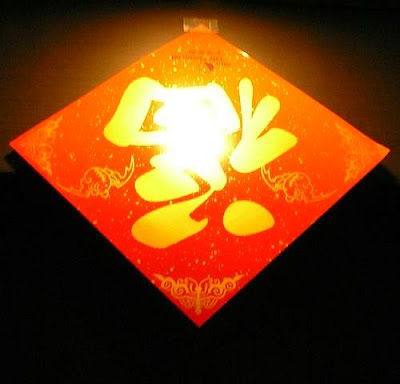
Fu (mandarin character) meaning blessings and happiness and wealth and fortune...
At New Years, everyone hangs the character (the ideogram) for "fu" that represents happiness outside their apartment.

But, at New Years, we hang our 'fu' character upside down. (Just like the way a bat hangs upside down)...

Image of an upside fu (fu is approaching) for the Chinese Lunar New Year...
Why do this? (Besides being able to see the lucky bats better...)

Two reasons.

First, you don't want your luck to empty at the start of the year, so you hang it upside down so that it won't leak away. (?)

Second, an inverted ideogram for "fu" is a homonym for "fu is approaching"... and approaching fu or happiness and wealth and richness is what you want for the coming year, most especially if you are Chinese.

So that is why we do that.

Actually, there are lots of other homonyms that we have to deal with here. For example, the last course of the last meal of the old year should be fish, ideally river carp, because fish (in Mandarin) is "yu" which is a homonym for abundance, which you want for the new year because more is better...

Similarly, you ought to always have chicken "ji" because that is a homonym for auspiciousness...

But enough of the word games, this New Year is the Year of the Ox.

The last time the Year of the Ox came around Hong Kong started off the year in British hands and ended in Chinese hands. So this Ox is the first fully Chinese Ox year in Hong Kong since the handover.

Close-up image of a cherry blossom tree festooned with money for Chinese New Year.My apartment building is well into the spirit of things.

We have a massive cherry blossom tree, a real tree, in the entrance festooned with lucky money and money envelopes to bring wealth and prosperity in the New Year to all of the tenants.

We also have an upcoming lion dance, and both miniatures and full-size lions throughout the apartment building.

Thank goodness there is no ox in the building. Yet. It might drive the lions to distraction.

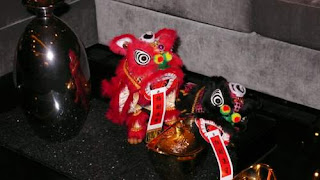
Here are the miniatures.

Image of tiny Chinese lions on the coffee table where guests wait in the foyer.

I will show you the big lions when the dance actually happens.

Now it is time to go out and enjoy more fireworks.

Last night fireworks were set off to scare all the ghosts away.

This morning fireworks are set off because they strew red paper everywhere; cacophonous confetti--but red is lucky and might bring you wealth.

Only here, and only in Chinese New Year, do you actually want to be "in the red"...

Welcome to my town.

Tschuess,
Chris

Postscript. Ooh. One of my favourite words in Mandarin is the word for fireworks..... bian pao.

To pronounce that in English, if you don't know the specialised transliteration system, is "Bee"+"eN"..."Pow!". What a great, onomatopoeic word for fireworks.

OK, I am off now.

Oh, and I think that Travis is going to be online today with MTM links.

Welcome back, Travis.

Friday, January 23, 2009

Peril in Venice; a battle at night

Image of a sign on a window, behind protective, pointy metal grating, warning of dangerous cat inside...Sign for a guard cat in Venice.Dear Gentle Reader,

We knew from our journeys around and through Venice that this was a dangerous city.

Battles and wars had often raged and ranged between other city states, other states, and even other Empires.

The Republic of Venice had lasted over a millennium and had had to put down enemies from within, not just outside its walls.

Around the city we saw boxes like this...

Image of nasty face, carved in marble in bas-relief, with a slot for a mouth.
If I pan back, you can see what was written on it...

Image of a nasty person, carved in marble in bas-relief, whose mouth was a slot to put denunciatory letters in, in Venice.
This was a mailbox of a special variety. 

This was denunciatory box, set into a wall. 

Walk silently and covertly to it and slip in your denunciation.

You could anonymously denounce your neighbours to the state; you could act as the private ears and eyes of the state. 

This was quite effective at keeping the population nervous and in line, and it helped the State avoid unpleasant surprises. 

This system even brought down a Doge once, Doge Marino Falier who was Venice's fifty-fifth head of state, briefly, from 1354-1355. In 1355 he was beheaded on the steps of his palace after it was found that he wanted to turn the Republic into an autocracy.

His punishment was not only death and mutilation of his corpse; he also suffered Damnatio memoriae. 

Damnatio memoriae meant that his memory was to be erased from the institutional memory of Venice. Even Doge Marino Falier's portrait, painted high in the left corner of the great Sala del Maggior Consiglio was covered over. 

(If you are visiting the Doge's Palace, it is in the upper left of the back wall if you face away from the grand "Paradisio" painted by Jacopo Tintoretto Sala del Maggior Consiglio, the Grand Hall of the Counselors, where all Venetian noblemen of 18 years and more could meet to debate proposals.) 

By covered over I mean that a black veil was painted over Doge Falier's image and name. The Damnatio memoriae was meant to be permanent.

Obviously, though, the denunciatory box system was not wholly successfully. 

Why?

On our last night in Venice, well, really on the penultimate morning, there was a fireship attack in the Grand Canal. 

We (your Heroine, I, the two German museum directors and the Genevois gourmet) presume the citizens, through those boxes, did not warn of this:

Image of a burning explosion above a ship in the Grand Canal, Venice
Apparently none of the denunciation boxes had warned of this attack. 

The initial salvo was followed by a hail of incendiary devices...

Image of incendiary particles showering down upon a ship in the Grand Canal, Venice.
Fortunately the attack, or the insurrection, was soon put down.

Now, there may be some doubters out there.

Some of you may say, humble scribe, you were in Venice for New Years. These were simply New Year celebrations.

I must dissent from that opinion.

I have done research.

New Years starts on midnight, 0:00 hours on the 24 hour clock, of January 1st in Western nations, and this attack was launched 37 minutes after the New Year had commenced. I scarcely need note the strategic value of this... hit the Venetians when they are unprepared, in the midst of their revelry...

I did further research for the doubters out there....

The New Years started on January 14 for Eastern Orthodox (Christian) nations. 

The Chinese New Year starts on 26 January 2009 and goes until 28 January.

The Zorastrians (and Parsees) celebrate their New Year's, Nowruz, on March 20 in 2009.

The Islamic New Year starts on 1 Muharram (it happened twice last year, January 10, 2008 and December 29, 2008! The next one will be on December 18, 2009...).

The Anglican (and Roman Catholic) new liturgical year started on November 29, 2008.

Many Hindu New Year festivals commence at, or just after, Diwali, a five day festival that began on October 28, 2008.

The Jewish New Year started with Rosh Hoshanah on October 1, 2008.

The Coptic Orthodox liturgical new year started September 20, 2008.

...

I think you get the point...

Nothing started at 12:37 am on January 1st... ...except an attempted attack or insurrection in Venice...

It must have been an early morning attack. (Well, it was. Your scribe was there.)

Even more damning... there was no talk of it in the news the next day.  

In a climate of fear most people follow silent counsel... Obviously those denunciatory boxes are still doing their job, even if they did not warn of this attack...


Tschuess,
Chris (tapping on the keys very quietly, Regina (rolling her eyes, but silently), and Pommes (swishing his tail and keeping his eyes out for enemies...silently also)