Showing posts with label USA. Show all posts

Monday, August 2, 2010

Chinese wages, fashion and factories

Image of Chinese workers in a market in Lijiang, Yunnan Province.Dear Gentle Reader,
I wrote about how an hour and a half visit to a high-end beauty salon to get a full hair wash, cut and styling, blow dry, and an obligatory head and neck massage, all with the latest fashion styling trends costs a client the princely sum of 13 RMB (renminbi), also known as 13 yuan.

Which is approximately 1.47 euros.
Or 1.91 USD.
Or 1.98 CDN.
Or 2.03 CHF...

Which should help explain why Western factories have flocked to China over the last 30 years, and, simultaneously, why Chinese workers are, now, starting to strike.

I don't know exactly how hair salons are run in China, but, I assume that they are run similarly to how they are run in the West.

In the West, the salon owner builds the salon and markets the salon.

Stylists (barbers) then rent a chair from the salon; the rental price usually is half the price of services rendered by the hair stylist.

I suspect that the same system is in place in China.

If this is so, the hairstylist at the high-end beauty salon I profiled on Friday takes home half of that 13 yuan charged for each hour and a half (approximately) that the stylist spends on a client.

That amounts to 6.5 yuan.

Which is approximately 0.74 euros.
Or 0.96 USD.
Or 0.99 CDN.
Or 1.02 CHF...

Let us assume that the stylist gets ten paying clients, back to back, in a day.

That means that for 15 hours work the stylist would keep 65 yuan...

...approximately 7.35 EUR.
Or 9.55 USD.
Or 9.85 CDN.
Or 10.15 CHF...

(The rates for 1 1/2 hours, one client visit, were all rounded up.)


...Of course, clients are not lined up out the door for the most exclusive beauty salon in town...

Image of the whole frontage of the hairstylist's shop in Kaifeng, Guangzhou Province, China. The characters in red read 'Ming Fa Lang' which translates, roughly, to 'Famous Hair Corridor' (Corridor as in the Long Corridor in the Summer Palace, outside of Beijing... if that makes things easier).
...Stylists might spend the whole day at the salon...

...At least 15 hours...

...But, only one of the seats had a client getting a haircut when your humble scribe poked his head in; the other chairs were empty...

...So, these hair stylists were living on much, much less than 65 yuan for a day's work...

And, please remember that they have to buy all of their own supplies out of that gross amount.

Stylists need to supply their own scissors, hair dryers, shampoo that they use on clients, hair supplies, et cetera...

And, as this is a high-end boutique, the hair stylists have to look upmarket and buy fancier clothes so that their clientele know that they are truly visiting an upmarket salon...

This is why Western industrialists shifted production to China.

It costs less to live in China, if you live life according to average Chinese standards.

For comparison, the 2010 federal minimum wage in the U.S.A. is $5.15 USD/hour.

If our hairdresser worked for a salary in the USA, and received the federal minimum wage for that 15 hours work, then our hairdresser would make $77.25 USD for 15 hours work in a day, assuming no overtime pay.

Again, for comparison, our hypothetical Chinese hairdresser could make a maximum of $9.55 USD for that same 15 hours of back to back work on ten clients in China...

These 'cheap' 13 RMB haircuts are not actually cheap to Chinese workers; these haircuts are only cheap to foreigners who receive far more than the unobtainable $9.55 USD for 15 hours of work.

As workers do not make a lot of money, prices can remain depressed--including the price of labour in China.

But, the Chinese factory workers, who have been making the baubles and the necessary items for the wealthy West, have become more keen to be able to afford and possess these same baubles and necessities for themselves.

And, they have become jealous of the Chinese factory owners who have become rich off the sweat of their bodies.

And, Gentle Reader, this goes a long way to explaining why we are finally starting to read about strikes in Chinese factories.

Strikes have been going on for years, but were always kept controlled, and hidden--even during the Asian Economic Crisis (1997-1999).

But, worker discontent is so widespread that strikes cannot be hushed up anymore.

Besides, the existence of strikes (and their possible recurrence in the future) are useful for applying pressure on foreign companies during future negotiations regarding future investments... ...and regarding future technology transfer agreements for access to cheap labour...

...Especially if the state guarantees to keep workers more in line, in the future, as workers have been kept in check in the past...

Now, however, Chinese factory workers want and expect to receive more for their blood, sweat and tears.

Otherwise, those factory labourers will turn their backs on their foremen, and on their employers, and head back to their originating villages...

Second image of Chinese workers in a market in Lijiang, Yunnan Province. This image is titled 'Having seen the good life being produced in the factories they toil in, these workers are willing to turn their backs on all, unless they start to get a piece of the good life
Which is happening now.

Which is why cheap labour is flooding into southern China from neighbouring countries in South-east Asia....

The bright side of the coin for the foreign firms who have invested in Chinese factories is that if they start paying factory workers more then that mythical Chinese market of over one billion consumers will finally start to become a reality... ...and the factories will be able to sell to Chinese, not just to overseas markets.


Monday, December 14, 2009

On poison, naturally

Image of something angular and round, lit up by night titled 'What is this?'.Dear Gentle Reader,

After Friday, I kept thinking about poison. And food.

I thought about strychnine, for example.

Strychnine brought me back to Dr. Thomas Neil Cream (1850-1892), the Lambeth Poisoner, who gave strychnine to young woman, from the USA to England, who aroused him.

When young ladies came to his practice dressed inappropriately, according to his private determination (read arousal), he would retaliate (?) by giving them candy--strychnine tablets.

The young women would be dead by the next morning.

Those 'candies' were taken by the girls themselves, but at least they didn't know what they were popping into their mouths.

I say that because the next person and poison I thought of was poor Socrates (469 BC - 399 BC) who was required by the State to willingly drink hemlock.

Socrates was required to pour a draught of hemlock down his own throat, froma cup he held in his own hand, with the full knowledge of what the consequences of those swallows would be.

The thing about hemlock is it triggers paralysis of the body while the mind stays perfectly alert.... so, at all times you understand what is happening as your body slowly shuts down and you drown in the fluid that collects in your lungs.

This, to me, sounds perfectly horrid, similar to the shut-in syndrome that some stroke patients suffer from.

These nasty thoughts, naturally, (strychnine is naturally derived from Strychnos nux vomica, the strychnine tree, from Asia, whilst hemlock is naturally derived from poison hemlock, conium maculatum) led me to the Italian wine/poison, cantarella.

Cantarella was the fabled poison of the Renaissance Spanish/Italian Borgia family.

The House of Borgia came to prominence with election of one of their own, Alfonso de Borja (1378-1458), as Pope Calixtus III (1455-1458).

Ensconced in Italy, after moving with Alfonso de Borja from Valencia, Spain, the House of Borgia became known for their political prowess which allowed them to get another member of the family elected as Pope; Rodrigo Borgia (1431-1503) became Pope Alexander VI (1492-1503).

More accurately, the Borgias become notorious for the way that people who opposed them, or who stood in their way, or who possessed large sums of liquid cash (which the family would later seize) would die.

By poisoning.

The Borgias are believed to have made a mixture of arsenic and wine which they would give to people, and this poison became known as cantarella.

The Borgias reputedly experimented on animals and, later, on people, to determine how to vary the dosages so that the poison would (a) not be detected, and (b) they could determine beforehand when their victim would die.

Knowing when death would occur was good for both building alibis and for arranging votes, or transfers of funds...

The recipe of cantarella has been lost to time but it is rumoured that it involved arsenic which had been rendered more efficacious by being mixed with the entrails of animals and squeezed out in solution...

What is known is that cantarella remained tasteless and undetectable when added to red wine.

The Borgias were a bit like the spinster Brewster aunts from Joseph Kesselring's "Arsenic and Old Lace".

But, far more successful.

And, who would refuse a dinner with the Borgias?

It is a bit hard to imagine any Westerner, during the Renaissance, refusing a dinner with the Pope or with one of his family members.

You are likely wondering where this is all heading, today.

Well, all this thought of poisoning, and of food, brings to mind a bit of poisoning your humble scribe experienced, a while ago.

Food poisoning, yes, but more in the sense of the Borgias. And, more natural.

Do you want to know more?

Same time, Friday.

After 3WW on Wednesday.

I'll tell you all about it, then.


Tschuess,
Chris

Click to hear 'Love Potion No. 9' by The Coasters 'cause you have to love something to kill for it, no? Even if it's just the thrill...

Amazon.com iTunes

Tschuess,
Chris

Wednesday, December 2, 2009

3WW (CLXVI)

Image of a slightly battered butterflyDear Gentle Reader,

It's 3WW time, again.

This week (CLXVI) the words are fondle, kick, and sumptuous.

Further, each haiku gets its very own American sentence title.


Sally Field, fresh from 'Gidget'; Who needs wings to fly... not Sister Bertrille!

Biplane? Bicornette!
A habit you'll never kick
...Sumptuous Sister...


This is the cover art for The Flying Nun LP by the artist Sally Field. The cover art copyright is believed to belong to the label, Colgems, or the graphic artist. The cover art can or could be obtained from Colgems. The entire cover: because the image is cover art, a form of product packaging, the entire image is needed to identify the product, properly convey the meaning and branding intended, and avoid tarnishing or misrepresenting the image. The copy is of sufficient resolution for commentary and identification but lower resolution than the original cover. Copies made from it will be of inferior quality, unsuitable as artwork on pirate versions or other uses that would compete with the commercial purpose of the original artwork. Main infobox. The image is used for identification in the context of critical commentary of the work for which it serves as cover art. It makes a significant contribution to the user's understanding of the haiku, which could not practically be conveyed by words alone in 17 syllables. The image is placed haiku, to show the primary visual image associated with the work, and to help the user quickly identify the work and know they have found what they are looking for. Use for this purpose does not compete with the purposes of the original artwork, namely the artist's providing graphic design services to music concerns and in turn marketing music to the public. As musical cover art, the image is not replaceable by free content; any other image that shows the packaging of the music would also be copyrighted, and any version that is not true to the original would be inadequate for identification or commentary. Use of the cover art beside the haiku complies with fair use under United States copyright law as described above.


Read a dictionary, study hard, pass the tests; win a better life...

Sumptuous hall--packed...
Habit? "H. A. B. I. T."
(Spelling Bee kick-off)


Giacomo della Porta, "St. Peter's Basilica"; Arch'techt...

Kicked habit? Never!
Protected sumptuous Pope!
Built church to order!


This image is entitled 'Vatican City at large' and shows St. Peter's Basilica. This image was taken by Sébastien Bertrand from Paris, France, on 1 January 2005 and submitted to the Wikimedia Commons. This file is licensed under the Creative Commons Attribution 2.0 License.


Tschuess,
Chris

Thursday, November 26, 2009

On Thanksgiving in Hong Kong

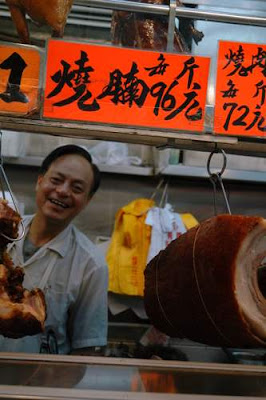
Image of Cantonese BBQ pork being sold from a small store in an alley, in Hong Kong.
Dear Gentle Reader,

Yesterday, I was asked what we have for Thanksgiving in Hong Kong.

This is a more difficult question to answer, for numerous reasons, than you might have expected.

You need to remember that the Hero of this blog, Pommes the Wonder Cat, eats fish.

So, from Pommes' perspective, Fish and Chips is mandatory before anyone starts to even talk about thanks. And the only giving he wants is a one way transaction. Fish to Chips.

(Pommes, the name, is German for chips, what my American friends would call french fries, and what my French friends would call pommes frites.)

And, when it is time to start thinking of thanks, Pommes' idea of giving of thanks is an insouciant feline sniff of 'whatever' whenever that fish has *finally* come his way.

I should note, of course, that Pommes does remove his claws from your leg when you actually hand him the fish; for that, your humble scribe always gives thanks.

The Heroine of this e-house is German. They don't celebrate Thanksgiving.

Finally, your humble scribe, like the Hero, is Canadian. So, technically, my Thanksgiving was a month or so ago.

So the easy answer would be, we don't celebrate Thanksgiving in this house, at least not in November.

But, that would be a cop-out for the question of what do people eat in Hong Kong for Thanksgiving.

The challenge in answering, however, is that that question must be phrased in the conditional future subjective.

Hong Kong, being, previously, a British colony, never had Thanksgiving as a holiday.

And I seriously doubt that the Chinese will be bringing Thanksgiving, as a holiday, to Hong Kong, or to the mainland, anytime soon.

So, the question has to be framed as "What would people in Hong Kong have for a Hong Kong Thanksgiving, if and when they were to celebrate such a thing?".

The Mayflower never stopped in port here.

Hong Kong never had Pilgrims fleeing religious persecution, only to, upon arrival, rob the locals of their cached food and desecrate local burial grounds.

True, Hong Kong had economic migrants, sojourners mostly, that came to Hong Kong for quick cash.

And, sure. Hong Kong's sojourners were willing to rob the locals, and each other, likely, and, presumably, had few concerns for local funerary, or other, customs.

But, there was no Mayflower compact to help us figure out when to start considering setting a date for a Hong Kong Thanksgiving.

And, before we set a menu, we do need to set a date for a Hong Kong Thanksgiving--to know what would be in season.

But, there was a compact that we can go by. One that, in some ways, mirrors the cross-cultural talks between the Pilgrims and the Native Americans...

The earliest agreement that Hong Kong would become British was reached on Jan 20, 1841, during the Convention of Chuenpi.

The Convention of Chuenpi called for the British to remove their men and boats from Chusan and, in return, to receive Hong Kong.

The British negotiator, Captain Charles Eliot, thought the Agreement in Principle would be binding and final so he proceeded to remove his men from the isle of Chusan, southeast of Shanghai, to Hong Kong Island--much farther from both Shanghai and Beijing.

The British landed on Hong Kong Island on Jan 25, 1841 and drank congratulatory toasts. They were thankful for a possession, even if it was a barren rock.

That landing and those toasts were repeated the next day, to be official, at Possession Point on Hong Kong Island.

(Strangely, Possession Point is not signposted anywhere in Hong Kong--I am still searching for clues as to where it was.)

So, maybe one of those two landing dates could be seen as Hong Kong Thanksgiving dates; dates for being thankful for having a harbour, a place to get out of the boats.

Of course the Convention of Chuenpi was renounced by the Chinese and, on Feb 24, 1841, hostilities were resumed by the British, but the British kept Hong Kong, at least until midnight of June 30, 1997.

If I had to choose a date I would go with the unofficial landing, and subsequent libation, of Jan 25.

(Hong Kong has always been a bit unofficial around the edges.)

Having set a date we can now set a menu.

Here, no one celebrates anything with turkey (although the hairy crab festival has just ended).

(Maybe I'll write about hairy crabs next week. Or brothels. They're both related. Take your pick.)

But, returning to the moment, I was asked what we would eat in Hong Kong for Thanksgiving.

MichaelO asked if we would have duck, rather than turkey.

I think not, MichaelO.

I think Hong Kong would go with something more traditional, more historical, and with much more of a kick.

Until Hong Kong finally went cold turkey, the raison d'etre of Hong Kong was opium.

I think a Hong Kong Thanksgiving, to be historically accurate, would have to involve opium.

Possibly shaped like a duck, but then smoked.

Hong Kong, you must remember, was created for one thing only.

The offloading, storage, and transshipment of opium from India into China.

(Sometimes that is shortened, the way things in English can be, to read: Hong Kong, you must remember, was created for one thing only--money.)

Opium helped stem the phenomenal outflow of silver from the British treasury to China.

The Chinese State had refused to purchase any goods from foreigners. The Chinese were happy to export only their own goods, and to receive silver, only, in payment.

The Chinese State controlled all importation and exportation so, for industrial goods, at least, what the State said, went.

The British, like the rest of Europe, liked many things produced in China, but the imperial coffers started to empty themselves, at an accelerating rate, to pay for imports from China.

British merchants then discovered that they could sell Indian opium (especially Bengali opium) to China.

The opium was smuggled into China by British merchants and sold to Chinese partners, illicitly, who completed the logistics of distribution to the masses.

And what did the smugglers receive for their opium? And what did the British Empire receive for its opium, when it sold it in India to private firms?

They received silver.

The British government made money on the sale of opium from its holdings in India and these sales alone reversed the net outflow of silver from the Imperial coffers. Further, that reversed flow of silver became a deluge of silver swamping the British Empire's Imperial treasury.

These revenue inflows afforded the luxuries and development of India, by the British, and of England, and much of the Imperial holdings.

The traders, both British and Chinese, also made fantastic sums.

How much opium are we talking about?

In 1830, the trade of opium into China was around 19,000 chests per year. By 1838, that trade had grown to around 40,000 chests of opium.

A chest held a picul of opium. This translates to between 60-65 kilograms, or 132-143 pounds, ish, of opium, per chest.

At 40,000 chests we are talking about up to 2,600 metric tonnes of opium, or 5.72 million pounds of the stuff.

In Hong Kong, today, and then, what matters is money.

And 5.72 million pounds of opium, per year, brings in a lot of money.

That is what drove the trade, and the founding of Hong Kong, and what people, Chinese and Western both, were thankful for, even when they found the opium trade distasteful.

Opium made the wheels of Empire spin round.

In North America, at Thanksgiving, after consuming the tryptophan glut that is turkey dinner, people pass out.

In Hong Kong, after filling your lungs and gut with opium, you pass out too.

And there is no need to eat.

That is why Opium den habituées are so thin and why Yves Saint Laurent never had to round up plus-sized models for his Opium fragrance collection.

So.

Short question with a long answer.

What would a Hong Kong Thanksgiving look like if there were to be one?

It would look just like an American turkey glut, but with less food, skinnier bellies, and only opium on the menu.

I hope that helps.


Tschuess,
Chris

Amazon.com iTunes

Click to hear 'Nuevo Mexico' from the album 'Opium' by Ottmar Liebert & Luna Negra
Amazon.com

Friday, November 13, 2009

On neural chains of chance, national prejudice, and the Character of Holland

Image of a shark net, a fabric chain, off of Stanley Beach in Hong Kong.
Dear Gentle Reader,

Be forewarned. Your humble scribe feels that it's time for a ramble; it's time to follow a neural chain.

On my birthday I attended a Scottish ball, a black tie ceilidh, here in Hong Kong.

A ceilidh is a Gaelic dancing social. Quick, nimble Gaelic dancing is usually accompanied by quick, nimble alcohol consumption; ceilidhs generally become more boisterous as the evening progresses.

Conversation, like dancing styles, also grows more fanciful as the evening progresses and the youthful gaiety of the evening reminded me of that Scottish playwright Sir James Matthew Barrie.

Sir J.M. Barrie (1860-1937) wrote Peter Pan, or The Boy Who Wouldn't Grow Up, in which Peter Pan and Tinkerbell took Wendy Darling, and her brothers John and Michael, to Neverland where the Darlings met the Lost Boys Gang, Tiger Lily, Dr. Hook, and other characters from Sir Barrie's imagination.

I won't spoil the ending. Or the middle.

Of course, and the spoiler might be here, Neverland is not real; Neverland is a land of the imagination for The Boy Who Wouldn't Grow Up.

But neural chains, like boys who won't grow up, cannot rest.

The Neverland that Michael Darling visited brought to mind both the estate and travails of another Michael, one Mr. Jackson; another boy who never grew up, at least not to the same state of adulthood as others.

Michael Jackson's legal skirmishes in life, and his estate's battles in death, bring to mind the skirmishes of war. But, of course, legal wars. Wars fought in the courtroom; wars with rules.

The rules of war bring to mind the laws of war, and, hence, Hugo Grotius, that Netherlander who wrote the first textbook on the Laws of War, and helped codify warring nations' practices to civilise war, for a while, at least.

"Civilising" efforts, however, are never absolute. (Elizabethan England saw Shakespeare and Marlowe, but groundlings hurled guts onto the Globe's stage during Shakespeare's performances whilst dog fights, cock fights, and bear baiting went on in the streets outside...)

The rule-bound war led, with strategy bound to prior weaponry, to vast slaughter amidst the trenches of The Great War, the War to End All Wars. After the unending orders for men to go "over the top" of one trench to another, to their deaths in the life grinder that was the trench-warfare theater, it was inconceivable that there could ever be another war.

Of course the War to End All Wars was not, despite its over the top death toll--almost 10 million military personnel and almost 7 million civilians by the end.

The appalling deaths of trench warfare, from the War to End All Wars, however, were to be eclipsed, within a generation, by the Second World War--22-25 million military deaths and 40-52 million civilian deaths. (Estimates vary.)

Further, the Second World War showcased the most "over the top" instrument of war yet devised, the Bomb with a capital B (killing 70,000 people in Hiroshima within three days of that singular strike, mostly civilians, and at least that many more in Hiroshima after that three day window).

The Bomb promised, or threatened, depending on your political stripes, to atomise the earth and, further, to rend earth into sound and fury, signifying everything, not the nothing which Faulkner thought.

Normally men fight to take land.

To conquer and then to pillage, or to hold.

But, the Bomb would negate land, and make it never land...

Or, at least, never land that is uninhabitable from the perspective of mere generations of men and women versus the radioactive half lives of atomic bomb fallout.

Too scary.

Let's go back to Michael Jackson.

No, he's too scary, too.

Right. Back to Peter Pan.

And to Neverland.

Land that never was.

The ultimate neverland, to an ancient Sumerian scribe raised in the desert of the Fertile Crescent by towering Babylon, is, of course, the ocean.

The ocean is never land, only water.

And those watery neverlands, with the roaring maw of the sea, are never safe for any desert scribe nor even for most sailors...

Out of your ship, in the rough sea, one finds that there is only so long that you can tread water. (Desert-bred scribes know that you can tread on land for far longer than in water.)

As you can imagine, from the never land, the ocean, the neural chain of chance automatically reconnects with the Netherlands.

The Netherlands; that tiny country sandwiched between the behemoths of France and Germany and then pushed below sea level.

The Netherlands; the Low Lands--a land mass which ought not to exist, as their land lies below sea level (and they abut the sea).

The Netherlands, a land that ought not to be--not necessarily a bad tourism slogan.

The Netherlands, the great synecdoche (where a part stands in for the whole) as many know the Netherlands simply by the name of its biggest, onetime, but no more, province, previously a county, Holland.

The County of Holland was officially recognized by the mid-eleventh century and existed until the seventeenth century.

As the County of Holland contained Amsterdam, Rotterdam, Den Hague, Haarlem, and Doordrecht, it is well understandable that this economic and maritime powerhouse came to stand for the whole in an ongoing historical synecdoche.

And, of course, with all that maritime, economic might came wealthy sailors.

Sailors who have been at sea a while...

...on perilous and correspondingly lucrative journeys...

...sailors, with money jangling in their pockets...

...sailors who have not been near the nether lands of women for a while...

So, of course, Amsterdam has a famous red light district... ...an alternate origin theory for the naming of the Netherlands? ...

But, away from the bedroom, the red room, and gender politics, backing into geopolitics, the Netherlands, as an economic and maritime power, was a threat to the other, very close, economic and maritime power of the day...

England.

And competition, and jealousy, invoked spite.

An aside.

Gin and tonic was the favoured drink of the British planters of India.

The planters were those fabulously wealthy, though socially shunned, British plantation owners, in India, in the days of empire (Pax Britannica).

Gin was originally a lower-class alcoholic drink for the masses, from the Netherlands, which made it's way to England.

Part of what made the planters in India so socially reviled, beyond their wealth, which generally exceeded their breeding, was that they drank so much, and that they drank that Dutch abomination, gin.

(As a further aside, the Indian planters drank Gin and Tonic for both the soporific effects of the gin and the medicinal effects of the bitter tonic water. Tonic water is bitter because it contains quinine, a prophylactic against malaria, the "bad air" (mal aria) disease now known to be spread by certain mosquitoes.)

Gin was not the only thing, however, despised by Englishmen to come from the Netherlands.

One of the great men of international law, Hugo Grotius (1583-1645), came from the Netherlands (although he soon fled, first to France, then to Sweden due to religious and political persecution).

Hugo Grotius not only realized, and codified, the laws of war, but Hugo also wrote a treatise on the law of the seas, the Mare Liberum, in which he promulgated the view that the High Seas are free, or open, to all.

The idea of a free sea was a shot across the bow of Britain, which used its naval might to control the seas.

John Selden (1584-1654), the British legal theorist, responded to Grotius' Mare Liberum with a legal/political tract (as all these tracts were, explicitly, then) called the Mare Clausum, the closed sea.

The Mare Clausam argued that maritime powers might encompass, enclose, and control the sea--to the exclusion of weaker maritime players.

Well, everyone has heard the expressions about the freedom of the High Seas; the open sea argument won out, at least for the next few hundred years, yet both vitriol and animosity remained between England and the Netherlands.

And vitriol brings to mind not just Greek fire, but invective, too.

And this long chain of chance, purporting to end at vitriol and invective, brought to mind the English metaphysical poet Andrew Marvell (1621-1678) and his biting invective directed against the Netherlands...

...Ideology wars, circa the seventeenth century...

By Andrew Marvell:

The Character of Holland


Holland, that scarce deserves the name of Land,
As but th'Off-scouring of the Brittish Sand;
And so much Earth as was contributed
By English Pilots when they heav'd the Lead;
Or what by th' Oceans slow alluvion fell,
Of shipwrackt Cockle and the Muscle-shell;
This indigested vomit of the Sea
Fell to the Dutch by just Propriety.

Glad then, as Miners that have found the Oar,
They with mad labour fish'd the Land to Shoar;
And div'd as desperately for each piece
Of Earth, as if't had been of Ambergreece;
Collecting anxiously small Loads of Clay,
Less then what building Swallows bear away;
Transfursing into them their Dunghil Soul.

How did they rivet, with Gigantick Piles,
Thorough the Center their new-catched Miles;
And to the stake a strugling Country bound,
Where barking Waves still bait the forced Ground;
Building their watry Babel far more high
To reach the Sea, then those to scale the Sky.

Yet still his claim the Injur'd Ocean laid,
And oft at Leap-frog ore their Steeples plaid:
As if on purpose it on Land had come
To shew them what's their Mare Liberum.
A daily deluge over them does boyl;
The Earth and Water play at Level-coyl;
The Fish oft-times the Burger dispossest,
And sat not as a Meat but as a Guest;
And oft the Tritons and the Sea-Nymphs saw
Whole sholes of Dutch serv'd up for Cabillan;
Or as they over the new Level rang'd
For pickled Herring, pickled Heeren chang'd.
Nature, it seem'd, asham'd of her mistake,
Would throw their land away at Duck and Drake.

Therefore Necessity, that first made Kings,
Something like Government among them brings.
For as with Pygmees who best kills the Crane,
Among the hungry he that treasures Grain,
Among the blind the one-ey'd blinkard reigns,
So rules among the drowned he that draines.
Not who first see the rising Sun commands,
But who could first discern the rising Lands.
Who best could know to pump an Earth so leak
Him they their Lord and Country's Father speak.
To make a Bank was a great Plot of State;
Invent a Shov'l and be a Magistrate.
Hence some small Dyke-grave unperceiv'd invades
The Pow'r, and grows as 'twere a King of pades.
But for less envy some Joynt States endures,
Who look like a Commission of the Sewers.
For these Half-anders, half wet, and half dry,
Nor bear strict service, nor pure Liberty.

'Tis probable Religion after this
Came next in order; which they could not miss.
How could the Dutch but be converted, when
Th' Apostles were so many Fishermen?
Besides the Waters of themselves did rise,
And, as their Land, so them did re-baptise.
Though Herring for their God few voices mist,
And Poor-John to have been th' Evangelist.

Faith, that could never Twins conceive before,
Never so fertile, spawn'd upon this shore:
More pregnant then their Marg'ret, that laid down
For Hans-in-Kelder of a whole Hans-Town.

Sure when Religion did it self imbark,
And from the east would Westward steer its Ark,
It struck, and splitting on this unknown ground,
Each one thence pillag'd the first piece he found:
Hence Amsterdam, Turk-Christian-Pagan-Jew,
Staple of Sects and Mint of Schisme grew;
That Bank of Conscience, where not one so strange
Opinion but finds Credit, and Exchange.
In vain for Catholicks our selves we bear;
The Universal Church is onely there.
Nor can Civility there want for Tillage,
Where wisely for their Court they chose a Village.
How fit a Title clothes their Governours,
Themselves the Hogs as all their Subjects Bores

Let it suffice to give their Country Fame
That it had one Civilis call'd by Name,
Some Fifteen hundred and more years ago,
But surely never any that was so.

See but their Mairmaids with their Tails of Fish,
Reeking at Church over the Chafing-Dish.
A vestal Turf enshrin'd in Earthen Ware
Fumes through the loop-holes of wooden Square.
Each to the Temple with these Altars tend,
But still does place it at her Western End:
While the fat steam of Female Sacrifice
Fills the Priests Nostrils and puts out his Eyes.

Or what a Spectacle the Skipper gross,
A Water-Hercules Butter-Coloss,
Tunn'd up with all their sev'ral Towns of Beer;
When Stagg'ring upon some Land, Snick and Sneer,
They try, like Statuaries, if they can,
Cut out each others Athos to a Man:
And carve in their large Bodies, where they please,
The Armes of the United Provinces.

But when such Amity at home is show'd;
What then are their confederacies abroad?
Let this one court'sie witness all the rest;
When their hole Navy they together prest,
Not Christian Captives to redeem from Bands:
Or intercept the Western golden Sands:
No, but all ancient Rights and Leagues must vail,
Rather then to the English strike their sail;
to whom their weather-beaten Province ows
It self, when as some greater Vessal tows
A Cock-boat tost with the same wind and fate;
We buoy'd so often up their Sinking State.

Was this Jus Belli & Pacis; could this be
Cause why their Burgomaster of the Sea
Ram'd with Gun-powder, flaming with Brand wine,
Should raging hold his Linstock to the Mine?
While, with feign'd Treaties, they invade by stealth
Our sore new circumcised Common wealth.

Yet of his vain Attempt no more he sees
Then of Case-Butter shot and Bullet-Cheese.
And the torn Navy stagger'd with him home,
While the Sea laught it self into a foam,
'Tis true since that (as fortune kindly sports,)
A wholesome Danger drove us to our ports.
While half their banish'd keels the Tempest tost,
Half bound at home in Prison to the frost:
That ours mean time at leisure might careen,
In a calm Winter, under Skies Serene.
As the obsequious Air and waters rest,
Till the dear Halcyon hatch out all its nest.
The Common wealth doth by its losses grow;
And, like its own Seas, only Ebbs to flow.
Besides that very Agitation laves,
And purges out the corruptible waves.

And now again our armed Bucentore
Doth yearly their Sea-Nuptials restore.
And how the Hydra of seaven Provinces
Is strangled by our Infant Hercules.
Their Tortoise wants its vainly stretched neck;
Their Navy all our Conquest or our Wreck:
Or, what is left, their Carthage overcome
Would render fain unto our better Rome.
Unless our Senate, lest their Youth disuse,
The War, (but who would) Peace if begg'd refuse.

For now of nothing may our State despair,
Darling of Heaven, and of Men the Care;
Provided that they be what they have been,
Watchful abroad, and honest still within.
For while our Neptune doth a Trident shake, Blake,
Steel'd with those piercing Heads, Dean, Monck and
And while Jove governs in the highest Sphere,
Vainly in Hell let Pluto domineer.

Marvell's word choice is wonderful, and his political invective is biting and forceful. Educated, yes, but also bombastic, gutter vitriol.

And thus, possibly fittingly, a neural chain that starts in whiskey-fuelled gaiety and imaginary lands ends up in world wars followed by Marvellous nationalism.

I might now understand why US President Woodrow Wilson died so unhappy.

My ramble is over. Now to find suitable music...


...

Only one piece of music seems appropriate after a spuriously connected ramble like that, and I will give you the most inappropriate version first.

I say that Thomas "Fat's" Waller's version, arranged in 1940, is the most inappropriate because Fat's Waller's version is the first secular version of "Dem Bones" or "Dry Bones"; it is a complete break in the spiritual chain from whence "Dem Dry Bones" had come.

The earliest musical version of "Dem Bones" comes from 1930 and the Delta Rhythm Boys.


But, the Delta Rhythm Boy's version of "Dem Bones" itself stems from a long line of Christian sermons, mostly from Black ministers in the Deep South of the USA, such as the following excerpted sermon by the Revered J. M. Gates from December, 1926.

This is a short part of the sermon (3 min 35 seconds). It starts slow but, within a minute, you can see where the song would later appear from.


I have lost a few crates of cds in various moves around the world. Imagine my surprise, today, to discover that the cd in question is one which I have lost (hence my resorting to the above web-archived version).

Click here to buy the cd directly from Document Records, the publishing group that brings the Rev. J.M. Gates to us from this Dec 1927 Sermon on wax. Thank you, Document, I'm sorry that I cannot find my original cd.

Amazon.com iTunes


And that is truly that. Sorry for being so wordy, today.

I'll try to blame Andrew Marvell for the length of this post. Or my fingers for typing it. But, I will return to shorter posts. It's just that it has been so long. My brain was eager to dance and, I know, it's time to bind the neural chains rather than let them whip around freely.


Tschuess,
Chris