Showing posts with label market. Show all posts

Wednesday, May 20, 2009

2IFC, Hong Kong, and global power manifested through buildings

Image of Hong Kong at night. Note the tall IFC2 tower, the super tall skyscraper, on Hong Kong Island.Dear Gentle Reader,

Welcome back. Again.

It's gratifying to see you after a month-long interregnum.

On Monday, I provided documentary evidence that Batman was in Hong Kong.

Today, I look more closely at that documentary evidence. 


Image of the promotional poster for the 'The Dark Night', 2008, with Christian Bale as Batman.
See that building rising up to the left of Batman? 

The one in the mid ground of the Batman photo? 

That building is the imposing, César Pelli designed, 415.8 m (with radio antenna)(1364.2 feet) tall 2IFC (International Finance Centre, Tower Two).

Image of 2IFC, Two International Finance Centre, in Hong Kong.
Strangely, 2IFC is usually pronounced IFC Two... Don't ask me why.

In fairness to other buildings around the world striving to be tall and to be counted, the architectural height, the height without aerials or lightning conductors, of 2IFC is only 406.9m (1335 feet). 

That still makes 2IFC the tallest building, currently, in Hong Kong, and the eighth tallest building in the world. 

When the Burj Dubai is finished in a couple of months, 2IFC will drop to being the ninth tallest building in the world.

On a Batman-related aside, 2IFC is the same building that Batman broke into in "The Dark Knight".

It is also the building that Batman is standing in in the promotional picture, shown below for "The Dark Knight".

Finally, and paradoxically, it also the building visible in the distance, to the left of Batman, in the same promotional picture... 

Image of the promotional poster for the 'The Dark Night', 2008, with Christian Bale as Batman.
How Batman accomplishes this is unknown to your humble scribe.

Seeing the same building, in the distance, that Batman is standing in is proof of movie magic to your humble scribe.

(Your Hero could have explained this to your scribe, but he is strangely absent. He apparently absconded from his catnip rehab clinic and left a note saying that he is looking for a Miss Kitty. ?. Can anyone explain this?)

Image of 2IFC (International Finance Centre Two) on Hong Kong Island, seen from the water dwarfing the neighbouring buildings.
As you can see, 2IFC, with its lucky 88 floors (over twenty floors are double height for trading floors) and its 62 elevators, dominates the Hong Kong skyline.

Soon, the ICC (the International Commerce Centre) being built in Kowloon will surpass 2IFC (Two International Financial Centre) in height. 

But, ICC will be on Kowloon, facing 2IFC. 

2IFC and ICC staring at each may be an architectural, financial reminder of Scylla (Σκύλλα) and Charybdis (Χάρυβδις), the twin classical monsters perched, respectively, on a massive rock and a whirlpool on opposite sides of the tiny (as narrow as 3.1 km or 1.9 miles) Straight of Messina between Sicily and Calabria.

Scylla and Charybdis destroyed and devoured all the sailors who attempted to sail by them; woe to the financial peon who tries to get between 2IFC and ICC.

Actually, a posting on the oligopolistic nature of Hong Kong might be interesting, at some point in time...

But, back to 2IFC.

When I researched the global statistics on 2IFC, and other buildings for comparison, I discovered something interesting.

With status comes competition. 

OK. That's obvious.

But, fights for building the tallest and highest have yielded different definitions and ways of measurement.

There are now four categories of potential highest buildings, or, more properly, structures. 

For reference these are: 

(1) structures (supported) is the category for structures built solely in the air (as opposed to rising out of the sea), and these structures can be supported by cables or by guy-wires, as many radio aerial structures are--these structures are measured by pinnacle height, or the maximum built height, for measuring and ranking purposes; 

(2) structures (media-supported) is for structures like oil platforms that are partially supported by mediums like mater--these, again use pinnacle height; 

(3) free standing structures (so no guy-wires)-- are for non-inhabitable buildings like the CN Tower in Toronto, Canada, and, again, pinnacle height is used; and

(4) buildings-- are for inhabitable structures and these are measured and ranked using architectural height, id est the height of the habitable building, not the pinnacle height.

What your humble scribe thought interesting was not the four categories of structures and how they were measured. 

Once the categories were defined, I was only interesting in determining the forty tallest buildings within category four.

What is interesting is the geographical and chronological distribution of the forty tallest buildings in the world.

11 of the 40 are in the United States of America (USA).
8 of the 40 are in the People's Republic of China (China).
7 of the 40 are in the United Arab Emirates (UAE, specifically Dubai).
6 of the 40 are in Hong Kong.
3 of the 40 are in Malaysia.
2 of the 40 are in Taiwan.

The remaining 3 structures are in Saudi Arabia, North Korea, and Australia.

Of course, China officially controls Hong Kong, although Hong Kong still gets to assert limited aspects of sovereignty until 2047. 

That means that my geographical listing of the 40 tallest buildings could be modified to read:

14 in China;
11 in the USA;
7 in the UAE; and
8 elsewhere.

Or, we could slice the tallest buildings in the world regionally.

20 of the 40 are in Asia.
11 of the 40 are in North America (OK, the USA).
8 of the 40 are in the Middle East.
1 of the 40 is in Oceania (Australia).

It is interesting to note that 0 of the 40 tallest buildings in the world are in the old world, altus mundi, Europe. 

The Russians were planning to build a contender in Moscow, but it has been scrapped due to the global financial meltdown.

Also, 0 of the 40 tallest buildings in the world are in the cradle of the world, Africa, where we all come from, which ought to surprise nobody given the paucity of global wealth located within Africa.

But, we could also look at this list historically or chronologically.

First, a tiny aside.

The original, architectural, land-based use of the word skyscraper, when the term shifted in use from the tall masts on ocean-going sailing ships to tall buildings, was for the Home Insurance Building completed in 1885 in Chicago. 

The Home Insurance Building was a whopping ten stories tall. (It is no longer standing and is certainly not on the list of forty, which is why it was an aside.) 

I will deal only with the standing buildings that still make up the 40 tallest buildings in the world, although I will include the  World Trade Center in the historical list for historical perspective and analysis.

So, onwards to the chronological groupings of buildings...
 
Even though the Great Depression started in 1929, the earliest two buildings on the list are the Chrysler Building, built in 1930, and the Empire State Building, built in 1931, both in New York.

The Great Depression saw a boom in road, reservoir, and dam construction in the USA through federal legislation authorized by President Hoover's (Hoover's presidency was 1929-1933) Emergency Relief and Construction Act, 1932, and then further stimulus brought in by FDR (President Franklin Delano Roosevelt) (FDR's presidency was 1933-1945, four terms!) as part of FDR's New Deal.

The Great Depression did not see, however, a boom or even a continuation of the building of skyscrapers.

The skyscraper building lull, after the Great Depression, lasted almost forty years, until 1969.

1969 saw Chicago's explosion resume, after the 1885 Home Insurance Building, with an order of magnitude gain over the first skyscraper the world had seen. 

1969 heralded the 100 storey John Hancock Centre measuring up at 344 m or 1129 feet. 

1970 and 1971 saw the World Trade Centre's Twin Towers completed, although they are not counted in the top forty because they are no longer standing.

1973 saw Chicago's Aon Centre and, in 1974, Chicago's Sears Tower being completed.

The next construction lull lasted 9 years until Houston's JP Morgan Chase Tower was completed in 1982.

1989 saw Chicago's AT&T Corporate Center completed as well as the US Bank Tower in Los Angeles.

Finally, 1992 saw Atlanta's Bank of America Plaza completed.

That marks the completion of the first 8 tallest buildings from my list of the 40 tallest buildings still standing.

It also marks 8 of the USA's 11 buildings in that list of 40 buildings.

1992 also saw the first non-American entry into the tallest building in the world.

The first non-America entry to the list of the 40 tallest buildings in the world was the topping out of the Ryugyong Hotel in North Korea, of all places.

31 of the 40 tallest buildings in the world were all completed in 1996 or later.

Of these 31 buildings, only 3 were built in the USA. 

Of those 31 buildings built in 1996 or later, 27 were built in Asia or in the Middle East.

Power is shifting.

It's visible.

And the very new world, or the very old, depending upon your perspective (modern financial clout versus a civilisation's age) is feeling pretty triumphal.

Image of fireworks against a backdrop of Victoria Harbour, Hong Kong Island, 2009.
 
Tschuess,
Chris

Monday, May 18, 2009

Gotham City in Hong Kong

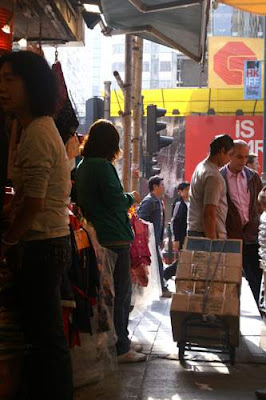
Image of a porter carrying goods by hand trolley and exiting an alley in Kowloon, Hong Kong.
Dear Gentle Reader,

The last month was an e-interregnum for your humble scribe. It is good to be back, but it may take me a while to get into the swing of things.

The pre-programmed posts, during the e-interregnum, kept saying that I lived in Gotham.

Today I'll take you on a quick stroll to a Gothamesque alley in my town to explain what I meant.

But, first, let me clear up some potential confusion. At least one reader thought that I was claiming to be Batman.

I am not Batman and do not claim to be Batman.

I cannot be Batman because I have seen him, and not in my mirror when shaving.

Batman's a neighbour.

Yes, I've seen the caped crusader.

It was nothing good, though. I saw him in an unfortunate, unanticipated bit of voyeurism, through the window of a neighbouring building.

I hadn't realized that Batman was a neighbour.

And Chinese.

And possessing a hefty paunch...

He was in his Batgear underoos.

Partially.

And his batmask.

Fully.

Doing the Bat Love Dance...

...I am still trying to unsear that image from my memory...

For a week afterwords, all I could say was "Bring out the batgimp, Robin" in a mental flashback mashup of both Pulp Fiction and the camp 1960s Batman and Robin TV series (the one with Adam West).

For those of you who need more proof that Batman was here, I enclose documentary evidence.

Image of the promotional poster for the 'The Dark Night', 2008, with Christian Bale as Batman.
And now, back from the Batcave to Gotham and its sister city, Hong Kong.

What makes Gotham City so memorable, to your humble scribe, is the omni-present, visceral contrast between glitziness and grittiness, between good and evil, and between sparkling steel glamour and wealth and stinking cesspits for the underclasses.

Which is just like Hong Kong.

This was why I kept saying, in my pre-programmed posts during the e-interregnum, that I lived in Gotham.

My building is an unlikely bit of glitziness meant, I think, to appeal to new Russian oil wealth.

When I exit the lobby of my building I pass under a behemoth glitzy, black, glass chandelier imported from Murano Island, the glass making mecca that is part of the Commune of Venice.

I pass by a gleaming, shining stainless steel sculpture and say hello, and goodbye, to the staff in their uniforms.

Then I walk outo into the Hong Kong heat and onto the street.

Half a block later I duck into an alley as a shortcut to take me to the next major street.

When I duck into that alley, I experience the transition from glitz to grit.

Ducking into that alley I dive into the Gothamesque seedy underbelly of Kowloon.

Normally, in Hong Kong, people walk abreast of each other in a jumbled skein of legs and arms and bags.

Image of the narrow start of the alley in Kowloon, Hong Kong, looking backwards after walking in it for 30 metres.People wouldn't walk abreast for long in this alley, even if there were only two people.

At least not without leaving their skin on the dirty, rough walls, because this alley starts off very thin.

The start of the alley is as wide as one seat, with two luxurious, padded, calf skin armrests, in first class on an airline. Or as wide as two seats plus one armrest in economy.

The alley widens after a bit and then gets darker as the buildings hedging it in become taller.

At the opposite end of the alley the light returns and the alley even becomes colourful.

Vendor stalls line either side of the far end of the alley, where the alley opens up onto a large street and pedestrian thoroughfare; the garish, gleaming, neon lit, tourist-oriented Nathan Road.

A busy thoroughfare like Nathan Road means significant foot traffic, which means potential sales in a market economy like Hong Kong.

Image of the alley at the far end where it opens onto Nathan Road, Kowloon, Hong Kong and where the alley vendors sell their colourful wares.Here, beside the busy pedestrian thoroughfare, the alley is brightened up with imitation 'genuine' silk gowns and robes and 100% handmade oil portaits, racks of gew gaws and, handily, luggage to store all your new acquisitions.

All these items line the walls of the alley, in the day-time, and are for sale as vendors try to beat the cost of Hong Kong rent by renting out the outsides of buildings, rather than the insides with their pricier ceilings and protection from the elements...

The rest of the alley, though, the middle, is grey and greasy and grimy and Gothamesque.

Which is great, to your humble scribe, because there is no bright without dim, no sweet without sour, no fresh without rancid, nor no perfume without rank odour.

Image of the alley, proper, in Kowloon, Hong Kong, near my house.
Without contrast there can be no differention, and my alley provides enough contrast to enjoy the finer things that Hong Kong has to offer.

I am all about the beauty of differences, so I love these alleys of Hong Kong.

I consider them my entries into Gotham.

Of course, I also have to agree with a six year old friend of mine, whom I was accompanying on a trip to the ballet and then to the park, when she looked at me very seriously, with a screwed up face and upturned nose, and she told me that my alley smelled bad.

She gave me the queerest look when I told her that that was one of the reasons why I liked it so much.

Despite their smells, and maybe because of them, I love these allies.

Where the tourists pass by these alleys are ambushes for guerrilla retail commerce "You buy now? You buy now! Very good! Cheap, cheap!"...

Further back from the thronging tourists, these alleys are homes for feral cats, cockroach overlords, and lesser cricket and ant serfs.

Hong Kong alleys let life fester and bloom, commercial and natural.

Gritty and grimy and sparkly and new.

This is my town.

Hong Kong.

Come visit and I might just take you to the good bits.

But we'll try to avoid the aging Batlothario in the neighbouring building.


Tschuess,
Chris

Wednesday, April 1, 2009

Suggestions for traveling

Image of a small, sidewalk shrine (in Hong Kong's New Territories) for local residents to provide offerings to one member of the pantheon of Chinese gods and goddesses to elicit better luck or outcomes or treatment...Dear Gentle Reader,

Last week, Teresa asked for suggestions for Americans traveling to Taiwan.

Teresa, it's been a long while since I was there. 

The Heroine and I have been chatting about returning to Taiwan, where we first met. 

Now there is a story. 

That involves scandal, Chinese doctors, toga wearing men, a witch, the police, surveillance teams, double-crossing taxi drivers, and para-military capture squads.

It includes thrilling chase sequences and hidden hideaways, smoky bars and steamy nightclubs, lost clothes and found love notes, secret ink and disappearing tattoos, chopper motorcycles entering densely populated warrens, crumbling concrete, and the electric crackle of decay and power lines.

It also includes directions, lost, and love, found.

Really! (真的!) 

(Although my version of that first encounter, and the context it occurred in, is far more glamorous than the Heroine's version. She leaves the good bits out.)

Taiwan can be magnificent.

But you are not interested in that, you want to know what to suggest to people visiting Taiwan.

For Taiwan, the obvious attractions are in Taipei. 

Send the first-timers to the Shilin Night Market. At night. 

Send them to the tea houses and to the temples. 

Send them to Taipei 101.

Image of a Night view of Taipei from Xiangshan Peak / 從象山俯瞰台北夜景 taken on 2006.09.17 by  / 本人 (photo by Jerome Chen http://beb.anyday.com.tw 攝影) and released to the world by the copyright holder with: Permission is granted to copy, distribute and/or modify this document under the terms of the GNU Free Documentation License, Version 1.2 or any later version published by the Free Software Foundation. This image was sourced through Wikimedia.

But that is all in the tourist guides.

If you really want to know what I thought, I'd say...

Well, I'd just tell them to observe everything. 

Watch the way people scan the shelves when they are buying. 

What is stocked on the shelves, and where.

What the "must have", impulse buy, high margin high profit item is right by the checkout stand.

The ways advertising tries to sell things.

The things that make the locals raise their eyebrows with delight, or with interest, and those things that make them lower their noses in disdain.

The ways cafes are operated and run. 

The ways people communicate with each other when they walk down the street. 

The ways men and women try to attract each other. 

The way kids play. 

The way that automotive traffic moves. 

The way that foot traffic moves.

I'd suggest they try and determine the underlying rules of the society and then prognosticate future actions to test their theories. 

Then, I would suggest that they do the same things when they arrive in Taiwan. 

And repeat, yet again, when they return to their home country. 

What we learn most, through traveling, is about ourselves and where we are from. 

We discover ourselves through observing and interacting with others.

That, Teresa, is the advice I would give. 

But, tell them to walk up Yang Ming Shan (陽明山) and hike in the jungle forest (and watch for snakes in the bamboo).

I would urge them to soak up cultural treasures in Taiwan's National Palace Museum, spin with wide-eyed wonder in the breathing, living, incense-snorting temples everywhere, and unwind for a placid day in the tea gardens in Jiufen (九份), just outside Taipei, having laoren cha (老人茶) (the old man's tea ceremony).

I'd tell them to dance all night in whatever the hippest night clubs are, this week, because who knows if tomorrow will come and leaving the night club when the day-treaders are heading to the slavery of the office is oh so rewarding.

Also, if they are in Taiwan for more than a week, I would exhort them to discover Taiwan, not just Taipei, because the island is so lush, and so worth exploring. 

Taiwan, after all, was called Ilha Formosa, or Beautiful Island, by the Portuguese on first sight based on the vegetative beauty they saw; the verdant, living, fog-bejewelled, coruscating palette covering the massive island. 

That is what they saw when the Portuguese sighted Taiwan in 1544 on their way to re-supply in the Pescadores (Portuguese for the Fishermen), now known as Penghu, 澎湖群島. And it is still true today, if you look beyond the pollution either side of the motorway and around the factories.

Beauty, and life, will out.


Tschuess,
Chris

Thursday, December 11, 2008

A weighty affair

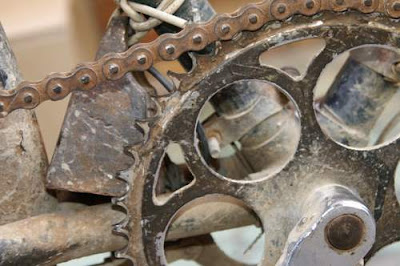
image of a Chinese bike, close focus on the major chain wheel, with a small weight affixed to the shaft by a wire.Dear Gentle Reader,

On July 1, 1997, governance of Hong Kong was handed over from the United Kingdom of Great Britain to the People's Republic of China. 

Part of the terms of the Handover Agreement specified that for fifty years following the handover of Hong Kong, the underlying legal system based on British common law and equity principles, apart from the creation and adoption of Hong Kong's new Basic Law, would remain fixed.

In popular terms, or in propaganda, this is described as two systems, one country.

Residents of Hong Kong enjoy many rights and responsibilities that are different from those rights granted to, and those obligations required from, residents of "Mailand China", the People's Republic of China.

What happens after fifty years and one day? All bets are off...

So what does two systems, one country, look like on the ground?

On Monday, we looked into a Hong Kong/Kowloon market

Yesterday, we made a meal from a Hong Kong/Kowloon market.

In the Hong Kong/Kowloon markets there is a tripartite system enshrined in law, but in practice only one system is used.

What is your scribe talking about?


This weights and measures ordinance has been in force in Hong Kong since June 30, 1997, and it deals with the definitions of units of measurements.

Parts one through four of the ordinance, dealing with length, area, volume, and capacity, give equal legal treatment to two systems of measurement, the British Imperial system and the Metric system.

Part five of the ordinance, dealing with measurement of mass or weight, is different.

Part five, dealing with mass or weight, provides legal standing for three systems of measuring weight.

Those three systems are British Imperial, Metric, and Chinese systems.

All three systems have the force of law.

Guess which one you have to know when shopping in the markets?

For those few people who do not know the Hong Kong Chinese system of measurement of mass or weight, it follows:

1 picul (tam) = 100 catties
1 catty (kan) = 0.60478982 kilograms
1 tael (leung) = 1/16 catty
1 mace (tsin) = 1/160 catty
1 candareen (fan) = 1/1600 catty
1 tael troy = 47.429 grams
1 mace troy = 1/10 tael troy
1 candareen troy =  1/10 mace troy

Simple, right?

For my Southern and British cousins, 1 pound is defined as = 0.45359237 kilogram exactly.

If you are not super fast with the math, let me help you.

1 catty = 1.3333333 pounds...

...Isn't that helpful.

Don't worry about bringing a calculator to the market; all the vendors have them.

Not only is the calculator useful to deal with weights and prices, calculators also transcend language when haggling like a bumpkin or negotiating like a sophisticate.

Tschuess,
Chris, Regina, and Pommes running out of toes