Showing posts with label Italy. Show all posts

Monday, December 14, 2009

On poison, naturally

Image of something angular and round, lit up by night titled 'What is this?'.Dear Gentle Reader,

After Friday, I kept thinking about poison. And food.

I thought about strychnine, for example.

Strychnine brought me back to Dr. Thomas Neil Cream (1850-1892), the Lambeth Poisoner, who gave strychnine to young woman, from the USA to England, who aroused him.

When young ladies came to his practice dressed inappropriately, according to his private determination (read arousal), he would retaliate (?) by giving them candy--strychnine tablets.

The young women would be dead by the next morning.

Those 'candies' were taken by the girls themselves, but at least they didn't know what they were popping into their mouths.

I say that because the next person and poison I thought of was poor Socrates (469 BC - 399 BC) who was required by the State to willingly drink hemlock.

Socrates was required to pour a draught of hemlock down his own throat, froma cup he held in his own hand, with the full knowledge of what the consequences of those swallows would be.

The thing about hemlock is it triggers paralysis of the body while the mind stays perfectly alert.... so, at all times you understand what is happening as your body slowly shuts down and you drown in the fluid that collects in your lungs.

This, to me, sounds perfectly horrid, similar to the shut-in syndrome that some stroke patients suffer from.

These nasty thoughts, naturally, (strychnine is naturally derived from Strychnos nux vomica, the strychnine tree, from Asia, whilst hemlock is naturally derived from poison hemlock, conium maculatum) led me to the Italian wine/poison, cantarella.

Cantarella was the fabled poison of the Renaissance Spanish/Italian Borgia family.

The House of Borgia came to prominence with election of one of their own, Alfonso de Borja (1378-1458), as Pope Calixtus III (1455-1458).

Ensconced in Italy, after moving with Alfonso de Borja from Valencia, Spain, the House of Borgia became known for their political prowess which allowed them to get another member of the family elected as Pope; Rodrigo Borgia (1431-1503) became Pope Alexander VI (1492-1503).

More accurately, the Borgias become notorious for the way that people who opposed them, or who stood in their way, or who possessed large sums of liquid cash (which the family would later seize) would die.

By poisoning.

The Borgias are believed to have made a mixture of arsenic and wine which they would give to people, and this poison became known as cantarella.

The Borgias reputedly experimented on animals and, later, on people, to determine how to vary the dosages so that the poison would (a) not be detected, and (b) they could determine beforehand when their victim would die.

Knowing when death would occur was good for both building alibis and for arranging votes, or transfers of funds...

The recipe of cantarella has been lost to time but it is rumoured that it involved arsenic which had been rendered more efficacious by being mixed with the entrails of animals and squeezed out in solution...

What is known is that cantarella remained tasteless and undetectable when added to red wine.

The Borgias were a bit like the spinster Brewster aunts from Joseph Kesselring's "Arsenic and Old Lace".

But, far more successful.

And, who would refuse a dinner with the Borgias?

It is a bit hard to imagine any Westerner, during the Renaissance, refusing a dinner with the Pope or with one of his family members.

You are likely wondering where this is all heading, today.

Well, all this thought of poisoning, and of food, brings to mind a bit of poisoning your humble scribe experienced, a while ago.

Food poisoning, yes, but more in the sense of the Borgias. And, more natural.

Do you want to know more?

Same time, Friday.

After 3WW on Wednesday.

I'll tell you all about it, then.


Tschuess,
Chris

Click to hear 'Love Potion No. 9' by The Coasters 'cause you have to love something to kill for it, no? Even if it's just the thrill...

Amazon.com iTunes

Tschuess,
Chris

Wednesday, December 2, 2009

3WW (CLXVI)

Image of a slightly battered butterflyDear Gentle Reader,

It's 3WW time, again.

This week (CLXVI) the words are fondle, kick, and sumptuous.

Further, each haiku gets its very own American sentence title.


Sally Field, fresh from 'Gidget'; Who needs wings to fly... not Sister Bertrille!

Biplane? Bicornette!
A habit you'll never kick
...Sumptuous Sister...


This is the cover art for The Flying Nun LP by the artist Sally Field. The cover art copyright is believed to belong to the label, Colgems, or the graphic artist. The cover art can or could be obtained from Colgems. The entire cover: because the image is cover art, a form of product packaging, the entire image is needed to identify the product, properly convey the meaning and branding intended, and avoid tarnishing or misrepresenting the image. The copy is of sufficient resolution for commentary and identification but lower resolution than the original cover. Copies made from it will be of inferior quality, unsuitable as artwork on pirate versions or other uses that would compete with the commercial purpose of the original artwork. Main infobox. The image is used for identification in the context of critical commentary of the work for which it serves as cover art. It makes a significant contribution to the user's understanding of the haiku, which could not practically be conveyed by words alone in 17 syllables. The image is placed haiku, to show the primary visual image associated with the work, and to help the user quickly identify the work and know they have found what they are looking for. Use for this purpose does not compete with the purposes of the original artwork, namely the artist's providing graphic design services to music concerns and in turn marketing music to the public. As musical cover art, the image is not replaceable by free content; any other image that shows the packaging of the music would also be copyrighted, and any version that is not true to the original would be inadequate for identification or commentary. Use of the cover art beside the haiku complies with fair use under United States copyright law as described above.


Read a dictionary, study hard, pass the tests; win a better life...

Sumptuous hall--packed...
Habit? "H. A. B. I. T."
(Spelling Bee kick-off)


Giacomo della Porta, "St. Peter's Basilica"; Arch'techt...

Kicked habit? Never!
Protected sumptuous Pope!
Built church to order!


This image is entitled 'Vatican City at large' and shows St. Peter's Basilica. This image was taken by Sébastien Bertrand from Paris, France, on 1 January 2005 and submitted to the Wikimedia Commons. This file is licensed under the Creative Commons Attribution 2.0 License.


Tschuess,
Chris

Wednesday, May 20, 2009

2IFC, Hong Kong, and global power manifested through buildings

Image of Hong Kong at night. Note the tall IFC2 tower, the super tall skyscraper, on Hong Kong Island.Dear Gentle Reader,
Welcome back. Again.

It's gratifying to see you after a month-long interregnum.

On Monday, I provided documentary evidence that Batman was in Hong Kong.

Today, I look more closely at that documentary evidence. 


Image of the promotional poster for the 'The Dark Night', 2008, with Christian Bale as Batman.
See that building rising up to the left of Batman? 

The one in the mid ground of the Batman photo? 

That building is the imposing, César Pelli designed, 415.8 m (with radio antenna)(1364.2 feet) tall 2IFC (International Finance Centre, Tower Two).

Image of 2IFC, Two International Finance Centre, in Hong Kong.
Strangely, 2IFC is usually pronounced IFC Two... Don't ask me why.

In fairness to other buildings around the world striving to be tall and to be counted, the architectural height, the height without aerials or lightning conductors, of 2IFC is only 406.9m (1335 feet). 

That still makes 2IFC the tallest building, currently, in Hong Kong, and the eighth tallest building in the world. 

When the Burj Dubai is finished in a couple of months, 2IFC will drop to being the ninth tallest building in the world.

On a Batman-related aside, 2IFC is the same building that Batman broke into in "The Dark Knight".

It is also the building that Batman is standing in in the promotional picture, shown below for "The Dark Knight".

Finally, and paradoxically, it also the building visible in the distance, to the left of Batman, in the same promotional picture... 

Image of the promotional poster for the 'The Dark Night', 2008, with Christian Bale as Batman.
How Batman accomplishes this is unknown to your humble scribe.

Seeing the same building, in the distance, that Batman is standing in is proof of movie magic to your humble scribe.

(Your Hero could have explained this to your scribe, but he is strangely absent. He apparently absconded from his catnip rehab clinic and left a note saying that he is looking for a Miss Kitty. ?. Can anyone explain this?)

Image of 2IFC (International Finance Centre Two) on Hong Kong Island, seen from the water dwarfing the neighbouring buildings.
As you can see, 2IFC, with its lucky 88 floors (over twenty floors are double height for trading floors) and its 62 elevators, dominates the Hong Kong skyline.

Soon, the ICC (the International Commerce Centre) being built in Kowloon will surpass 2IFC (Two International Financial Centre) in height. 

But, ICC will be on Kowloon, facing 2IFC. 

2IFC and ICC staring at each may be an architectural, financial reminder of Scylla (Σκύλλα) and Charybdis (Χάρυβδις), the twin classical monsters perched, respectively, on a massive rock and a whirlpool on opposite sides of the tiny (as narrow as 3.1 km or 1.9 miles) Straight of Messina between Sicily and Calabria.

Scylla and Charybdis destroyed and devoured all the sailors who attempted to sail by them; woe to the financial peon who tries to get between 2IFC and ICC.

Actually, a posting on the oligopolistic nature of Hong Kong might be interesting, at some point in time...

But, back to 2IFC.

When I researched the global statistics on 2IFC, and other buildings for comparison, I discovered something interesting.

With status comes competition. 

OK. That's obvious.

But, fights for building the tallest and highest have yielded different definitions and ways of measurement.

There are now four categories of potential highest buildings, or, more properly, structures. 

For reference these are: 

(1) structures (supported) is the category for structures built solely in the air (as opposed to rising out of the sea), and these structures can be supported by cables or by guy-wires, as many radio aerial structures are--these structures are measured by pinnacle height, or the maximum built height, for measuring and ranking purposes; 

(2) structures (media-supported) is for structures like oil platforms that are partially supported by mediums like mater--these, again use pinnacle height; 

(3) free standing structures (so no guy-wires)-- are for non-inhabitable buildings like the CN Tower in Toronto, Canada, and, again, pinnacle height is used; and

(4) buildings-- are for inhabitable structures and these are measured and ranked using architectural height, id est the height of the habitable building, not the pinnacle height.

What your humble scribe thought interesting was not the four categories of structures and how they were measured. 

Once the categories were defined, I was only interesting in determining the forty tallest buildings within category four.

What is interesting is the geographical and chronological distribution of the forty tallest buildings in the world.

11 of the 40 are in the United States of America (USA).
8 of the 40 are in the People's Republic of China (China).
7 of the 40 are in the United Arab Emirates (UAE, specifically Dubai).
6 of the 40 are in Hong Kong.
3 of the 40 are in Malaysia.
2 of the 40 are in Taiwan.

The remaining 3 structures are in Saudi Arabia, North Korea, and Australia.

Of course, China officially controls Hong Kong, although Hong Kong still gets to assert limited aspects of sovereignty until 2047. 

That means that my geographical listing of the 40 tallest buildings could be modified to read:

14 in China;
11 in the USA;
7 in the UAE; and
8 elsewhere.

Or, we could slice the tallest buildings in the world regionally.

20 of the 40 are in Asia.
11 of the 40 are in North America (OK, the USA).
8 of the 40 are in the Middle East.
1 of the 40 is in Oceania (Australia).

It is interesting to note that 0 of the 40 tallest buildings in the world are in the old world, altus mundi, Europe. 

The Russians were planning to build a contender in Moscow, but it has been scrapped due to the global financial meltdown.

Also, 0 of the 40 tallest buildings in the world are in the cradle of the world, Africa, where we all come from, which ought to surprise nobody given the paucity of global wealth located within Africa.

But, we could also look at this list historically or chronologically.

First, a tiny aside.

The original, architectural, land-based use of the word skyscraper, when the term shifted in use from the tall masts on ocean-going sailing ships to tall buildings, was for the Home Insurance Building completed in 1885 in Chicago. 

The Home Insurance Building was a whopping ten stories tall. (It is no longer standing and is certainly not on the list of forty, which is why it was an aside.) 

I will deal only with the standing buildings that still make up the 40 tallest buildings in the world, although I will include the  World Trade Center in the historical list for historical perspective and analysis.

So, onwards to the chronological groupings of buildings...
 
Even though the Great Depression started in 1929, the earliest two buildings on the list are the Chrysler Building, built in 1930, and the Empire State Building, built in 1931, both in New York.

The Great Depression saw a boom in road, reservoir, and dam construction in the USA through federal legislation authorized by President Hoover's (Hoover's presidency was 1929-1933) Emergency Relief and Construction Act, 1932, and then further stimulus brought in by FDR (President Franklin Delano Roosevelt) (FDR's presidency was 1933-1945, four terms!) as part of FDR's New Deal.

The Great Depression did not see, however, a boom or even a continuation of the building of skyscrapers.

The skyscraper building lull, after the Great Depression, lasted almost forty years, until 1969.

1969 saw Chicago's explosion resume, after the 1885 Home Insurance Building, with an order of magnitude gain over the first skyscraper the world had seen. 

1969 heralded the 100 storey John Hancock Centre measuring up at 344 m or 1129 feet. 

1970 and 1971 saw the World Trade Centre's Twin Towers completed, although they are not counted in the top forty because they are no longer standing.

1973 saw Chicago's Aon Centre and, in 1974, Chicago's Sears Tower being completed.

The next construction lull lasted 9 years until Houston's JP Morgan Chase Tower was completed in 1982.

1989 saw Chicago's AT&T Corporate Center completed as well as the US Bank Tower in Los Angeles.

Finally, 1992 saw Atlanta's Bank of America Plaza completed.

That marks the completion of the first 8 tallest buildings from my list of the 40 tallest buildings still standing.

It also marks 8 of the USA's 11 buildings in that list of 40 buildings.

1992 also saw the first non-American entry into the tallest building in the world.

The first non-America entry to the list of the 40 tallest buildings in the world was the topping out of the Ryugyong Hotel in North Korea, of all places.

31 of the 40 tallest buildings in the world were all completed in 1996 or later.

Of these 31 buildings, only 3 were built in the USA. 

Of those 31 buildings built in 1996 or later, 27 were built in Asia or in the Middle East.

Power is shifting.

It's visible.

And the very new world, or the very old, depending upon your perspective (modern financial clout versus a civilisation's age) is feeling pretty triumphal.

Image of fireworks against a backdrop of Victoria Harbour, Hong Kong Island, 2009.
 
Tschuess,
Chris

Monday, May 11, 2009

Part X of XII of the interregnum: Venice's underbelly

Graffiti image of Dante Alighieri found in Venice, Italy.Dear Gentle Reader,

Last week of the e-interregnum!

I keep saying that I live in Gotham.

I might even write about that, one day. Maybe I'll write about living in Gotham next Monday, my first Monday with "live" writing in a month. But, not today.

While I have not been writing "live" and offering written fluff, for three weeks (and this is the last week, I promise), I am providing a pictorial view of the underbelly of cities (Well, only one other city until today).

Today, Venice.

The Serenissima is a fantastic city with a rich history of conquest, exploration, and occupation which I have written about before. But, your humble scribe has no time to write until May 18, as an e-interregnum is currently in effect as previously noted here.

So, instead, a head-level look at the popular art. And by popular art, I mean art by the populous.

By the people.

A series of graffiti shots.

Your humble scribe may add commentary after May 18. We'll see. But, till then, each picture counts as 1000 words.


Tschuess,
Chris


Graffiti image of a targeted angel on the Rialto Bridge, Venice.


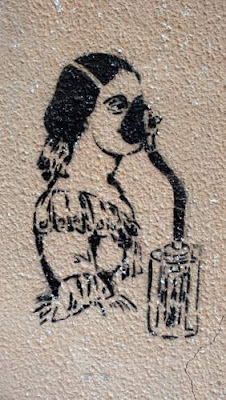
Graffiti image of an Italian woman with a gas mask on, found beside a canal in Venice, Italy.


Graffiti image of a cubist skull found in Venice, Italy


Graffiti image of eyes, alone, looking down from a wall in Venice, Italy.


Graffiti poster image for Beppe Grillo, an Italian blogger, found near the Rialto Bridge in Venice, Italy.


Graffiti image of plane dropping bombs found in Venice, Italy near the Arsenale.


As per always,
on every post,
on this blog,

putting the mouse over the picture reveals the captions.

And these postings are all automated,

as your humble scribe will not be back until 18 May.

But,

I will be keen

to read

what

YOU

choose

to say.

Friday, May 8, 2009

Part IX of XII of the interregnum: Genoa's underbelly

Graffiti image of a praying, radiant nun from the old town centre of Genoa, Italy.Dear Gentle Reader,

I live in Gotham. 

I might even write about that, one day. But not now.

While I am not offering written fluff, for three weeks, I am providing a pictorial view of the underbelly of cities. Today, the final, assorted images of Genoa.

Genoa (Genova in Italian) is a fantastic city with a rich history of conquest, exploration, and occupation. But the humble scribe has no time to write until May 18, as an e-interregnum is currently in effect as previously noted here.

So, instead, a head-level look at the popular art. And by popular art, I mean art by the populous. 

By the people.

A series of graffiti shots.

Your humble scribe may add commentary after May 18. We'll see. But, till then, each picture counts as 1000 words.


Tschuess,
Chris


Graffiti image of a pretty girl pop star from the old town centre of Genoa, Italy.


Graffiti image of a face in red and black and legionaire's helmet from the old town centre of Genoa, Italy.


Graffiti image of a skull and cross-bones superimposed on torn backing of an graffiti posting from the old town centre of Genoa, Italy.


Graffiti image of a cubist, tribal-art inspired(?) head from the old town centre of Genoa, Italy.


Graffiti image of a very strange, spacey head and torso, in purple, from the old town centre of Genoa, Italy.


Graffiti image of a round head with top-knot askew from the old town centre of Genoa, Italy.


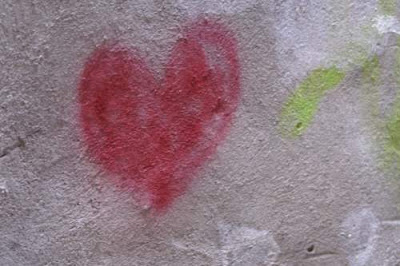
Graffiti image of a heart from the old town centre of Genoa, Italy.


As per always, 
on every post, 
on this blog, 

putting the mouse over the picture reveals the captions.

And these postings are all automated, 

as your humble scribe will not be back until 18 May.

But, 

I will be keen

to read 

what 

YOU

choose

to say.