Showing posts with label bikes. Show all posts

Monday, July 26, 2010

Blue skies and bike seats

Image of pigeons wheeling, silhouetted, after afternoon prayers, above the Jama Masjid in the old town of New Delhi against an impossibly blue and bright sky.
Dear Gentle Reader,

Blue skies are apparently ahead.

Which would be good, as storm clouds have raged, or, worse, droned for a while.

For anyone who actually ever checks over here, yet another mea culpa.

The past couple of years have been a bit trying, medically, as interesting diagnoses come and go.

Parkinson's disease one day.

Multiple sclerosis, another.

Fortunately, both of those were rejected after extensive testing.

Unfortunately, the underlying conditions were ultimately described as a syndrome; diagnostic shorthand for "we know what symptoms you present, and they are real, but we have no idea what the underlying cause is, or how, ultimately, to treat you".

Great.
Really.

I really didn't want Parkinson's, or MS, true.

And I really didn't want the underlying conditions, either.

Another set of conditions were ultimately resolved in a similar way--by calling them a syndrome, again.

Which was all sort of fine.
Ish.

Until, rather recently, there was another concern.

Doctors thought that I might have pancreatic cancer.

And pancreatic cancer is really not good.

Whilst life is terminal (we ride a sinking boat from birth, to paraphrase some Buddhists), pancreatic cancer tends to accelerate the submersion like a torpedo hitting amidship.

Pancreatic cancer led to an extensive pharmacological diet aimed at whacking me in the belly--amidship my ship.

Now, for your humble scribe, pharmacological diets can be rather interesting, and not just amidship. My upper decks and command centres take hits of their own.

Fermented sugar, alone, has interesting effects while stronger pharmawonders tend to bend the hues of the spectrum and provide organic whammy bars to your humble scribe's sensory interpretation systems...

(Your humble scribe hallucinates, visually and aurally (hypnogogic hallucinations), upon taking Tylenol 3s, which my Southern Cousins would call Tylenol with Codeine... ...most people take Tylenol 3s with much less ado simply for pain relief.)

...But, my big pharma anti-pancreatic cancer diet held new combinatorial side-effects for my pleasure and enjoyment...

...such as autodigestion of my cartilage and tendons...
(...mmm...)

...and total-body tendonitis...
(...woohoo).

And then, just before I took off to India, I was told that pancreatic cancer was not, in fact, a concern.

Presumably a new syndrome diagnosis will be offered to me to replace the diagnosis taken away from me but, again, I am rather fine with this.

I still have a pharma diet, which is a much reduced pharma diet from my 'peak', which is good (ish) though I've only managed two non-pharma meals in the last seven days...

(And yet those love handles still persist!)

(...Do you actually have to want to be an ascetic (rather than being forced into asceticism) to get those sveltish lines of Siddhartha Gautama, post his "Great Departure" (when he left his Father's kingdom, and luxury, to live life as an ascetic)?)

Anyway.

All this is by way of an explanation for my absence, as I had promised a few people that I would write, ages ago.

And then broke those promises.

Now you know why.

Anyway, enough whining.

I've been gone a rather long time; I am trying to get back onto the saddle.

Image of a great, red with huge yellow polka-dotted bicycle saddle found in Bhubaneshwar, Orissa (India).


I hope to write more soon, and maybe even read.

Till then...


Tschuess,
Chris


Click to hear The Be Good Tanya's 'The Littlest Bird' from their album 'Blue Horse'

Amazon.com

Tuesday, December 1, 2009

On stuffing

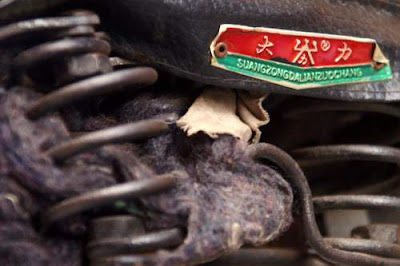
Close-up image of a bicycle seat, in China, seat manufactured by Suong Zong Dalian Zuo Chang.Dear Gentle Reader,

The stuffing has been knocked out of your humble scribe.

Or rearranged.

I managed to pop a few of my ribs out of their cartilaginous supports--where they meet up with the other ribs.

Being in the position to compare this with breaking your ribs I can inform you that while neither is fun, this is marginally worse.

...How interesting that I wrote about opiates last week...

I will attempt 3WW tomorrow, because it is always quick. The hairy crabs, however, will have to wait their turn. Or maybe they are waiting for me...

'Till then, here is another shot of the first image, from farther back...


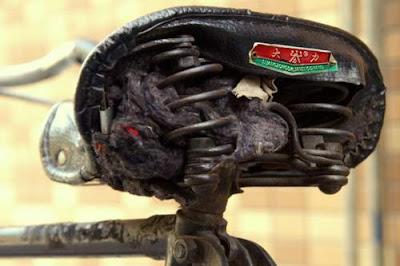
Image of a bicycle seat losing its stuffing, in China, seat manufactured by Suong Zong Dalian Zuo Chang.
Click to hear 'Betty et Zorg', the introductory music from the movie '37.2° Le matin' by Gabriel Yared. This piece describes how I feel this week.
Amazon.com iTunes

Tschuess,
Chris

Wednesday, July 22, 2009

The structure of security, a look at Northern Ireland's past

Image of a faithful photographic reproduction of an original two-dimensional work of art. The Original artwork is an engraving entitle 'A View of the Giant's Causeway: East Prospect.' dated 1768 and produced by Susanna Drury (1698-1770). The original is found at the Linda Hall Library of Science, Engineering, and Technology. This image was sourced from the Wikimedia Commons and is in good faith presumed to be a public domain image.Dear Gentle Reader,

After Monday's visual post on institutional enforcement mechanisms of the social contract in China, I thought it only fair and reasonable to recall a similar example from the West, and maybe raise a few topics more explicitly, though tangentially.

It was a dark night, in 1988, that I arrived in Belfast.

I had been cycling and hiking around Ireland and Northern Ireland with my girlfriend after a sojourn in Egypt.

Sometimes, in Ireland, it was a challenge to have an English girlfriend, but Popsy was not only lovely, she was my interpreter.

While, allegedly, everyone spoke English, many of the dialects and accents were too thick to fit comfortably into my tiny ears, accustomed as they were to the certain, known accents of General American and of California, broadcast through the air into all of our homes in the USA and in Canada.

Popsy and I had been cycling around, and across, Ireland for a numbler of days. (A numbler is too many to count, especially when it is raining, Irish style--up too, not just down or sideways.)

We had had trepidation about going to Northern Ireland because of the news footage of The Troubles that we had both grown up with, on both sides of the Atlantic, but if you were going to circumnavigate the entire island, you could not avoid Northern Ireland.

We had entered Northern Ireland via Londonderry/Derry (depending upon your regime perspective) a few nights before and we had both been surprised by the arrival maze, the structure for imposing order, and trying to create security, at the entrance to the city.

The arrival maze was a chain-link fence, extending ten feet or so above our heads, where armed soldiers stood on a platform, looking down upon us.

Those elevated soldiers, and others, at face level, protected by bullet-proof glass, scrutinized us for suspicious behaviour or gait or packages or something.

Those soldiers determined who was allowed admittance (definitely to Londonderry only, not to Derry)--and who was shunted off for further inspection and possible detention.

The maze forced you into a serpentine, single-file line and was clearly designed to funnel, channel, control, and regulate large crowds.

For us, however, it was a momentary experience; we arrived in the middle of the afternoon with zero people in the chain-queue and we were through it in a trice.

We were through it so fast that it left just a wisp of a wondering memory. The soldiers, though intimidating, were soon forgotten, like Irish faeryfolk.

It was soon obvious, to us, that that maze was simply some institutional stickiness; a holdover from "The Troubles" that no one had bothered to dismantle or that vested interests wanted to keep to justify security expenditures.

It was obviously a holdover because, as we cycled gaily and drank our way across the Gaelic Northern Coast, we saw no sign of The Troubles.

Within a day, the majuscule Troubles had been downgraded to merely the troubles, a minuscule memory of prior strife and attempted insurrection.

Obviously reason and rationality and common humanity had won out, we decided, but the Press wouldn't let good stories like death and despair drop.

The people we met were uniformly cheerful and welcoming and the villages had a ruddy, wholesome, vivacious appeal.

And, helpfully, we never received any snarky comments, or muttered threats, or curses, about Popsy's obvious Southern English accent and origins.

Wind ruffled hair, but nationalism no longer seemed to ruffle feathers, or concerns, in the Northern Ireland which we discovered.

We skipped from one hexagonal chunk of columnar basalt to the next along the Giant's Causeway in County Antrim and sang taunts to Fionn mac Cumhaill (transliterated to Finn McCool for those with no Gaelic blood in their tongues or their ears), daring him to arise from slumber to test skills with us.

Geologists will tell you that the Giant's Causeway is composed of columnar basalt, specifically igneous basalt (one type of lava), which has cooled quickly, usually as it jetted up from the hot centre of the earth into water.

Mythologists will tell you that the subject of the infamous (in Gaelic myths) Fiannaidheacht, the cycle of myths relating to Fionn mac Cumhaill, threw rocks violently into the harbour, making a pathway to Scotland for a multiplicity of reasons.

Maybe the causeway, later destroyed, was built to have a tussle with a Scottish giant, maybe to provide security for Fionn mac Cumhaill's mythical Irish state from Scottish giant aggression, maybe to facilitate a crossing to Scotland and staying dry the whole while, maybe for an amorous adventure...

Who knows? We tried awakening Fionn mac Cumhaill to challenge him to a duel, the loser having to answer questions truthfully.

Fionn didn't respond to our taunts and we were unable to reduce multiple possible answers to a single truth.

Having played Gaelic football, hurling (an Irish, martial combination of hockey and lacrosse), and engaged in general mayhem in Irish bars with Irishmen and Irishwomen, around the world, I have come to accept that Gaelic answers tend to be multiple, which is wise to know, especially if you offer to buy a round.

"You're buying a round of pints, Chris? I'll take three..." (!)

But, back to that trip. Popsy's right knee had been giving her trouble throughout our Irish expedition.

For four hours of one day I had cycled behind her and would grab her seat (usually the bike's, for clarity) and would sling her and her bike forward as her knee was swollen and too painful to pedal.

Hiking along the Giant's causeway, Popsy started to get twinges in her knee, again, and for the jaunt down to Belfast I suggested that we pack up the hired bikes and take the bus, a suggestion that was accepted with alacrity and relief.

While the bus stopped at some pubs, for liquid relief, prior to entering Belfast, the bus had made no special security stop on entering Belfast itself.

We just coasted into downtown Belfast, alighted from our coach, and fished our bikes and bags from the bowels of the bus.

Well, I fished the bikes and bags out of the belly of the beast.

Popsy stamped her feet against the night's chill and leafed through the guidebook for recommendations on cheap places to stay while I mantled (the opposite of dismantled, no?) our bikes.

And then we set off.

As I said, in the very beginning, it was a dark night when we entered Belfast.

There was a crescent moon hanging in the air, a huge abyss of blackness broken at ground level by weak street lights, and a thin film of wet fog hugged the ground and sniffed, wet and limp, around our ankles and buttocks like an old dog.

Leaving the bus station, we were surprised by another maze, just as in Londonderry/Derry, and here it was a bit of a problem getting our bikes through this maze.

We had to roll our bikes vertically through this maze, on back tires alone, as the walls of this maze were closer, tighter.

This was awkward, as our panniers, or bike bags, were not meant to be suspended at this angle, but, it was night, and the chain-queue was empty.

True, the soldiers seemed surly, but we, again, were through in a trice, as we had been before, the first time we had encountered this maze system.

And, erasing the momentary discomfort of the soldiers' rough scrutiny, straight in front of us was Belfast's baroque revival City Hall, standing proud in the centre of Donegall Square.

We were incredibly fortunate because we had the view of the grand structure floating on the ground-hugging fog all to ourselves; there appeared to be nobody else around.

There were not even any cars.

The city was preternaturally quiet and still and beautiful.

Except for the kids standing still with green glowsticks that I could now make out through the ground-level mist.

There appeared to be a line of kids on both sides of the street, Gothic kids, perhaps, in black, who were hard to make out, but they all seemed to have green glowsticks or something.

Maybe they were Druids, I thought, hopefully.

Had we stumbled on some archaic, once-a-year druidic festival in Belfast?

Excited, I turned to ask Popsy about it, and whether we could ride our bikes now, and to ask her how her knee was, when I noticed the green dots on her chest.

And then I looked down and saw green dots on my own chest.

Popsy looked slightly ashen and told me to keep walking.

She said we had to get through the Square to get to the hotel which she had found in the guide book and had phoned from the bus station.

As we approached the line of stationary Goth kids I realized (a) that I really did need glasses and (b) that these were neither Goths nor Druids.

These kids in black were all elite SAS soldiers with hard eyes, big shoulders, and still adam's apples.

Further, they were all in full flak gear.

With military rifles.

Rifles raised, and ready.

With green laser sights.

And green night scopes.

And fingers on the triggers...

As we approached the column of men on Donegal Square the cluster of green dots on each of our chests reduced to one, one for each us, fixed upon our hearts.

As we walked by the column of men on our side of the street, through the silent, otherwise deserted square, one set of soldiers would train their weapons, and green laser sights, on our chests.

The first set of soldiers would continue aiming their laser sights, and hence their military assault rifles, at our chests as we walked by them.

These soldiers would only remove their aim from our chests, and return to aiming at non-existent oncoming traffic, when the next set of soldiers had trained their weapons, and green laser sights, on our chests.

They were avoiding each other's line of fire, while keeping us covered at all times.

When there were two green laser sights on my chest, at each laser sight handover, I swear I could feel the hot threat directly on the meat of my heart.

It was a physically sobering walk.

The effects of the Guinness, from the last stop of the bus prior to Belfast, left our minds rapidly as an adrenaline cocktail raced through our bodies, purging impediments to our fight or flight instince.

We fought the adrenaline and tried to stay calm, although we did walk much faster when we were through the cordon sanitaire and on our way to our hotel.

Later, that night, safely at our hotel, we were serenaded to sleep by the not-distant-at-all percussionary whumps of bombs.

Enforcement mechanisms frequently have their reasons.

It is the justification, and the triggers, and, potenially, the proportionality of enforcement mechanisms that are tricky and worthy of serious consideration.

Enforcement mechanisms, as security structures in societies, are found everywhere, and in every form of State, although Monday's and today's posts are more of the in-your-face variety.

Most discussions around rights revolve around the personal, civil rights of the citizenry, and the obligations of the State to its citizenry.

Sometimes those discussions stray into the obligations of the citizenry, in return for the rights they enjoy.

Rarely, however, do those discussions, consider the rights which the state reserves to itself, and what the manifestations of those rights can look like, unless the discussion is a diatribe.

Maybe the British government was justified in the soldier's response that night, and many other nights.

Bombs went off.

People died and property was destroyed there, and in England, and the carnage had been ongoing for decades.

Reasonable men and women, ignoring the unreasonable ones, have come to very different conclusions on the neccessity or reasonableness of English actions in Northern Island.

The War Measures Act was imposed, in peacetime, in Canada in 1970--a country frequently seen as paragon of virtuous civil society.

And there are the displays of state force in China.

Nothing is necessarily black and white, however, especially when considering the architecture, or structure, of security operations and apparatus.

Analysis and contemplation are always required.

That I leave to you, Gentle Reader, and I know that I leave it in good hands and minds.

I simply advocate a good look around, even if it is only while judiciously leaving a site.

I generally feel secure about a structure only when I understand its makeup, its rationale, and its footprint.

Tschuess,
Chris

Friday, March 27, 2009

Coming of age: rattlesnakes, judo, and bikes

Image of a rattlesnake warning sign located in a park managed by county of Los Angeles, department of parks and recreation (sic). Photographed and uploaded by user:Geographer. This work is licensed under the Creative Commons Attribution 2.5 License and was sourced from Wikimedia.Dear Gentle Reader,

Monday's post on green vipers in Asia took your humble scribe back to his own childhood.

Every year, almost, was a different city if not a different province for your humble scribe. 

Your humble scribe's Dad specialised in making offices work better without firing people. He made offices more efficient and helped people become more productive--skills that put him in demand. 

Despite a peripatetic life, grades one to three were rooted in Lethbridge, Alberta.

There were a lot of rattlesnakes around Lethbridge.

There also were a lot of Japanese Canadians who lived around Lethbridge, because many Japanese Canadians had been interned near here, during the Second World War, as their loyalty to Canada was considered suspect. 

Blood, it was pointed out by politicians at the time, was thicker than water. 

Some people see this as proof of racism in Canada. 

While it's true that some Polish Canadians, for example, were also interned during the Second World War (your humble scribe has visited their internment site in the Rocky Mountains), not all Polish Canadians were interned. But, over 22,000 Japanese Canadians were.

So, your humble scribe agrees that the internment of Japanese Canadians in World War Two was proof of endemic racism in Canada, at least in that era.

Among the many Japanese Canadians who stayed in Southern Alberta, after their internment was lifted, was Yoshio "Yosh" Senda who lives in Lethbridge.

Yoshio Senda has now been elevated to Membership in the Order of Canada, Canada's highest civilian order. 

Yosh's patriotism is no longer suspect.

The motto of the Order of Canada is desiderantes meliorem patriam (they desire a better country) because its few, elite members contributed substantially to Canada's betterment over the course of their lives.

Yoshio Senda is one of a handful of ninth dan (ninth degree black belts) in the world recognized by the Kodokan Judo Institute in Tokyo, Japan. He was the founder of organised Judo in Canada and coached numerous judokas and national teams.

Yosh Senda is the highest ranked judoka in Canada, ever, and the gentlest man imaginable.

Yosh (more properly Senda Sensei) was your humble scribe's first Sensei.

Yosh deserves his own post, but not today.

Yosh taught Judo out of the University of Lethbridge in Alberta, in Canada's dry prairies. 

In Lethbridge, if the weather was warm, I would cycle the few kilometers to the dojo (the judo practice hall) and then back home.

I remember going home on my beautiful bike, one particular summer evening. 

That bike was my first bike.

It had high handlebars with tassels that I half cut to make them spiky and tough, a banana seat, and it was metallic gold. 

CCM (Canada Cycle Manufacturing) made that bike.

That bike was the greatest bike of my life (to that point).

It gave me mobility, freedom, and the feel of the wind in my hair.

This post is not about that bike, either. 

At least not specifically.

This post is about riding my bike home, after Judo practice, and going through the prairies.

I am cycling up the long hill, out of the river canyon formed by the Oldman River. 

It's a steep climb.

When the local Blackfoot First Nation weren't slaughtering members of the Cree First Nation here, and crowing about that, calling the place Assini-etomochi ("where we slaughtered the Cree"), they might call it Aksaysim ("steep banks"). 

I have almost finished cycling up those steep banks.

The burn is sweet and deep in my calves, tired from Judo practice. 

Leaving the climb, I am now cycling onto the flats of the prairies.

The sun is going down but it's not at the horizon yet, that band way off in the distance where the flat sky meets the flat land. This is the place where dreams and nightmares both must come from, because there is nowhere else on the landscape for such great beasts to hide.

I know to keep a lookout for smaller beasts, snakes, because they become quite active right now. 

The rattlesnakes are warm from the sun, have gathered on the asphalt for its residual heat, and they get frisky because, while they are still warm, the asphalt is cooling down and it is time for them to leave.

I know all this. 

I've been told this. 

But, I've never seen a rattlesnake while cycling.

Until tonight.

Tonight I see one.

I see it right in front of me; I have been daydreaming and haven't been paying attention.

I squeal my CCM bike to a stop. 

Suddenly, the fact that I modified my golden CCM so that it would not fully brake and so that it would slide and skid to a halt is no longer quite so cool.

The rattlesnake is motionless on the ground, maybe a foot in front of me (Canada hasn't gone metric yet, but this would become 33 cm in a couple of years.)

At this distance I can see the texture of its overlapping scales.

I can see the detail of the yellows and browns and blacks and sand colours on the snake's scales.

I observe the patterns and my eyes are inexorably drawn to the snake's head.

I look up to its head and lock eyes with its eyes.

Frantically, my hind brain screams at me. 

"Don't look at its eyes!" 

"Don't be aggressive!"

"Stop looking at its eyes!"

Eventually, I listen to my hind brain as a second terror asserts itself.

I have been stopped on my bike one foot, or 33 cm, away from the snake.

I have been balancing on my bike, terrified to put a foot down.

Suddenly, I become aware that I have been balancing on tires alone.

I have never managed to do this before.

I can't do this.

With that certain knowledge, eyes locked on the neck of the rattlesnake, I start to fall.

Electric terror bisects my brain with a massive electrical surge.

My foot unconsciously lunges out and steadies me.  

Watching my alien foot, in slow motion, approach the ground and the snake, I wait for the bite.

...

Amazingly, with a warm ankle near its heat-sensitive pits, the rattlesnake does not strike.

Maybe the sudden jerk squeezed all the warm blood out of my leg and into my body?

...

I start praying for forgiveness for all my misdeeds and promising to change if I get out of this situation alive.

I will clean my room.

I will make my bed. Every morning.

I will stop calling Tara Yvette Gemer, at school, "the Barfing Mammal".

I will tell Dad that I flushed that apple down the toilet which caused him such grief. 

...

Dad had asked me, four hours after he started trying to fix the flooded toilet, if I knew how an apple had become lodged in the toilet's nether regions of plumbing, requiring complete removal of the toilet to extricate the apple. 

I suggested that the apple might have fallen from the tree outside, through the open window, with a gust of wind.

Dad stared at me, apparently considering this, as he looked me in my eyes. 

I almost thought that I heard him counting.

Dad pointed out that the apple, now recovered, had had one bite taken out of it.

I waited, silent, wondering if Dad would follow this observation with another question.

He did. 

He asked me if, given this new information, I had any other ideas as to how this apple might have arrived, deep inside the toilet.

I suggested that Mom might have done it. 

He asked me why she would have flushed an apple down the toilet after one bite.

I said, who knew? Mom does all sorts of crazy things.

I had a point, and a good one, too. 

And, besides, I wasn't stating anything as facts, merely as possibilities to be considered.

I guess Dad believed me because he just shook his head and kept recoiling the toilet snake... 

And, he didn't ask me any more questions about the apple. 

So, I left him to the task.)

...

(English language aside: 

A toilet snake is an exceptionally long, flexible, spiral spring that is threaded through a toilet and can extend into the pipes. It can push through, and unblock, many obstructions in toilets. It is, as Dad found, ineffective against whole apples.)

...

Thinking back on the apple, I kept staring at the rattlesnake stretched out on the cooling asphalt.


Then my calf started twitching.

Then my thigh started quivering.

Then my whole body started shaking.

The sun started to set over the horizon.

And I desperately had to pee--I never should have had so much water after practice.

And that snake just lay there, daring me to move my foot again.

...

Just then, a car came by.

In the early evening flash of its beams, my attention was distracted.

I saw the rest of the snake's body.

My eyes flicked away from the snake's head and down the length of its thick girth, strangely still and stretched out on the asphalt.

I saw the huge, flat, double groove where two side-by-side tractor-trailer tyres had flattened the snake's body.

This rattlesnake was dead--it had never even rattled.

This snake had been dead for hours. 

How did I know? The pavement was dry.

But, the pavement was not dry for long as I stiffly let my bike drop and released a pent up stream after the car had gone on in the distance.

That ragged stream was hot with fear, with shame at being afraid, and with shame at not seeing the tread marks and the signs of death. Shame at being fooled by my fears. 

My breath was ragged, as the hot liquid splashed onto the sandy soil and onto the asphalt. The fears of youth were not spent, but the fears of that day poured out.

Finally, I knew that I could go home.

I arrived home late.

I was in trouble with my Mom for dawdling and wasting time.

I was smart enough to not tell her about the snake; I wanted to keep on cycling.

I didn't tell Dad about the apple, either. 

It was neither an apple of life nor of knowledge, after all.

It was just an apple of deceit. 

I went to bed without any supper, but it was OK; I had swiped another apple when my Mom wasn't looking.

And I had faced down my first snake, albeit a dead one.

I might not have been a man yet, but I was not just a child anymore.

This was one of the passages from innocence to experience.

I was eight.


Tschuess,
Chris