Showing posts with label France. Show all posts

Thursday, March 18, 2010

3WW CLXXXI (3WW3)

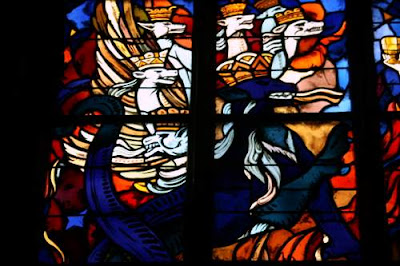
Detail of a stained glass window from a Church in Normandy. From Caen, I believe.
Dear Gentle Reader,

It's 3WW time, again.

This week the prompt words for prose or poetry are pulse, shard, and weary.

Your starter is a titled picture with, as always, descriptions if you run your mouse over the image.

Then, as usual, I serve up three haiku/senryu, each with an American Sentence title.

For dessert, a musical offering.

If you're like me, have dessert first and enjoy it while reading.

So, away.

I have to get back to packing.

We are in the midst of moving and we have too much stuff.

So, sorry if I try to store some words here, on the web, but there is no room in the stables tonight...

And, with that, let the games begin with pulse, shard, and weary...


On safari, the carnivore rules over all--- ROWRRR... (sob) ...CruNCH ... ... ... ... ... ... (...no pulse...)

shards of meat (and bone)
but, no pulse (legume, bean, pea)
weary vegan pales...


The origin of glass, a Western, or a Near (not Far) Eastern, tale...

Pliny's Phoenicians
found proto-shards where weary
sailors' fires throbbed, pulsed.


What is this poem all about?

Well, Gentle Reader, a circuitous explanation ensues. Sorry.

You ought to know, by now, that your humble scribe is (currently) based in Hong Kong.

Hong Kong is right beside China.

Hong Kong is even in China, if you believe the Mainlanders rather than your visa requirements.

Hong Kong is certainly within the media orbit of modern China.

Recent Chinese 'historical' pop culture movies (Red Cliff, for example) extol the fact that ancient China invented almost everything.

Like soccer. (A specious claim, at best).

Your humble scribe and Heroine find themselves amused to note that almost all things are Chinese these days.

Soccer/football?
Surely Chinese.

CERN and the Higgs Boson?
Surely Chinese.

The alphabet?
Mmmhmm.

Crime?
Vice? ...

...Well, those are obviously foreign.

...Especially when you read or hear the news, in China...

But, glass?
The beach at Mont St-Michel, Normandy, France, as seen through transfigured beach... the medieval glass of Mont St-Michel

Glass is definitely not Chinese.

Glass is one of those areas where, if you are a Westerner, you can hold your head high on the origins of innovation front because the ancient Chinese did not invent glass.

The Chinese 'discovered' glass only from overland traders sometime in the end of the Spring and Autumn period of Chinese dynastic history (770 BC - 476 BC) or in the beginning of the Warring States period (475 BC - 221 BC).

Pliny the Elder (23-79), however, gives us the historic/mythic origin theory that Phoenician sailors (Phoenicians are those Fertile Crescent trading folks whom most Lebanese claim as their forebears) discovered glass sometime around 5000 BC.

Pliny's Phoenician sailors/merchants were cooking their meal of reconstituted pulses in pots over fires on the beach as they rested their weary bodies...

Those Phoenician pots, in turn, while cooking the pulses, rested upon blocks of nitrates which the sailors/merchants were carrying.

And, as those blocks of nitrate melted, from the heat of cooking fires, the melted nitrate fused with silica, the sand on the beach, to form 'ur-glass'--the original man-made glass.

This originating glass was not only clear(ish) but, when the half-melted nitrate trading blocks were forcibly removed, this proto-glass would have resolved into shards of glass...

...which would have engrossed the attention of sailors, weariness forgotten, with sharp shards of a novel, transparent solid in front of them and their bellies full of reconstituted pulses.

See how easy this fit into today's 3WW words?

3WW even allowed me to point out Western technical/innovation prowess.

Even Mesopotamian prowess.

For, despite Pliny's tale of the Phoenicans of around 5000 BC, the first archaeological record of glass comes to us from pre-Bronze Age Mesopotamia--from the pre-Sumerian Uruk Period (4000 BC - 3100 BC ).

Sure, this is almost a thousand years before my beloved Akkadians spring to prominence in Mesopotamia, but, for once, I can write about something that was not invented first in China.

Thanks, Thom (Keeper of 3WW and provisioner of words).

Words like these make my day.

(Although, Thom, I would love the challenge of an x, y and z themed 3WW, too--as you suggested on your prompt page...)


To the victors go the spoils, and thanks, of royalty; to the writers...

pusillanimous;
lacking heroes' pulse, courage.
Weary shards of men...


(Of course, today, the writers get royalties.

But, not if they publishes on the web...)


There you go, hepcats.

Maybe when I am less bone weary the haiku will pop out easier.

Tonight, well, this is better than nought.

I hope.


Tschuess,
Chris


Wednesday, March 10, 2010

3WW CLXXX

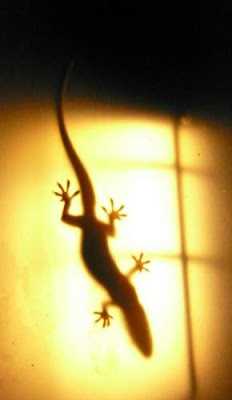
Beauty wants to be seen. It needs to peek out! But, is this gecko seen? Or unseen? Veiled or viewed? And I cannot believe that Thom, of 3WW, did not know what he was hoping for when he came up with the 3WW word, this week. Good on him.Dear Gentle Reader,

It is 3WW time.

This week the prompt words are modify, obedient, and veil.

Your starter is a titled picture with, as always, descriptions if you run your mouse over the image.

Then, as usual, I serve up three haiku/senryu, each with an American Sentence title.

For dessert, a musical offering.

If you're like me, have dessert first, and enjoy it while reading.

So, away.

Let the games begin with modify, obedient, and veil...


Please, Sir, up or down, in or out, fast or slow, ..., ...how do you like it, sir?

A veil keeps sin out.
But, modified, with shimmies...
...obedience in...


** Bearing in mind that not everyone speaks English as a first language, all my poems are meant to be read aloud.

The last line of this haiku has a greater effect, I think, when these two words are in the same eigenspace of comprehension as their oral/aural equivalent...

...'obedient sin'...

...then shimmy the two in your mind...

...obedient sin/obedience in...

...then tell me what is obedient, and to whom, and you're a better man than I am, Gunga Din.


Sarkozy wants her to be strong (obedient); "Modify thy veil!"

Obedience or
Obeisance? Try my veil./? It
modifies me?/. Thee?/.


** With a Gallic shrug, and a governmental tug, her veil could be gone... ...Sarkozy, President of France, declared that the burqa, the full body 'veil', is not welcome in France. Six months later, a French parliamentary committee recommended banning full veils from public buildings.

Now your humble scribe is not going to be drawn into a discussion of the nuances between purdahs and burqas, hijabs and niqabs.

One bottom line is that either people have freedom to choose their elements of expression in apparel or they do not.

And, of course, properly, both sides of the debate can argue that they are for the
freedom to choose elements of expression in apparel and that the other side is against the same proposition.
Which, in a way, is part of the wonderful duality of life. Long live the differences.
Point and counterpart sometimes produce harmony, but, today, in France, they produce dissonance. And the score has not even been finished--it is certainly not settled.
I've tried, in the poem, to shimmy between the interrogative and the declarative and it is meant to feel dissonant.
I'm just not so sure that it works.
Like France's policy.


At 'de Ent o' days, when 'de Taliban come, sleepin', not fightin's, sin!

Oh Bee, 'de Ent' comes!
Modify 'dose bad ways quick!
I won't wear no veil!


Tschuess,
Chris


Click to hear 'At an Arabian House Party' by Raymond Scott and his Orchestra

Amazon.com


Tschuess,
Chris


Wednesday, March 3, 2010

3WW CLXXIX

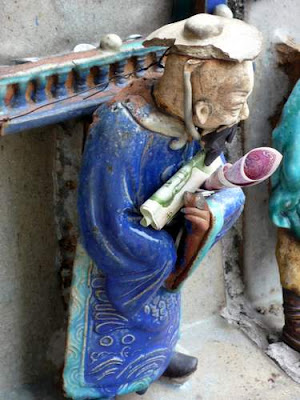
Detail of a ceramic frieze atop the Dragon Mother's Temple, Guang Dong Province, China. People lean over the upper balcony to tuck money into the sculptures to help lubricate the passage of their wishes to reality.Dear Gentle Reader,

It's 3WW.

This week the prompt words are amaze, frail, and sacred.

Your starter is a titled picture with, as always, descriptions if you run your mouse over the image.

Then, as usual, I serve up three haiku/senryu, each with an American Sentence title.

For dessert, I close off with a musical offering.

So, promptly, away.

Let the games begin with amaze, frail, and sacred...


Amazing Grace, Newton's sweet sound--though he'd sold men, bound, in slavery...

frail prayers waft up,
borne with sacred incense swirls;
plead amazing grace


** True, John Newton (1725-1807) did end life campaigning with John Wilberforce for the abolition of slavery, but he started life as a slaver, and, though he had changed careers to become a curate, he had not denounced slavery when he penned 'Amazing Grace' in 1779.

The British Slave Trade Act of 1807, which Wilberforce and Newton campaigned for, became law little more than 9 months before Newton's death and abolished slavery in the British Empire.

Britain would take until 1833 to determine that slavery as an institution was inherently illegal.

That said, the Western world would not see slavery as being a jus cogens, an international legal wrong, or, more specifically, that a jus cogens itself could exist until the conventions for drafting the Vienna Convention on the Law of Treaties were commenced in 1949 and the text finally adopted in 1969 (see Article 53). It would still take until 1980 for the Vienna Convention on the Law of Treaties, 1969, to enter into force.

This whole 'aside' merely is my way of pointing out the frailty of some prayers, especially those implicitly contained within 'Amazing Grace', penned at the time by an unrepentant ex-slaver and slave trader.


Forget storge, philia, and agape; give me eros each day.

frail hearts quail, tremble.
love is sacred? hah! Violent!
stunned, amazed, we pant.


** Storge, philia, agape, and eros are the four forms of love in Classical Greek thought.

Storge, στοργή, refers to loving, familial affection.

Philia, φιλία, refers to friendship--the love between friends.

Agape, αγάπη, refers to an abiding, deep love and contentment.

Eros, έρως, finally, refers to passionate love. Eros doesn't have to be sexual, but Plato's modification of love, Platonic love, a non-sexual love, is a modification of eros--which point to the importance of sexuality in the non-Platonic eros.


Crowds queued (Paris-style) for her; Quasimodo tried to save her; she died.

frail Esmeralda's
sacred sanctuary fails;
amazed Q's heart breaks


** If you haven't read Victor Hugo's (1802-1885) 'Notre-Dame de Paris', or, 'The Hunchback of Notre Dame" then this little piece will surely fail. The only thing I will point to here is the ambiguity of 'Q' in the last line.

Normally this 'Q' would clearly refer to Quasimodo, but, with the title of this poem, 'Q' could also be the Parisian crowd which 'queued' outside of Notre-Dame to show its support of Esmeralda--fabulously misread by Louis XI, the King of France, in the book....


*** As per queuing 'Paris-style', don't think Paris of Hector, or of Helen, think French Revolution.

Think Eugène Delacroix and 'La Liberté guidant le peuple', or, 'Liberty guiding the people'...

Image of painting by Eugène Delacroix (1798-1863) entitled ' La Liberté guidant le peuple', or 'Liberty guiding the People'. This image is in the public domain and is sourced from the Wikimedia Commons.

An aside and a query. Does "to hector" in English come from Homer's Iliad?

Hector (eldest son of King Priam [of Troy] and Hecuba), who berated his brother, Paris, with lines like "Paris, you pretty boy, you woman seducer, why were you ever born? Why weren't you killed before your wedding day"...


Tschuess,
Chris

Ah... and the music for today is...

Hmm. My data storage site appears to be down...

I'll have to try to add the music later...


Friday, December 11, 2009

On Pelletier and Caventou, malaria, syphilis, and a gin and tonic

Image of the Hong Kong Island skyline from the lounge of the Intercontinental Hotel in Hong Kong. This image is entitle 'Relaxing in the Intercontinental Hotel in Hong Kong with my Dad and a gin and tonic. This really gives you an idea of just how big IFC2, in the far right of the skyline, is'.Dear Gentle Reader,

Your humble scribe has mentioned, in passing, the British, in India, before.

And we have glossed over the quinine they took, as tonic water, combined with that Dutch poison, gin.

The British dosed their bitter medicine (quinine dissolved in carbonated water--tonic water) with gin to make it, the quinine, more palatable.

But, what is quinine? Where is it from? Why do we all know its name?

Quinine is a medicine used to combat malaria, which, with all our drugs and skills and knowledge, today, is still a significant global killer.

Malaria was even more feared before reliable medicines were known.

But, that doesn't tell us much about what quinine is.

Image of the quinine molecule sourced from the Wikimedia Commons; in the public domain.Quinine, C20H24N2O2, is an alkaloid derived from a plant.

It was isolated in 1820 by Pierre-Joseph Pelletier (1788-1842) and Joseph-Bienaimé Caventou (1795-1887), two French chemists who worked in Paris.

Those gentlemen were great.

They isolated quinine to treat malaria.

They also isolated brucine, a poison, that would later be used, in small doses, to treat and regulate blood pressure.

(Brucine also regulates blood pressure when administered in large doses, but it does so in a more permanent and unpleasant fashion).

Pelletier and Caventou also isolated strychnine to treat rats and other rodents.

Permanently.

(People were treated with strychnine, too. The less-reputable Dr. Thomas Neil Cream (1850-1892), the Lambeth Poisoner, murdered many women, and a few men, as a way to treat the world and purge sexual sin...)

Pelletier and Caventou even isolated chlorophyll.

Chlorophyll is not just the stuff that freshens your breath in some breath mints.

Chlorophyll is the green chemical that allows plants to convert CO2 and water (H2O) into sugar n(CH20) and O2; chlorophyll allows plants to turn sunlight into chemical energy which is rather important for ecosystems on earth.

That chemical reaction, as an aside, written out, looks something like this:

6CO2 + 6H2O + photons (light) → C6H12O6 + 6O2

But, without the chlorophyll, nothing happens. That arrow requires chlorophyll, the catalyst in the equation.

So.

Love those plants.

Treat them well.

(Give peas a chance.)

Finally, Messers Pierre-Joseph Pelletier and Joseph-Bienaimé Caventou even isolated caffeine, a very valuable chemical in the modern world.

Your humble scribe remembers isolating caffeine in an organic chemistry lab a long, long time ago.

Hours of work for a little bit of powder.

I apparently loved the labour, though; I stayed up for a week afterwards.

But, back to quinine.

Quinine was a far more valuable chemical in Pelletier and Caventou's time than caffeine is in our time.

In 1820, quinine, C20H24N2O2, was a very big deal.

Why? Because of malaria.

Malaria was, and had been, a scourge to Europeans scouring the globe for opportunities evangelical, mercantile and sovereign.

The bacteriological agent, Plasmodium, which was responsible for malaria and which was transmitted by the Anopheles mosquitoes (but only by the ladies), would not be discovered until 1880 by Charles Laveran (1845-1922).

However, the Jesuits had made a remarkable discovery, in Peru, early in the seventeenth century.

The Jesuits discovered what the Quechua Indians of that Spanish possession, Peru, knew. They learned that if you boiled the bark of what became known as the Cinchona shrub/tree you might be able to cure a malaria victim.

The mythical, Western origin legend was that the Countess of Chinchona, wife of the Spanish Viceroy to Peru, was cured of malaria by the Quechua Indians and, hence, later, Carolus Linaeus would name the shrub/tree Cinchona.

(Isn't it obvious that the miracle plant would be named after the Western victim rather than the people who supplied the information? No? Go back to your history books!)

Jesuit's bark (later, Cinchona bark) became known in Europe as the cure, and as a possible prophylactic, or preventative treatment, against malaria.

The prophylactic treatment came from the work of one Dr. Christian Hahnemann (1755-1843), the father of homeopathy--the concept that like cures like.

The historical pre-foundation of homeopathy can be found in the English expression "the hair of the dog" which refers to the idea of taking a stiff drink in the morning to ward off a hangover from the night before.

Its etymology was the ancient belief that if you were bit by a dog, you should cut out some of the hair of the dog that bit you and stuff that into your wound to ward off disease, especially rabies.

This treatment came from Roman times as an example of the medicinal rule similia similibus curantor, or like cures like.

Dr. Hahnemann, a German physician, noted that cinchona could not only cure malaria, but if taken in large doses by a healthy person, cinchona would induce the same symptoms as malaria.

Recalling the old Roman adage, and modern, recorded observations, Dr. Hahnemann founded the medicinal science of homeopathy--from observations on the curative, and causative, properties of cinchona bark.

So, remembering that the active ingredient of cinchona bark, essentially, was quinine--quinine could be argued to the root (though it comes from bark) of homeopathy.

More things should be noted about malaria and quinine.

Another scourge of Europe, and the world at that time, was the pox, women's pox, the scourge.... syphilis.

(An aside, while malaria really is only spread by ladies, lady Anopheles mosquitoes, that is, it was believed for a long time that syphilis was only spread by ladies which was why it was called woman's pox.)

Syphilis was painful, virulent, incurable, and fatal.

People tried cures, like injecting large quantities of mercury up men's urethras, and tried prophylactics... like condoms made from fishskins... with the scales still on... or from the intestines of sheep, or lambs... an interesting origin theory, perhaps, for the slang terms alluding to a phallus as a sausage....

But, sadly, none of the cures or prophylactics worked.

Then it was discovered, perversely, that a malarial infection would kill a syphilis infection.

Although the patient would still die.

Until Jesuit's bark came along, however, because powdered cinchona helped some people survive malaria.

So quinine, the isolated active compound from cinchona bark, or Jesuit's bark, had a monumental impact on the world.

Now that malaria could be cured, it was easier, or at least safer, to explore the world and to extract wealth from it.

Further, one could now fornicate with abandon.

Life was looking up.

(Especially now that scratchy fish-scale condoms could be abandoned.)

Based upon Dr. Hahnemann's theories of homeopathy, people took quinine as a prophylactic against getting malaria, especially when they were abroad.

Grains of wildly bitter quinine were given to members of the Indian Army and the Indian civil service.

Enlisted men had to take the quinine on their parade grounds, under the watchful gaze of their officers, as the medicinal quinine was so stupefyingly bitter that some would try to not take it.

Wealthy British planters in India consumed large quantities of gin to help the bitter quinine grains go down. And they found that gin went well with the bitter taste of quinine.

Eventually some clever chap thought of brewing up bark from the remijia tree of Peru so that people could have a better bitter tonic, and by better, I mean cheaper.

Remijia is a relative of the cinchona shrub/tree. It has a more bitter taste than cinchona bark and while it has some quinine in its bark, it has less quinine that cinchona...which makes remijia relatively cheaper although more flavourful. And the name of the game in advertising is not reality, but appearances.

The new tonic water from remijia bark tasted more of quinine than cinchona bark did, although it actually had less, so it was ideal for a mass distributor of a bitter, quinine flavoured tonic for profit.

And thus Indian tonic water, and hence a gin and tonic, was born.

And why did your humble scribe go off on that long, earlier, laudatory aside on Messers Pierre-Joseph Pelletier and Joseph-Bienaimé Caventou?

...Beside the fact that quinine had a monumental impact on the world from curing and preventing malaria, to curing syphilis, to creating the gin and tonic cocktail...

Because, after Pelletier and Caventou had isolated quinine, the key to combatting malaria, and, circuitously, syphilis, Pelletier and Caventou freely gave their knowledge away to the world.

Their benefit was seeing the world benefit.

I think that that is worth a laudatory aside for those two gentlemen.

So.

Charge your glass with some gin.

And some tonic.

And join me in a toast to Pelletier and Caventou.


Tschuess,
Chris


And the music for today...

Click to hear 'Root Trees' by Shawn Lee & Clutchy Hawkins

Amazon.com

Tschuess,
Chris

Image of the Hong Kong Island skyline from the lounge of the Intercontinental Hotel in Hong Kong, again, after dinner. This image is entitle 'See? Gin and Tonics make everything better... Next stop, Nobu's...'.