Showing posts with label factories. Show all posts

Monday, May 25, 2009

Back to the Heart of Darkness

Image of porters entering Chungking Mansion in Hong Kong to ferry out finished goods from grey-market factories.Dear Gentle Reader,

...in the midst of the incomprehensible, which is also detestable. ...it [the detestable] has a fascination, too, ... The fascination of the abomination...
Joseph Conrad (1857-1924)
The Heart of Darkness

Last week I mentioned that many things besides cockroaches and rats come out of the alley near my apartment in Hong Kong.

And I then left you hanging.

I had previously alluded to the fact that this alley, which I duck into to change worlds from glitz to grit, is, in many ways, a passageway into the heart of darkness.

Further, I love this alley; I have a fascination with abominations.

I described the dark, dank, pungent, physical nature of my alley, last week, in two postings.

I also mentioned that one side of my alley was Chungking Mansions, which houses some of the most notorious, cheapest, and nastiest of the cheap hostelries of Hong Kong.

Further, I noted that Chungking Mansions houses many grey and black market factories and that many goods pass hands in Chungking Mansions.

Waiting in the street, outside my alley, are dozens of these:

Image of porters' handcarts chained at the corner of the street by an alley, in Hong Kong, waiting for goods to ship.
And, as the morning drones on and the heat fills the street, the street also fills with smiling Indian and Pakistani men, like these, waiting to earn their money as porters or as land stevedores with their hand trolleys...

Image of porters waiting happily for work in Hong Kong.
These men dart through the alley from late morning until dusk ferrying finished goods, or raw materials, or work in progress between fleets of grey-market transport vehicles and the factories of Chungking Mansions.

I say grey market transport vehicles because these are regular civilian minivans, with no special licensing...
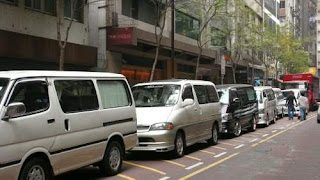
Image of a row of grey-market transport vehicles, in Hong Kong, waiting for grey-market goods to be loaded for shipments to the port.
But, these minivans are filled to the brim with goods which they transport from factory to factory and then from factory to the ports of Hong Kong.

These minivans are filled to the brim and then lace curtains are drawn across the windows to hide the goods from traffic authorities--to disguise their cargo trucks as regular minivans. ...Minivans that just happen to ride really low...

Throughout the day, these vehicles fill up and drive away, or arrive, are emptied, and wait to be filled again, by men like this...

Image of a porter carting materials, or work in progress, from a truck to a factory in Chungking Mansions in Hong Kong.
Image of a small pile of goods for shipment, created by grey-market factories in Chungking Mansions, in Hong Kong.These men create ad hoc piles on the side of the pavement, by the trucks, where bills of lading are checked or created.

This picture to the left shows what one man brings back in one load on his hand trolley and has, subsequently, placed on a pallette.

Did I mention that this ferrying is done not just through my my dark alley, but also through the stairwells of Chungking Mansions?

These loads are hoisted up and down Chungking Mansions' 17 stories, with it's stairs clad in steel, steel cladding that is routinely replaced due to wear and tear.

These loads are not transported through the aging elevators; those two elevators are too slow, even for Hong Kong, and prone to stoppages.

As the men ferry loads back and forth between their factory and the van they work for, the stack on the sidewalk grows higher and wider and longer...

Image of a larger pile of goods for shipment, created by grey-market factories in Chungking Mansions, in Hong Kong.
And it doesn't take much of a glance at the packaging to see the destination of the goods...

Image of packaging showing shipping destination of goods created by grey-market factories in Chungking Mansions, in Hong Kong.
The coastal city of Lagos, very close to the bordering state of Benin, is no longer the political capital of Nigeria.

Abuja, purpose-built from scratch in the 1980s, in the geographical centre of Nigeria, was granted that honour in 1991 in a bid to soothe regional tensions inside Nigeria.

The port city of Lagos, however, a city of almost 8 million official residents in Nigeria's 2006 census, is Africa's second biggest city.

Lagos is the financial and industrial and commercial capital of Nigeria. And, Nigeria is estimated to contain over 148 million people, which makes it the most populous country in Africa.

Nigeria's critical mass of people have long helped it have thriving markets resulting in Nigeria being an economic powerhouse in Africa--and Lagos is the port town where the commercial goods enter Nigeria to be distributed here, and elsewhere in Africa.

As an aside, Nigeria is, literally, that black area, that area surrounding the river Niger (which means black in Latin).

Nigeria is a portmanteau word stemming from the Niger Area, the area around the river Niger, which was consolidated and administered/exploited by Imperial England.

Every package your humble scribe has ever seen on the side of the road, outside the alley, has been addressed to Lagos, Nigeria.

Educated rumour, which I have not yet been able to confirm with an academic citation, has it that every mobile phone handset in Africa has passed through Chungking Mansions in Hong Kong.

Given the scale of the porters' activity, I can well believe this claim.

Your humble scribe has, on rare occasions, seen spot quality checks where packages have been split open; I have seen every conceivable consumer good packaged for shipment to Lagos, at these times, spread out on the sidewalk, outside my alley.

It is true that there is much dross in the alley that I enjoy so much.

And yet that dross is a by-product of the furious activity pounding out through walls and floors of Chungking Mansions and other neighbouring buildings.

I am drawn to the chaos, the disorder, and the rankness of my alley because it births activity and value and commerce and worth. It births; it is a site of creation.

Many people enjoy gentility and a genteel life.

But, contracts are not really written on bleached, white, twenty pound paper.

Not in the heat of the moment.

Contracts are scrawled on cartons or tablecloths or the backs of envelopes by captains of industry. And then their lieutenants, their lawyers, are told to pretty the scrawls up.

Dainty, courtly dances occur in the clean and the tidy margins of life.

Gutters teem with wriggling, striving life.

And neither commerce nor creativity is genteel.

England's Elizabethan Era (1558-1603) is, from a literary perspective, associated with William Shakespeare, Christopher Marlowe, and Sir Francis Bacon.

England's Elizabethan Era is also associated with dog fights to the death, bear baiting with sabres, and the Star Chamber, that judicial/political weapon of tyranny which allowed its civilian victims no redress or appeal.

There is a duality omnipresent in the world.

Sometimes beauty begets beauty. But ugliness can also birth great things.

The appalling can be as beautiful, or at least as intriguing, as the beautiful.

Hieronymus Bosch's creations stem from observations on moral decay while precious metals and stones also come from the dark heart of the Earth.

Your humble scribe readily admits his "fascination with the abomination".

I, socio-economic rubbernecker, (up and down the socio-economic ladder) hope you have enjoyed today's riverboat journey to my alley in my town, Hong Kong. This quick visit to the heart of darkness.

Oh. And Mistah Kurtz? He AIN'T dead.


Tschuess,
Chris

Friday, May 22, 2009

Gotham City and my Hong Kong alley, part two

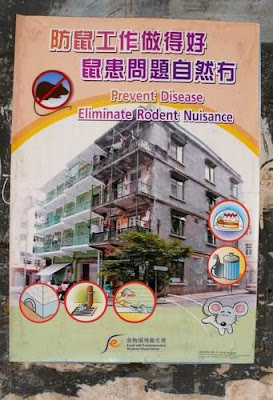
Image of an anti-rat poster in Kowloon, Hong Kong.
Dear Gentle Reader,

Back to the alley.

The Heroine couldn't believe that, on Monday, I didn't start by telling you how, when you enter the alley, you get doused with a fine mist from the exhaust vent of a greasy spoon Chinese kitchen.

I thought that that information was on a need to know basis.

She thought that if I was offering to take people to the places that I think are interesting, then people need to know the hazards of my company...

So... complementary hair care treatment, deep fry facial cleansers, and aromatic clothing misters are installed in the opening of the alley.

And, if you missed that complementary bit, they are free.

That refreshing scent of high calorie cooking oil might be why rats are, apparently, found here too.

Which is why, presumably, the government has this anti-rat poster up.

To make the rats feel less welcome.

If institutional xenophobia does not deter the rats, then the city uses more extreme measures...

Image of a sign in a Kowloon, Hong Kong, alley warning people not to touch the poisoned food. It's for the rats. Hopefully they cannot read. The rats, that is.

Hong Kong takes rats seriously. (Remember that Bubonic Plague outbreak?)

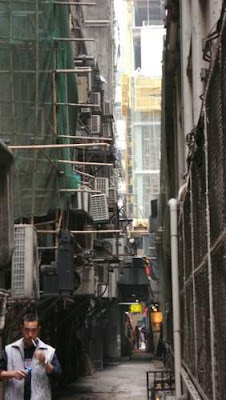
Of course, once you are well into the alley, it is hard to see much of anything, even rats or roaches.

The alleys are kept dim due to the height of the surrounding buildings.

If today is full disclosure day, my dank alley is not only cooled by the shade, it is also kept cool by mist.

It is misted by the hundreds of overhanging old air conditioners dropping their spray onto the men who toil and trudge in the heat.

Image of air conditioners stacked on top of each other, outside Chungking Mansion's walls, and above the people walking through my alley.

I just always make a little prayer on behalf of all the screwing that has hopefully gone on here. 

(With regard to the installation of the air conditioners, obviously.)

Porters run, or walk quickly, down the bulk of the alley, quickly carting boxed bundles from the unlicensed, gray-market factories illicitly built and run from within Chungking Mansion's groaning walls. 

Did I mention that Chungking Mansions abuts half of the alley?

Chungking Mansion's floors hold more than just notoriously cheap hostels and dormitories. It also holds numerous grey and black market factories. And, supposedly, the majority of the Nepalese community in Hong Kong.

Chungking Mansion's floors struggle to support heavy equipment stamping out things for commerce. 

These shivering floors were built to withstand the patter of feet and the blood-filled echoes of loves lost, loves found, and love made. These floors were not built to withstand the relentless pounding of metal on metal or plastic or paper. But they do.

Chungking Mansions was also not built to cope with the waste generated by all the factories and the hostels, and stores, and the restaurants, and the takeaways for the guests and the workers. So, there is a fair bit of detritus, which is quite helpful for the cockroaches and for the rats.

When the sun is directly overhead of the alley, briefly, it illuminates the alley, causing the vermin to scuttle for cover. 

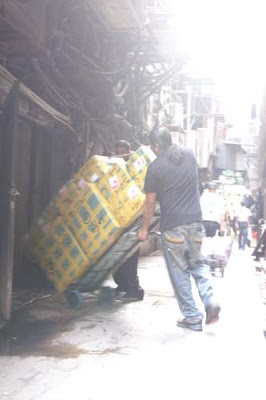
This also makes it easier to see and photograph the porters carrying loads to and from the factories and businesses located inside Chungking Mansions.

Image of a porter carrying cartons from Chungking Mansions to the quasi-legal moving trucks on the back street.
These porters are not fast because they are worried about the sky falling, or an air-con unit falling, or even the rats and gigantic cockroaches of Hong Kong...

These porters move quickly because they are paid by the piece or by the pound. Whichever is less.

What are those cartons for?

Where do these cartons go?

Stay tuned, Monday...


Tschuess,
Chris

Wednesday, March 18, 2009

Carbon markets Cambodian style

Image of a street vendor in Cambodia preparing her food in a halved oil drum with charcoal as the energy sourceDear Gentle Reader,
 
Today, the 2009 Carbon Markets Insight Conference is wrapping up in Copenhagen.

The conference is trying to lay the groundwork for new, improved carbon markets around the world.

In Cambodia, carbon markets are old hat.

Cooking power, for example, is supplied from charcoal, carbonised wood.

And you don't get that charcoal for free... which implies a market.

The title image is a street vendor's DIY charcoal BBQ for making food to sell in Phnom Penh.

Your humble scribe wandered into the kitchens of a few small restaurants; they were powered by charcoal also.

Where does one buy charcoal?

My first question, as I live in Asia, is do you mean wholesale or retail?

Image of carbon for sale at the side of the road for housewives to power their stoves and feed their families

Retail carbon sales are made at the side of the road, like everything else, of course. 

Mind you, the wholesale network is also a roadside job.

I woke up before sunrise and caught these people in the twilight sorting carbon, wholesale, on the road in front of my hotel. 


Image of a Cambodian man arriving with a bike loaded up with charcoal--carbonized wood.
I couldn't take pictures until it was brighter; I didn't want to spoil any one's night vision with my flash because sorting black objects in the dark is not easy...

Image of a Cambodian man sorting his load of charcoal, carbonized wood.
After the boss has roughly determined how much charcoal he has bought, he will hand it down to his workers who will squat on the road, weigh it, and repackage it...

Image of a Cambodian man passing charcoal, carbonized wood, on to his helpers to sort and repackage in smaller sacks.
Then the dollar baggies are delivered to restaurants and market stalls.

There. You have it. 

Carbon markets Cambodian style.

Just don't ask where the wood that is cut down to be burned is from. 

People in third world countries don't look upon jungles as being as beautiful as wealthy eco-tourists do. For them jungles are just nuisances that might contain some things which are easily convertible into food or cash.

The argument here is that when you are just trying to survive, today counts more than tomorrow.

Tschuess,
Chris

Friday, January 9, 2009

Power comes from a gun: the Arsenale

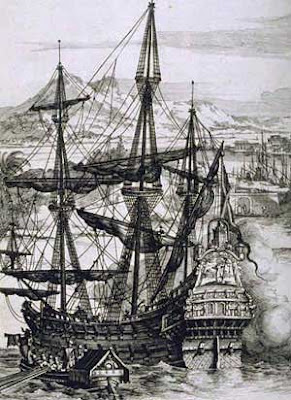
Image of a late 17th century Spanish Galleon taken from the Wikipedia Commons.
Dear Gentle Reader,

To understand Venice, the Serenissima, you have to understand the Arsenale.

First, click on this link to see an image of the main island.

Where the "A" is marked on the map is the Piazza San Marco, which is where the Doge's Palace and the Basilica of St. Mark are found. The Piazza is the apparent site of Venice's wealth and power.

See that big section to the right, with the artificial lake in the middle? That is the real source of power in old Venice. That is the Aresenale, powered by her workers, the Arsenalotti.

Look, if you did not click on the link above, you really ought to. 

The map provides a visual perspective on spatial power dynamics in old Venice. Look at how big the Piazza is... Look at how big the Arsenale is... 

If the size of your desk shows your power in the modern corporate battlefield, the size of your guns mattered in the battlefield of commerce in the preceeding millenium.

And the Arsenale was the metaphorical gun of the Serenissima (Venice).

The Arsenale was where the ships of the Serenissma were constructed. That artificial lake is where the newly-built boats were floated and loaded. Here is where the big guns were made, and the boats to carry them...

Gunboats. 

And you never ran guns, you sailed or rowed with them.  

(You would run with them too... even in a maritime city state. Venetians controlled the sea and the land too. They needed to control land somewhere to get wood for their fleets and food for provisions and metals for her guns. So the Arsenale also made guns, from naval artillery to handguns.)

(Further, the Venetian Condottieri (mercenary leader) Bartolomeo Colleoni (1395/1400-1475) is credited with inventing the first horse-drawn artillery by having Venetian naval artillery reconfigured in the Arsenale for his land troops. Back to the story...)

Image of the walking entry to the Arsenale. Interestingly enough, after publication of Dante's Divine Comedy, there are three areas just off this gate which reference Dante's work. The Inferno, to the left, was one of the areas where gunpowder was stored. Purgatory was the waiting room where you waited to determine entrance, and where guards spent much time, and Paradisio was a small area of gardens leading to the Commander's offices. This information was derived by studying old military charts in the Maritime Museum off the Grand Canale.

It was known, in Venice, that power came from the barrel of a gun long before Chairman Mao coined his pithy phrase. 

Mao Tse-tung (Mao Zedong in pinyin transliteration) was, after all, a librarian at Beijing University in the beginning. He knew his history. 

And history, in the medieval world and in the Renaissance, was made by the most powerful. From the twelth to the seventeenth centuries, the Republic of Venice, the Serenissma, was one of the Great States, sometimes the greatest, in the West.

The Serenissma had power emanating from a tripod of: 

(1) vast wealth derived from monopolistic control of the Eastern trade routes (providing precious commodities like silk, spice, and scents, not to mention new technologies); 

(2) diplomatic contacts derived from her experience in establishing and maintaining her monopolies, her network of safe fortress harbours, and the lands needed to provide her with the resources to build and maintain her fleets; and 

(3) Venice had the firepower (ships and guns from the Arsenale) to maintain the safety of her commercial fleets, ports, and commercial/diplomatic interests.

The Serenissma defined the military/industrial/governmental complex long before America's involvement in Vietnam...

The Arsenale occupied over 6.2% of the main island of Venice's total landmass. Its workers, the Arsenalotti, numbered almost 16,000 by the early 1500s and they could produce almost one war vessel per day at their period of peak productivity.

It might be useful to put this into perspective. 

The most important naval battle, from a Western viewpoint, of the European Renaissance was the third Battle of Lepanto in 1571. 

In 1571, at the Battle of Lepanto, the Ottoman Empire was finally defeated in a five and half hour battle at sea. Control of the Mediterranean, and the wealth of the East, was restored to the West again, much to Venice, although Spain via the Holy Roman Emperor, Charles V, took much of the credit.

The balance of geo-political power and mercantile power shifted back to Christian powers from the Islamic powers as a result of this battle. 

Essentially, power shifted as a result of this one, lop-sided naval victory as the West captured or sunk the Ottoman Fleet, and though the Ottomans had the physical resources to rebuild, which they did rapidly, they lacked the experienced officers corps afterwards, as that had been irreparably lost in the Battle of Lepanto.

The Battle of Lepanto (the third, victorious battle, and, largely, the only one quoted in the West) was the last major battle with largely oar-powered vessels and it was the greatest naval conquest of its time.

The Holy League's fleet consisted of 206 galleys and 6 galleasses. The galleasses were huge merchant galleys transformed so that they could carry heavy guns on their flank, in addition to their regular complement of guns

The galleasse was the aircraft carrier of its day, exuding military power and extending the scope and range of naval power through its heavy artillery armaments.

The Ottoman Empire's fleet consisted of 222 war galley and 56 galliots. Galliots were, essentially, lesser Galleys that carried less men and both fewer and smaller cannon.

Let me paraphrase that succintly... 

The total Holy League fleet consisted of 206 plus 6. The total Ottoman Empire fleet consisted of 222 + 56.  The fleets in battle, therefore, consisted of 428 galleys, 6 galleases, and 56 galliots.

Of this number, Venice contributed 109 galleys and 6 galleases. Those 6 Venetian galleasses alone, apparently, sunk over 70 Ottoman galleys.

And the Arsenale, at its peak, pumped out nearly a ship a day for almost four months.

That is why, to understand the Serenissima and her power, you have to understand the Arsenale.

Image of one of the two gates leading to the Arsenale.
The Arsenale was likely born in 1104 when a fire swept over the main island of Venice and destroyed many dockworks, allowing for new ideas upon reconstruction. 

With its development, the Venetians created a variant prototype of the assembly line (the assembly line would, later, propel Henry Ford to fame and incalcuable wealth when he founded the Ford Motor Company much later, in June of 1903). 

(Venetians also produced ships in more colours than black.)

Specialized labour (the Arsenalotti), specialized work sites arranged sequentially, and specialized storerooms marked the Venetian military/industrial complex of the Arsenal out for prodigious productivity.

Interestingly enough, the Arsenalotti were well-paid workers who were also recruited, not conscripted, along with guildsmen of the Republic of Venice, to work the oars of Venice's mighty war vessels, when the need would arise.

All Venetians enjoyed the wealth and the prestige of Venice and all would do what was necessary to defend their rights and privileges.

The Arsenalotti were well paid because their work was so valuable to the state, and because it was so hard. 

Dante Alighieri (1265-1321), the Florentine poet and father of the Italian language, was escorted past the entrance of the Arsenale. His observations on the workers formed the basis for Canto 21 of the Inferno, the first in his trilogy, the Divine Comedy. As you well know, the subject matter of the Inferno is Hell, and the lost souls in it who are tormented by devils and demons. The Divine Comedy is a literary guidebook to Hell, Purgatory, and Heaven, as imagined by Dante.

A copy of Canto 21 (it is short) is found at the end of this posting, watched over by a wonderful demon which your humble scribe found sticking out of a wall. 

And that, Gentle Reader, forms todays post.

Your humble scribe ends here, but gently hopes you will continue reading the Canto, below.

Imagine the workers slaving away (as free men of the Republic) to build a warboat a day for the glory and wealth of their state. 

Further, imagine lost souls in Hell, truly slaving away, as Virgil guides Dante through Hell, showing him the sites as they go...


Tschuess,
Chris

Postscript.

The demon (shown below) was supporting a marble remembrance shield, on the island Cemetario, where the dead are buried, on the back side of the Venetian lagoon. 

Interestingly enough, the only way to see this demon was to lie on the ground and look up. This was a particularly unpleasant task on that particular day as that was the one day that snow had fallen, and slush lay thick and wet on the ground. 

What suffering is given for thee, Gentle Reader? Great suffering and privation indeed. But I think it was worth it...

Carven image of a demon found on the islet Cemetario in the Venetian lagoon.
The excerpt, Canto 21 from the Inferno by Dante Alighieri, has been moved to here... so that this post looks shorter... (It is now the previous post by 5 minutes.)

Friday, October 24, 2008

Meta-factories and mega-production in China

Image of a piece of machinery in a factoryDear Gentle Reader,

This article looks at one reason why the "the China price" has moved from low-value manufactured goods to high-value manufactured goods.  Your scribe credits what he calls the meta-factory with allowing "the China price" to move up the value chain.

"The China Price" refers to the lowest possible manufacturing price that China's manufacturers are famous for.  

When China joined the world of global commerce, the country produced low-value products that required a large input of low-skilled labour.

It was the cheap price of Chinese labour, combined with high volume outputs, that allowed for "the China price", but now "the China price" is moving up the value chain.

The rise of the meta-factory, a virtual factory with a contributed inventory of manufacturing production units, is allowing "the China price" to impact more and more production markets.

My thesis is that mega-production has been brought about by the rise of meta-factories.  Let's look at mega-production first before I define meta-factories.

Classically, mega-production would be understood as a very large factory output of a particular product to achieve economies of scale.  ('Economies of scale' refers to the idea that if you produce a lot of something, eventually you can produce that thing for much lower cost than someone who produces less.)  

Historically, it has been economy of scale outputs by Chinese factories combined with exceptionally low labour costs and regulatory costs (historically lax environmental and safety regulations, and later lax enforcement, for example) that helped China develop "the China price".

The new reality is that meta-factories allow for mega-production in the sense that vast ranges of products are capable of being produced, not just vast output of a single product. That is what I mean by mega-production in this article.

In the meta-factory a number of businesswomen or men bring together the various manufacturing production units which they own (the machines which are used individually along a factory production line).  

These owners contribute to each other the potential use of idle manufacturing production units, or the potential use of manufacturing production units which are not being used in an optimal capacity.

These meta-factories are not grounded; they are ephemeral, and, as production opportunities coalesce into production contracts, the needed units are combined at a location to produce a "classical" factory production line. 

These classical production lines produce all the goods that the "Factory to the World" produces.

When I read the phrase "Factory to the World" these days it references the reality that China produces almost everything that anyone in the world would want to consume.  

Further, people buy from China because China's businesswomen and men produce goods the world can afford--they produce goods priced at "the China price".

To me, the epithet "Factory to the World" has become a reality due to the rise of the astonishing meta/mega-factories found in both the Pearl River Delta beside Hong Kong and, to a lesser extent, in the Yangtze River Delta beside Shanghai.

A classical factory might look like this. 

Image of an activated carbon factory in Datong, China
A factory like this is purpose-built and designed to produce a thing, a product, efficiently.

Raw materials, coal and energy, are brought to the factory, transformed by manufacturing production units, and a finished product, activated carbon, leaves the factory.

Meta-factories are different because they are an inventory of manufacturing production units available for differing configurations and combinations. These combinatorial possibilities allow for a tremendously broad range of potential output products.

The meta-factory arose as businessmen and women in China started contributing their unused pieces of machinery, the manufacturing production units, into ad hoc joint ventures. 

This allowed the component pieces of factories to become mobile, and the manufacturing production units themselves became "inputs" to other factories.

New factories would be assembled from unused or idle pieces of equipment.  As manufacturing production units were need for higher value applications, they could be swapped out.  

Soon the Pearl River Delta became a meta-factory, so that it could produce mega-factories (from an output perspective).  

Consortia of friends/business owners could assemble their own manufacturing production units to create virtual factories to bid on contracts.

Factory components could be set up anywhere.  When an important person like a buyer or an inspector comes to visit, the manufacturing production line for a specific product can be set up in the pretty factory listed on the contract or pictured in the sales brochure.  

When the important person is gone, the manufacturing production line can be set up in another location, maybe an idle section of another factory, and the glamour site is ready for the next visiting buyer or inspector.

This is the marvel that allows China to be the factory to the world.

It's not just that China can and does produce everything that people in the world could want to consume due to huge, cheap labour pools.  India has massive labour pools, but India is not (yet at least) a factory to the world.

In China, as production and demand opportunities shift, the manufacturers and the owners of units of production can shift or swap components around.

These businessmen and women can bid on tenders to produce anything, almost, without having to buy any, or at least many, manufacturing production units prior to bidding.  

The bidders know they can go into the circle of owners, the meta-market of the meta-factory, and get manufacturing production units to do almost anything. 

For these bidders, the cost of entering new industries drops. The Chinese "meta-factory" owners can now bring "the China price" to new industries that were previously immune to "the China price".  Correspondingly, the Chinese business class moves up the manufacturing value chain.  

Greater wealth also allows for greater state wealth, through taxation, and much of that state wealth is being re-invested in infrastructure projects. Improved infrastructure benefits all factories, but especially the meta-factories as it allows the manufacturing production units to be even more mobile.

There is, however, one thing that these meta-factories cannot swap production around to accommodate...

That one thing is reduced demand.  This whole system still requires exactly what it allows... continuous use of the units of production.

When a global downturn drops sales and production, then unit costs rise and these meta-factories are in trouble.

When credit becomes more expensive, or, worse, inaccessible (see the China opinion post on the credit crisis), then further problems occur which these meta-factory owners are not insulated against.

And that is what your humble scribe sees happening now.

Tchuess,
Chris