Dear Gentle Reader,
Hello again, from behind the Bamboo Curtain.
I have been known to talk about origins and architecture, both, in this e-place.
Origin comes from the Latin origo, origin meaning a beginning.
In the beginning, there was nature.
Then there was that that was not of nature.
That dichotomy, things produced by nature as opposed to things made by man, produced art.
Art, in the beginning of English's history, meant anything made by man, as opposed to anything produced by nature.
In more modern times, we have modified that distinction and replaced art with craft.
We tend to think of craftsmen as delivering skill and technique to modify the natural world, whereas some extra inner spark is required for art. But, in earliest times, craft fulfilled that distinction entirely.
Of course, technically, craft comes from techne, and from art.
Techne, the other half of craft, comes from the Greek Technikos, from which we also derive the English words technique and technical.
Origin comes from the Latin origo, origin meaning a beginning.
In the beginning, there was nature.
Then there was that that was not of nature.
That dichotomy, things produced by nature as opposed to things made by man, produced art.
Art, in the beginning of English's history, meant anything made by man, as opposed to anything produced by nature.
In more modern times, we have modified that distinction and replaced art with craft.
We tend to think of craftsmen as delivering skill and technique to modify the natural world, whereas some extra inner spark is required for art. But, in earliest times, craft fulfilled that distinction entirely.
Of course, technically, craft comes from techne, and from art.
Techne, the other half of craft, comes from the Greek Technikos, from which we also derive the English words technique and technical.
I sense impending e-yawns.
I hurriedly increase the pace to reach my first destination, this morning.
Architecture, as an English word, my OED tells me, dates to at least 1563, and its first meaning is the art or science of constructing edifices for human use, specialized as Civil, Ecclesiastical, Naval, and Military.
(The Romans had the word already, architectura, as did the French, architecture.)
Fundamentally, architecture was about creating new, structural things from nature.
Trees had to be trimmed and fashioned into columns and beams.
Nature was, at least initially, copied and transformed by architects.
Architecture, as an English word, my OED tells me, dates to at least 1563, and its first meaning is the art or science of constructing edifices for human use, specialized as Civil, Ecclesiastical, Naval, and Military.
(The Romans had the word already, architectura, as did the French, architecture.)
Fundamentally, architecture was about creating new, structural things from nature.
Trees had to be trimmed and fashioned into columns and beams.
Later, stone was dug, quarried, cut, and dressed to be formed into blocks to be transported to building sites to make structures.
Some think that classical columns, in dressed stone, were derived from people copying the look of trees cut and dressed to form supporting columns in proto-houses.
Some think that classical columns, in dressed stone, were derived from people copying the look of trees cut and dressed to form supporting columns in proto-houses.
Rocks were obviously at the base of mountains. Why not also use rocks at the base of buildings? And then for walls?
Architecture required obvious changes from Nature, and the manipulation of nature to new purposes.
Gothic builders might remove trees from the earth, dig through the earth and remove the earth, to get to stone that they might quarry for building purposes.
Then, when they started building a great ecclesiastical structure, say a Gothic church, the master builder might put nature to new uses in his original art, the construction of the edifice.

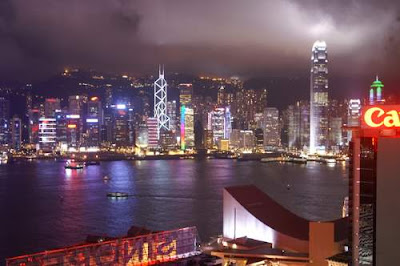
 Truth is stranger than fiction.
 There are at least 57 types of bamboo found in Hong Kong growing from sea level to the tops of the mountains.
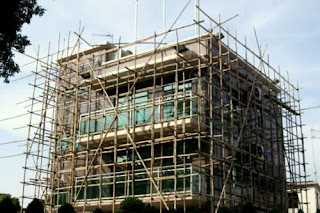
 Now, the craftsmen use plastic ties.
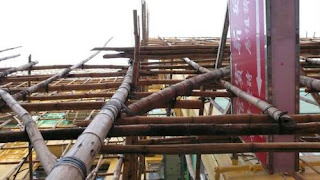
 Let's step back, and look up at this second example of scaffolding to see the interplay of vertical structure and diagonal supports.
 OK...
OK...


Architecture required obvious changes from Nature, and the manipulation of nature to new purposes.
Gothic builders might remove trees from the earth, dig through the earth and remove the earth, to get to stone that they might quarry for building purposes.
Then, when they started building a great ecclesiastical structure, say a Gothic church, the master builder might put nature to new uses in his original art, the construction of the edifice.
When Gothic builders could not reach up to place stones in the walls, they created timber platforms to stand upon and to lug stones onto, by means of winches and block and tackle mechanisms.
When the timber platforms seemed too high for safety (they were hauling heavy stones on them) they would dismantle the timber platform, shovel heaps of earth into the church, and rebuild the platform upon the new earthen base. This iterative process would continue until the church was built.
When the church was completed the architect and the builders would finally remove all the platforms and the earth, decorating the interior with paintings and frescoes as they went downwards to bare earth and consecration of the structure.
What does any of this have to do with Hong Kong?
Lots of tall buildings here, yes...
But, Gothic structures were not built in Hong Kong. Besides, the origins of Hong Kong's skyscrapers and high rises does not seem remotely linked to nature.
Hong Kong residents definitely did not fill these structures with earth or wooden platforms to build them from the inside out.
These buildings are distinctly different from nature.
So why would I have started, today, with the top image of bamboo?
Or debated about using this picture as the lead image?
Truth is stranger than fiction.And, it has to be seen to be believed.
First, Hong Kong is profit oriented.
Land prices are the highest here, on the planet.
(Which is my rent is so freaking expensive.)
Also, this is why you want to cut your building costs as low as possible, and to construct things as rapidly as possible.
Which is where the ubiquitous bamboo shown in the title image comes in.
Bamboo is a grass from the Poaceae family.
More technically, bamboo is perennial evergreen from the subfamily Bambusoideae, tribe Bambuseae.
There are at least 57 types of bamboo found in Hong Kong growing from sea level to the tops of the mountains.It is ubiquitous in nature, so artists and craftsmen have found uses for it so that it is now ubiquitous in art (original usage) in China and Hong Kong.
It is strong, tall, and flexible.
The flexibility is useful in a place racked by strong winds.
And so, builders in Hong Kong use bamboo for scaffolding...
Gothic craftsmen built wooden platforms inside the churches to build the church.
Hong Kong craftsmen build bamboo platforms--scaffolding--outside the structures they build.
Bamboo scaffolding was simply tied up at the joins with twine, historically.
Now, the craftsmen use plastic ties.And, in situ, they look like this..
Let's step back, and look up at this second example of scaffolding to see the interplay of vertical structure and diagonal supports.That picture may be funky, but it does not provide much clarity.
Let's step back across the street to get a sense of perspective...
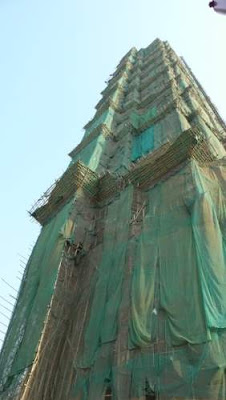
OK...Well, this is a little bigger than the first building which we saw bamboo scaffolding erected around.
The fierce winds, in typhoon season, can easily pass through the bamboo scaffolding, so it won't be ripped down.
The scaffolding is light, so it can be supported easily by itself.
The scaffolding is also cheaply found, and will not rust in a wet environment, like steel scaffolding would.
Also, because space is limited, it can easily be burnt or used as fill when its useful life has expired.
Further, if there is an economic downturn, you don't need to store the scaffolding on expensive land. Just burn your inventory. It grows around you anyway, and the burnt scaffolding can even be used as fertilizer...
Finally, bamboo is light and easy to transport around the city to various building sites.
But wait.
I forget, Gentle Reader, that you have seen many pictures of Hong Kong.
You know the buildings here are, generally, much bigger than single storey houses or small eight storey low rises.
So, the question now is, what do they do for the big buildings?
What do they use for scaffolding? It has to be cheap, easy for rapid set up and take down, and substantial enough to work for some of the planet's tallest building construction sites.
Let's walk down the street...
This building site certainly seems to have a more substantial scaffolding structure.
Of course, this one is still, obviously, made of bamboo.
But this scaffolding has also been covered with a light plastic mesh that the wind can still pass through it.
Presumably the mesh prevents people or things from falling between the gaps in the bamboo.
But, the bamboo seems to be set closer together, here.
The squares seem to be much smaller, no?
Or is that just a trick of perspective?
Let's step back again...
Those pieces of bamboo are the same size, and in the same configuration as the previous scaffolding... ...they just go up higher.
Note the streetlight extending over the sidewalk hoarding at the bottom left of the picture for perspective. I couldn't step farther back to get better perspective--a busy motorway impeded my picture taking.
So bamboo, the ubiquitous product generated by nature, has been transformed, by art, into a building material.
It has been formed into a superstructure for architecture.
The bamboo cage becomes a meta-structure, mirroring the outline of the building it encloses.
(Meta-structure? Well, in some ways, yes. It is very insubstantial, and airy... and that is one of bamboo scaffolding's virtues after all...that wind and rain can pass through the bamboo scaffolding--it supplies minimal resistance.)
And the origin of modern architectural structures in Hong Kong is derived from Nature, and her bamboo, but bamboo used in ways that nature did not build on her own.
This architecture is truly art, and its origins are truly a craft, originating in nature, then modified by intelligence and effort.
Once again, this is my town. Welcome to Hong Kong.
Tschuess,
Chris









 Posts
Posts