Wednesday, March 18, 2009

Carbon markets Cambodian style

Image of a street vendor in Cambodia preparing her food in a halved oil drum with charcoal as the energy sourceDear Gentle Reader,
 
Today, the 2009 Carbon Markets Insight Conference is wrapping up in Copenhagen.

The conference is trying to lay the groundwork for new, improved carbon markets around the world.

In Cambodia, carbon markets are old hat.

Cooking power, for example, is supplied from charcoal, carbonised wood.

And you don't get that charcoal for free... which implies a market.

The title image is a street vendor's DIY charcoal BBQ for making food to sell in Phnom Penh.

Your humble scribe wandered into the kitchens of a few small restaurants; they were powered by charcoal also.

Where does one buy charcoal?

My first question, as I live in Asia, is do you mean wholesale or retail?

Image of carbon for sale at the side of the road for housewives to power their stoves and feed their families

Retail carbon sales are made at the side of the road, like everything else, of course. 

Mind you, the wholesale network is also a roadside job.

I woke up before sunrise and caught these people in the twilight sorting carbon, wholesale, on the road in front of my hotel. 


Image of a Cambodian man arriving with a bike loaded up with charcoal--carbonized wood.
I couldn't take pictures until it was brighter; I didn't want to spoil any one's night vision with my flash because sorting black objects in the dark is not easy...

Image of a Cambodian man sorting his load of charcoal, carbonized wood.
After the boss has roughly determined how much charcoal he has bought, he will hand it down to his workers who will squat on the road, weigh it, and repackage it...

Image of a Cambodian man passing charcoal, carbonized wood, on to his helpers to sort and repackage in smaller sacks.
Then the dollar baggies are delivered to restaurants and market stalls.

There. You have it. 

Carbon markets Cambodian style.

Just don't ask where the wood that is cut down to be burned is from. 

People in third world countries don't look upon jungles as being as beautiful as wealthy eco-tourists do. For them jungles are just nuisances that might contain some things which are easily convertible into food or cash.

The argument here is that when you are just trying to survive, today counts more than tomorrow.

Tschuess,
Chris

Tuesday, March 17, 2009

Ugly American was not intended; an explanation

Image of a Bank of Hell banknote; I am worried that people will view your humble scribe the wrong way and cast aspersions of nationalistic vitriol, withdrawn from the Bank of Hell, on your humble scribe based upon yesterday's posting...Dear Gentle Reader,

Mea culpa.

I wrote some long notes to yesterday's post. 

But, just as I know that very few roll their mouse over the images to see what messages or titles I have left, almost nobody goes back to look at comments. 

So, I will repackage them because it is important.

Yesterday's post could be seen as an easy attack on three self-centered Americans who happened to be girls. Classic ugly Americans in action. That was not my intention.

The post was meant to be a sardonic look at the actions of three young people, three young girls, who happened to be American.

The posting does me no credit as I had to have an Oscar Wilde line at the end; I couldn't just walk away. 

But, I feel worse if people think I harbour anti-American sentiments.

So, I will risk further assaults on my character and revisit yesterday.

In yesterday's post I meant to highlight the profligate silliness, obtuseness, and self-centered nature of youth (compared, of course, to the foil of my helpfulness, reasonableness, and cleverness.)

First, ugly Americans do exist.

As do hooligan Brits, lager lout Dutch, culturally self-centered and self-righteous French, towel-wielding beach-reserving Germans, et cetera. And snide Canadians, too.

There are, statistically and in my experience, almost as many ugly Canadians as ugly Americans.

But, thankfully for Canadians, there are ten times more Americans than Canadians, which skews the number of ugly Americans as opposed to ugly Canadians that other countries' citizenry get to meet.

Then, we can further skew the ratio because more than ten times the number of Americans, compared to Canadians, have the disposable income to send their kids, or themselves, abroad.

That results in more than the 10:1 ratio of ugly Americans:ugly Canadians abroad that you would expect.

And the ugly idiots always stand out, if only for their idiocy and ugliness. 

Everyone remembers the idiots; their impacts crowd out the memories of the lovely people. 

Now add international resentment to the USA's wealth and power... 

Still, today, a vast amount of the world's GDP (GDP is Gross Domestic Product--the total value of all final goods and services produced with the national borders of a political economy within a particular year) is generated inside the USA. 

Yes, the EU generates a similar GDP, but that is the entire EU... not just one country... (The EU is the European Union whose countries now include all of Western Europe less Switzerland, all of Northern Europe less Norway, all of Southern Europe, and most of Eastern Europe...)

I just crunched the numbers. 

If we use 2007 IMF (International Monetary Fund) numbers then the US produces 25% of world GDP and the EU produces almost 31% of world GDP.

If we use 2007 World Bank numbers then the US produces 25% of world GDP and the EU produces 22% of world GDP.

If we use 2007 CIA world factbook numbers then the US produces 18% of world GDP and the EU produces 24% of world GDP.

Whichever numbers you use, the US is wealthy. 

This wealth provides the US federal government the ability to fund military and economic activities to create and project power.

The USA is still the only global superpower as it has been from the end of the cold war to today. 

It still is the world's policeman, and it struts accordingly, some days. 

It has also taken on the role of the world's judge through the doctrine of extra-territorial jurisdiction which is the US doctrine that US laws apply anywhere and everywhere... ...a bit of a slap in the face to the sovereignty of every other country on the planet.

So, people like to latch onto the idiots and tar the rest with their cultural misdeeds. It allows people to feel better, nationalistically, when innately comparing their country to the might, power, and wealth of the USA.

It's too easy to make fun of the ignorant few. 

Hence my big mea culpa, today; I do not want to be considered anti-American.

I am just intolerant of fools, no matter what their nationality.

I had not intended to raise the spectre of ugly Americans in yesterday's post, I was just poking fun at three vapid, self-centered young girls. 

And, heck, they were likely exhausted, jet-lagged, culture-shocked, and unprepared to hear people tell them hotel rack rates in dollars in English and they might have been confusing the HKD prices with USD prices. 

The ten dollar (USD) per night hell holes in Chungking Mansions might have been interpreted by them as 78 USD per night, instead of the 78 HKD per night that would have been meant when the reception staff would have leered and said "78 dollars, Missie" to their breasts.

What bothered me about the three girls was the way they were trying to control me with orders and their gravity-defying breasts. And the slyness of the looks they gave each other when they thought I had given up some state secrets of housing to them...

Tschuess,
Chris

Monday, March 16, 2009

Where to stay? Where to stay? Budget accommodation in Hong Kong

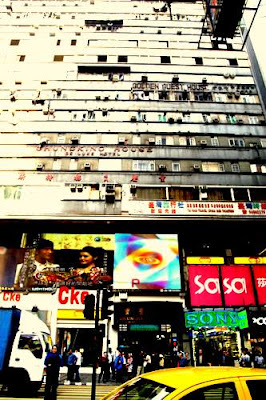
Image of Chungking Mansions, Kowloon, Hong Kong.Dear Gentle Reader,

Sorry for being late, today.

It's tax time, which means I have spent the day trading currencies in preparation for paying taxes.

Death puts me in the mind to spend, but taxes put me in the mind to save.

And saving money sometimes leads one to the topic of cheap.

At least it leads me to cheap.

And, on that note, anyone who has backpacked into Hong Kong in the last 40 years knows about Chungking Mansions on Nathan Road in Kowloon.

Why?

Because backpacking implies cheap.

Or at least cautious with cash.

And Chungking Mansions, if not where cheap was born, is where cheap resides today.


Image of Chungking Mansions, Kowloon, Hong Kong--the street level scene.
Located at the edge of the tourist district in Tsim Sha Tsui, the hostels in Chungking Mansions boast of the lowest nightly rates anywhere in urban, accessible Hong Kong.


Image of Chungking Mansions, Kowloon, Hong Kong--above street level; where the cheap hostels live.

And they are right.

If you are unwilling to hike up a mountain to a remote hostel, or take two hours to go to the middle of nowheresville for your sojourn in hip, happening Hong Kong, then Chungking Mansions does contain the cheapest hostels around.

Of course, in a city that has ranked as one of the highest rental markets in the world, something has to give if you offer, or expect, super low rates.

For clarification, for those of you who stayed at The Peninsula or the Ritz-Carlton or at the Mandarin Oriental, the rental rates at Chungking Mansion's hostels, despite the building's name, are really low.

These are low nightly rates, not just in comparison to other rates in Hong Kong, but low in absolute dollars as well.

Poor student backpackers and threadbare travellers stay here. Possibly affluent Scots, too...

So, what gives to get those great rates?

...Space, privacy, amenities, hygiene, and sanitation.

That would cover it.

Image of a cockroach climbing a building

The other day your humble scribe walked by three sweet young things, backpacking around Asia together, fresh out of a sorority somewhere (two had their greek call signs emblazoned on their shirts).

The three near-lolitas (is it me, or are the young getting younger every year?) were on the street, complaining about how gross the space in that last hostel was, how every hotel was trying to rip them off, and how "These places are all une dégustation" as the worldy French scholar in the group drawled.

The lover in me had to stop.

The word lover, that is.

What froze my feet to the 25°C pavement was the "dégustation" allusion.

While the girls' prospective accomodations might have involved a careful, appreciative tasting experience, that would have been for the endemic cockroaches, I suspected, and not for these fresh-scrubbed yet sweaty and gritty girls.

"I think you mean degoulasse..." I stopped and suggested to the girls, as the routine surge of humanity pushed and pressed around me on the sidewalk.

"...a French colloquialism for disgusting... a case of yuck, not a tasting experience which is what that dégustation implies, unless you have very unusual, and I dare say an unsafe method, of checking out your potential resting places for the night..."

The girls stared (glared?) at me.

I smiled helpfully, thinking maybe I shouldn't have stopped. Though the mangling of language, when a deliberate patois is not intended, is something that fills me with dismay.

The girls asked if I lived here.

I confirmed that I did.

Then they asked me where a really clean, big, spacious, super cheap place, ideally with a view would be found.

No, that's not right.

Actually, it was more like a simpering order with a side of vamp.

I suddenly wished that I had not stopped.

Still, I had (stopped).

I had an obligation to help, now that I had stopped, and I like helping people.

And these lolitas, fresh off the plane, clearly needed help.

(Two needed significant support, also, or they would be unhappy in fifteen years...)

I explained that for the last few years Hong Kong had been the most expensive place on the planet, on a price per square foot basis, for every rental class.

They didn't care about that.

They just wanted to know where a really clean, big, spacious, super cheap place, ideally with an ocean view would be located for them.

Slightly bemused, I noted that the financial nature of Hong Kong was relevant.

They would have to pony up to stay somewhere nice or suck it up and take what they could afford; I suggested a couple of OKish hostels I had heard of to be helpful.

One girl explained condescendingly to the idiot (your humble scribe) that she was pre-law and that even in Minneapolis you could get OK motels at OK prices, not like the crap they had just seen, and they had been to one of the overpriced hotels, too.

I started explaining again that you couldn't be in the most expensive city in the world, by measuring the cost of real estate, and get their wish list filled at the room rates they were suggesting was reasonable.

The Minneapolis Queen Bee brain trust rolled her eyes.

Her two henchwomen sighed as if I was the biggest waste of space.

I reconsidered my answer.

Your humble scribe knows when discussion is not useful.

I thought for a moment more, and asked if they had walked by the old Peninsula Hotel and pointed it out top them.

(The Peninsula is the byword for luxury in Hong Kong, if you have not visited. Their afternoon tea with clotted cream... well, visit and discover.)

Image of the Peninsula Hotel, Kowloon, Hong Kong, and one of the hotel's fleet of Rolls Royces which are available for the guests.
They had, and finally we were getting somewhere, I was informed.

They wanted something like that, only cheap.

I understood completely.

I noted that many liked the Pen (implying a non-existent shorthand for the legendary Peninsula Hotel).

The girls nodded, grudgingly.

I further noted that some thought the "Pen's" rates were high and that its fleet of Rolls Royces for its guests' pleasure was unnecessary for some and added unnecessarily to the price.

Six breasts and three brain pans jiggled vertically, indicating assent and nodding to prompt me to continue--I was getting somewhere with them.

I suggested the lesser known Stanley Pen.

Three heads bobbed as one and slyly looked at each other as if noting their success at tricking the information out of the stupid man.

The Stanley Pen was super clean, I continued, right off the beach, and wouldn't cost much on a nightly basis.

One was already leafing through the Lonely Planet's index.

Of course, I noted, like the Hotel California, it's hard to leave, and people killed to get in...

They looked blankly at me.

Ask the nearest policeman for directions, I suggested, as I left.

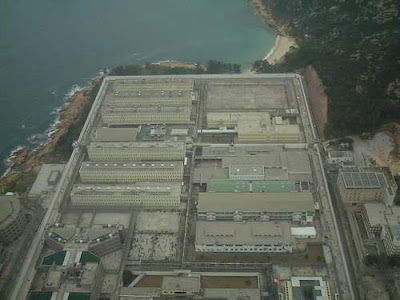
Here's a picture of the Stanley Pen, or the Stanley Maximum Security Prison as it is better known.

Image of the Stanley Maximum Security Prison in Hong Kong, taken from the air, sourced from the Wikipedia Commons. This image was taken by Author= User:Heli Pauline and she has transferred to the public domain for any purpose.
Gentle Reader. I tried to be helpful.

I tried to help them find their way in my town.

I really did.

...The Stanley Pen is by the beach...

I am sure it is clean, and, relatively, spacious, too...

Even if my suggestion was specious...

Tschuess,
Chris

Friday, March 13, 2009

Augustine Heard & Co.; A Sino-American trading house in Hong Kong

Image of two luxury yachts being transported into Victoria Harbour, Hong Kong, on top of a freighter.
Dear Gentle Reader,

Today, a quick tale.

In days of yore, Augustine Heard & Co. (“AHC”) was a prominent Sino-American trading company in Asia. 

AHC started in Canton, moved to Hong Kong, and had offices in Shanghai, Canton, Macao, Hankow, Hanyang, Kukiang, Foochow, Yokohama, Nagasaki, and Kanagawa. 

AHC was to be involved with HSBC (the Hongkong and Shanghai Banking Corporation) from its start and was also an intimate trading partner of Jardine Matheson. 

With 1028 volumes, and 153 cartons, in the joint Yale/HBS Heard Archive (at Harvard Business School) the firm left a legacy for scholars, not just the Heard family.

The Heard family were English, but had left for Massachusetts in 1647. 

By the late eighteenth century they were established in distilleries, property, West Indies trade, and politics in Massachusetts’ Senate. 

By 1801, the first Heard had come to Asia and never left. That 23 year old Heard was interred in Whampoa (Guangzhou/Canton, China). 

Asia was hard; there are many young men and young women in the expatriate graveyards.

The next Heard in Asia fared better. 

Augustine Heard arrived in 1809 as a supercargo, or master seller, on a trading vessel. 

By 1834, Augustine Heard had progressed from supercargo to Captain to ship investor to partner in the great American trading firm Russell & Co., based in Macao, and had then retired back to Massachusetts to look after American interests; but, Russell & Co. was foundering.

In 1840 Augustine Heard formed AHC which was headquartered in Canton. 

Within short order four Heards of the next generation had been apprenticed to management and had become partners in what was, swiftly, a family business. 

The Second Opium War (1857-1858) was between the British and French Empires on one side and The Chinese Qing Empire on the other. The Chinese wanted to stop the Opium trade to reverse silver outflows from the Chinese territory and the Western Empires wanted it to continue and expand due to the correspondingly phenomenal inflows of silver into their respective treasuries.

Almost immediately after AHC's incorporation, the great British Hong (trading giant/commercial conglomerate based out of China or Hong Kong) Jardine Matheson asked AHC to take over its China trade (prinicipally Opium). 

Why? Because, in the First Opium War the British Hongs were denied access to China and Jardine Matheson did not want to lose its client networks.

AHC took over all of Jardine Matheson’s opium trade for the duration of the Opium War and the embargo on British ships. 

Jardine Matheson's windfall trade provided cash flows of 10 million USD per annum to AHC while the Second Opium War lasted.

AHC used this windfall to finance meaningful expansion including opening the first modern, Western office in Japan (Yokohama) in 1859 (John Heard inveigled himself onto the US military vessel taking the US Minister to Japan). 

Further, AHC had ordered the first steamer (700 tons displacement) to arrive in Asia, in 1861, for coastal and river shipping. 

In 1860, when the embargo ended, AHC returned Jardine Matheson’s opium trade and AHC focused on: trading (mostly cotton from the USA and some opium from India to China, and silks and teas on the return voyage); coastal shipping and river shipping in the Orient (rice from Siam and Formosa); insurance agency; and machining, iron works, and baking in Hong Kong.

AHC spent fortunes acquiring a palatial residence in Macau, a massive presence on the Bund in Shanghai, and Heard House in Hong Kong (now Hong Kong's Court of Final Appeal), among many other assets and extravagances. 

Cash flows had been immense, but, times were changing. 

The eponymous Augustine had long since retired, and beside John Heard who opened up the Japanese trade, many of the Heard scions in the partnership were not the best at cash flow management. 

Worse, there was a culture of excessive expenditure at AHC. 

This, combined with four other factors, led to the demise of AHC by 1875. 

What were those other four factors? 

First, AHC did not substitute sail for steam on her great sea voyages (possibly due to challenges discovered by being a first mover in steam-driven coastal and river shipping). 

Second, the coastal and river shipping markets were taken over by local firms. 

Third, the advent of telegrams shifted the balance of control of information away from the traders to the buyers. 

Finally, the establishment of banks in Hong Kong exposed all the trading firms to increased competition, as capital to build ships and finance trade had been a significant barrier to entry to competitors. 

These factors reduced AHC profit margins then AHC profits entirely. 

By 1875, AHC was bankrupt.

A cautionary tale for today? Who knows. 

But, your humble scribe was quite surprised to look out and see these two luxury yachts being freighted (!) into Victoria Harbour, Hong Kong, this morning.

I guess some people are still spending.

Remember Augustine Heard & Co. ....

Tschuess,
Chris

Wednesday, March 11, 2009

3WW (CXXVIII) entries

Image of a pond of eyes, at night; a public art installation outside the Sha Tin Town Hall in Sha Tin, Hong Kong.Dear Gentle Reader,

It's 3WW time again.

A chance to discover the world through different eyes, when you discover how others have used the same words.

(There are talented prose and poetry writers who play 3WW... I know my place, it's not with them. But, I enjoy reading what they have crafted.)

This week the three word prompts are cajole, recluse, and temper.

I wish you all the best of luck. It's haiku time for me.

Tschuess,
Chris


WHEN THE BREVIARY OF FAITH, OR SIN, IS WRONGLY READ

Temptation cajoled...
with tempered blade the recluse
expurgated rot.


IN FLAGRANTE DELICTO; CRIME OF PASSION
PART ONE: THE ACTOR

His vows? Reclusive.
Fled. Cajoled by lust to go.
Passion tempered naught.


IN FLAGRANTE DELICTO; CRIME OF PASSION
PART TWO: THE AUDIENCE

Reason? Reclusive.
Fled, cajoled by revenge and
delicious temper.


IN FLAGRANTE DELICTO; CRIME OF PASSION
PART THREE: THE END

Him: Recluse in grave.
Her: Not cajoled--cuffed, forced, gone.
Her: No temper. Dead.


IF THE PEN IS MIGHTIER THAN THE SWORD,
FIND THE RIGHT TOOL FOR THE JOB
(a.k.a. SEEKING NIHONTO NIB FOR AN INVESTIGATIVE JOURNALIST)

cajole reclusive
Sensei to forge and temper
one folded steel nib


BECAUSE WE DON'T WANT THIS MAN JUDGED BY A JURY OF HIS PEERS...


"Recuse this recluse..."
Cajoled the attorney
"His temper... He's ill..."